
Determine the necessary mass, volume, or concentration for preparing a solution.
S130 - ≥99% , CAS No.1160852-22-1
AVAILABLE TO ORDER
GRADE & PURITY ≥99%
Storage
Store at -20°C
Shipped In
Ice chest + Ice pads
≥99% for sensitive chromatographic and analytical workflows requiring minimal baseline interference.
Store at -20°C Ships Ice chest + Ice pads Check lot-specific COA for exact specifications.
SDS, COA, datasheet, and spec sheet available for download. Lot-specific COA accessible via lot number lookup.
Cited in 0 peer-reviewed publications across chromatography, organic synthesis, and cross-coupling reactions.
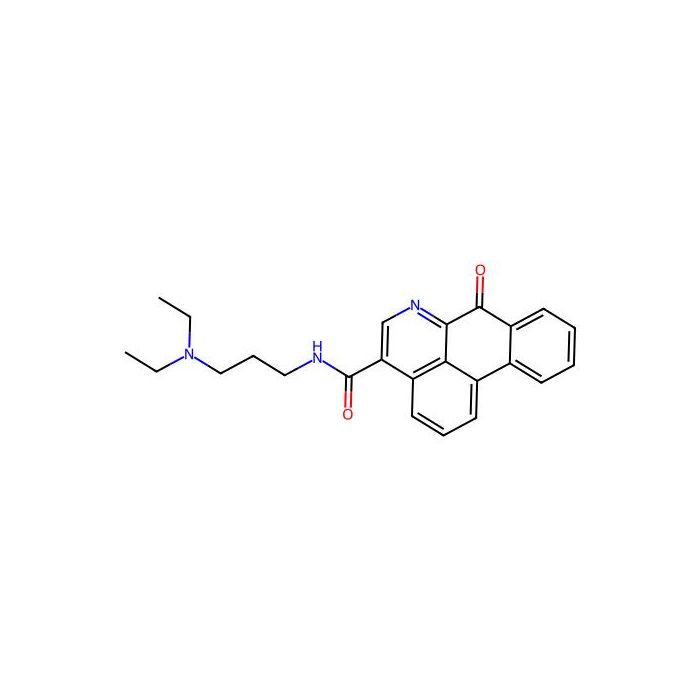
S130 is a high affinity, selective inhibitor of ATG4B (a major cysteine protease) with an IC 50 of 3.24 µM. S130 suppresses autophagy flux
In Vitro
S130 suppresses autophagy and activates apoptosis by inhibiting ATG4B, leads to enhanced cytotoxicity. S130 (10 μM; 6 hours) suppresses autophagy at the early LC3 priming step or late autolysosome degradation stage. S130 accumulates autolysosomes with more lipidated LC3. S130 (0-25 μM; 48 hours) induces cell death through inhibiting the activity of ATG4B at a dose higher than 6.3 µM. And such cytotoxicity might not cause cell death through necroptosis. Nutrient deprivation enhances S130-induced cytotoxicity. S130 (0-10μM; 24 hours) suppresses approximately 79% of the cleavage of full-length LC3-GST at the 10 µM, while no substrates were processed in ATG4B KO cells. S130 displays obvious inhibitory effects on ATG4B. MCE has not independently confirmed the accuracy of these methods. They are for reference only. Cell Cytotoxicity AssayCell Line: HeLa cells, HCT116 cells, HL60 cells Concentration: 0 μM, 3.1 μM, 6.3 μM, 12.5 μM, 25 μM Incubation Time: 48 hours Result: Had significant cytotoxic effects on HeLa cells (IC 50 =16.1 µM), HCT116 cells(IC 50 =9.0 µM) and HL60 cells (IC 50 =4.7 µM) at a dose higher than 6.3 µM. And such cytotoxicity might not cause cell death through necroptosis. Cell Autophagy AssayCell Line: HeLa cells and MEF cells Concentration: 10 μM Incubation Time: 6 hours Result: Suppressed autophagy at the early LC3 priming step or late autolysosome degradation stage. Western Blot AnalysisCell Line: HeLa cells Concentration: 0 μM, 5 μM, 10 μM Incubation Time: 24 hours Result: Suppressed approximately 79% of the cleavage of full-length LC3-GST at 10 µM, while no substrates were processed in ATG4B KO cells.
In Vivo
S130 (20 mg/kg; i.p.; daily; 3 weeks) suppresses tumor growth, and shows an efficient in vivo antitumor effect with a sound safety on vital organs . MCE has not independently confirmed the accuracy of these methods. They are for reference only. Animal Model: BALB/c nude female mice (4 weeks), with HCT116 cells xenograft Dosage: 20 mg/kg Administration: Intraperitoneal injection; daily; 3 weeks Result: Was able to suppress tumor growth and with a sound safety on vital organs.
Form:Solid
IC50& Target:IC50: 3.24 µM (ATG4B)
Comprehensive hazard, handling, storage, and regulatory compliance document.
Download SDS →Lot-specific quality data. Enter your lot number to retrieve the exact COA.
Look up COA →Full quality attributes and acceptance criteria for this grade.
View spec sheet →Taxonomy Tree
| Kingdom | Organic compounds |
|---|---|
| Superclass | Alkaloids and derivatives |
| Class | Aporphines |
| Subclass | Not available |
| Intermediate Tree Nodes | Not available |
| Direct Parent | Aporphines |
| Alternative Parents | Phenanthrenes and derivatives Benzoquinolines Quinoline-3-carboxamides Naphthalenes Isoquinolines and derivatives Pyridinecarboxylic acids and derivatives Aryl ketones Heteroaromatic compounds Trialkylamines Secondary carboxylic acid amides Amino acids and derivatives Azacyclic compounds Organic oxides Hydrocarbon derivatives |
| Molecular Framework | Aromatic heteropolycyclic compounds |
| Substituents | Aporphine - Benzoquinoline - Phenanthrene - Quinoline-3-carboxamide - Isoquinoline - Naphthalene - Quinoline - Pyridine carboxylic acid or derivatives - Aryl ketone - Pyridine - Benzenoid - Heteroaromatic compound - Tertiary amine - Secondary carboxylic acid amide - Amino acid or derivatives - Tertiary aliphatic amine - Carboxamide group - Ketone - Organoheterocyclic compound - Azacycle - Carboxylic acid derivative - Amine - Organic oxide - Hydrocarbon derivative - Organonitrogen compound - Organic oxygen compound - Organic nitrogen compound - Organooxygen compound - Aromatic heteropolycyclic compound |
| Description | This compound belongs to the class of organic compounds known as aporphines. These are quinoline alkaloids containing the dibenzo[de,g]quinoline ring system or a dehydrogenated derivative thereof. |
| External Descriptors | Not available |
| Solubility | DMSO : 125 mg/mL (322.61 mM; Need ultrasonic) |
|---|---|
| Molecular Weight | 387.500 g/mol |
| XLogP3 | 4.000 |
| Hydrogen Bond Donor Count | 1 |
| Hydrogen Bond Acceptor Count | 4 |
| Rotatable Bond Count | 7 |
| Exact Mass | 387.195 Da |
| Monoisotopic Mass | 387.195 Da |
| Topological Polar Surface Area | 62.300 Ų |
| Heavy Atom Count | 29 |
| Formal Charge | 0 |
| Complexity | 591.000 |
| Isotope Atom Count | 0 |
| Defined Atom Stereocenter Count | 0 |
| Undefined Atom Stereocenter Count | 0 |
| Defined Bond Stereocenter Count | 0 |
| Undefined Bond Stereocenter Count | 0 |
| The total count of all stereochemical bonds | 0 |
| Covalently-Bonded Unit Count | 1 |