The store will not work correctly when cookies are disabled.
JavaScript seems to be disabled in your browser. For the best experience on our site, be sure to turn on Javascript in your browser.
· · COA & SDS available for every product · Same-day shipping on in-stock items Salviaflaside - Moligand™, ≥98% , CAS No.178895-25-5
GRADE & PURITY Moligand™ ? Moligand™ — Aladdin's line of ligands and bioactive small molecules. Use for receptor, pathway, and binding studies needing defined small-molecule tools. ≥98% Synonyms
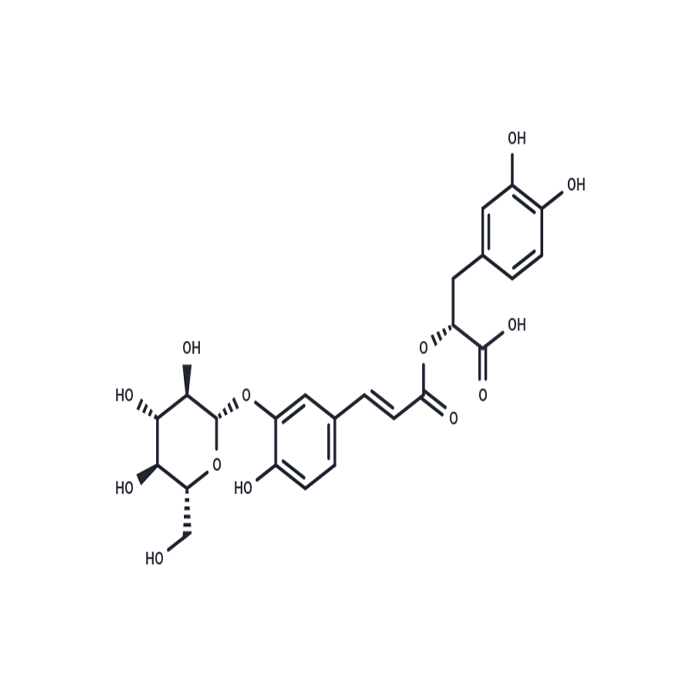
(2R)-3-(3,4-dihydroxyphenyl)-2-[(E)-3-[4-hydroxy-3-[(2S,3R,4S,5S,6R)-3,4,5-trihydroxy-6- | (hydroxymethyl)oxan-2-yl]oxyphenyl]prop-2-enoyl]oxypropanoic acid | (R-(E))-alpha-((3-(3-(beta-D-glucopyranosyloxy)-4-hydroxyphenyl)-1-oxo-2-propenyl)oxy)-3,4- | di
Storage
Store at 2-8°C,Protected from light
🧪
Why this grade Moligand™, ≥98% Moligand™ for sensitive chromatographic and analytical workflows requiring minimal baseline interference.
🌡
Storage & shipping Store at 2-8°C,Protected from light Ships Wet ice Check lot-specific COA for exact specifications.
📋
Quality documents SDS, COA, datasheet, and spec sheet available for download. Lot-specific COA accessible via lot number lookup.
📚
Literature proof Cited in 0 peer-reviewed publications across chromatography, organic synthesis, and cross-coupling reactions.
Overview Salviaflaside is a main bioactive component of Spica Prunellae.
Specifications Synonyms
(2R)-3-(3,4-dihydroxyphenyl)-2-[(E)-3-[4-hydroxy-3-[(2S,3R,4S,5S,6R)-3,4,5-trihydroxy-6- | (hydroxymethyl)oxan-2-yl]oxyphenyl]prop-2-enoyl]oxypropanoic acid | (R-(E))-alpha-((3-(3-(beta-D-glucopyranosyloxy)-4-hydroxyphenyl)-1-oxo-2-propenyl)oxy)-3,4- | di
Specifications & Purity
Moligand™, ≥98%
Storage
Store at 2-8°C,Protected from light
Shipped In
Wet ice
This product requires cold chain shipping. Ground and other economy services are not available.
Names and Identifiers Canonical Smiles
C1=CC(=C(C=C1CC(C(=O)O)OC(=O)C=CC2=CC(=C(C=C2)O)OC3C(C(C(C(O3)CO)O)O)O)O)O
IUPAC Name
(2R)-3-(3,4-dihydroxyphenyl)-2-[(E)-3-[4-hydroxy-3-[(2S,3R,4S,5S,6R)-3,4,5-trihydroxy-6-(hydroxymethyl)oxan-2-yl]oxyphenyl]prop-2-enoyl]oxypropanoic acid
InChIKey
DSMWJDJWYGMEBO-PRFRQLEPSA-N
INCHI
1S/C24H26O13/c25-10-18-20(30)21(31)22(32)24(37-18)36-16-8-11(1-5-14(16)27)3-6-19(29)35-17(23(33)34)9-12-2-4-13(26)15(28)7-12/h1-8,17-18,20-22,24-28,30-32H,9-10H2,(H,33,34)/b6-3+/t17-,18-,20-,21+,22-,24-/m1/s1
Isomeric SMILES
C1=CC(=C(C=C1C[C@H](C(=O)O)OC(=O)/C=C/C2=CC(=C(C=C2)O)O[C@H]3[C@@H]([C@H]([C@@H]([C@H](O3)CO)O)O)O)O)O
Documentation 📋 Safety Data Sheet (SDS) Comprehensive hazard, handling, storage, and regulatory compliance document.
Download SDS → ✅ Certificate of Analysis (COA) Lot-specific quality data. Enter your lot number to retrieve the exact COA.
Look up COA → 📊 Datasheet Quick-reference summary of product specifications and applications.
View datasheet → 🔬 Specification Sheet Full quality attributes and acceptance criteria for this grade.
View spec sheet →
Advanced Data Taxonomic Classification Kingdom Organic compounds Superclass Organic oxygen compounds Class Organooxygen compounds Subclass Carbohydrates and carbohydrate conjugates Intermediate Tree Nodes Glycosyl compounds Direct Parent Phenolic glycosides Alternative Parents Cinnamic acid esters Coumaric acids and derivatives Hexoses O-glycosyl compounds Phenylpropanoic acids Catechols Styrenes Phenol ethers Phenoxy compounds Fatty acid esters 1-hydroxy-4-unsubstituted benzenoids 1-hydroxy-2-unsubstituted benzenoids Dicarboxylic acids and derivatives Oxanes Enoate esters Secondary alcohols Polyols Carboxylic acids Oxacyclic compounds Acetals Organic oxides Hydrocarbon derivatives Primary alcohols Carbonyl compounds Molecular Framework Aromatic heteromonocyclic compounds Substituents Phenolic glycoside - Cinnamic acid or derivatives - Coumaric acid or derivatives - Hexose monosaccharide - Hydroxycinnamic acid or derivatives - Cinnamic acid ester - O-glycosyl compound - 3-phenylpropanoic-acid - Phenoxy compound - Catechol - Phenol ether - Styrene - 1-hydroxy-4-unsubstituted benzenoid - 1-hydroxy-2-unsubstituted benzenoid - Fatty acid ester - Phenol - Dicarboxylic acid or derivatives - Monosaccharide - Fatty acyl - Oxane - Monocyclic benzene moiety - Benzenoid - Alpha,beta-unsaturated carboxylic ester - Enoate ester - Carboxylic acid ester - Secondary alcohol - Oxacycle - Acetal - Carboxylic acid - Organoheterocyclic compound - Carboxylic acid derivative - Polyol - Hydrocarbon derivative - Organic oxide - Alcohol - Primary alcohol - Carbonyl group - Aromatic heteromonocyclic compound Description This compound belongs to the class of organic compounds known as phenolic glycosides. These are organic compounds containing a phenolic structure attached to a glycosyl moiety. Some examples of phenolic structures include lignans, and flavonoids. Among the sugar units found in natural glycosides are D-glucose, L-Fructose, and L rhamnose. External Descriptors Not available Data sources 1. Djoumbou Feunang Y, Eisner R, Knox C, Chepelev L, Hastings J, Owen G, Fahy E, Steinbeck C, Subramanian S, Bolton E, Greiner R, and Wishart DS. ClassyFire: Automated Chemical Classification With A Comprehensive, Computable Taxonomy. Journal of Cheminformatics, 2016, 8:61.
3D Structure Certificates(CoA,COO,BSE/TSE and Analysis Chart) Chemical and Physical Properties Sensitivity Light sensitive;Moisture sensitive Molecular Weight 522.500 g/mol XLogP3 0.600 Hydrogen Bond Donor Count 8 Hydrogen Bond Acceptor Count 13 Rotatable Bond Count 10 Exact Mass 522.137 Da Monoisotopic Mass 522.137 Da Topological Polar Surface Area 224.000 Ų Heavy Atom Count 37 Formal Charge 0 Complexity 791.000 Isotope Atom Count 0 Defined Atom Stereocenter Count 6 Undefined Atom Stereocenter Count 0 Defined Bond Stereocenter Count 1 Undefined Bond Stereocenter Count 0 The total count of all stereochemical bonds 1 Covalently-Bonded Unit Count 1
Solution Calculators Molarity Calculator Determine the necessary mass, volume, or concentration for preparing a solution.
Dilution Calculator Determine the dilution needed to prepare a stock solution.
Reconstitution Calculator Reviews Need help choosing the grade? Our grade selection guide covers purity, stabilizer status, and application suitability for all variants in our catalog.
View Moligand™ grade guide →
We use cookies to ensure the website functions properly and, where permitted, to improve your experience. You can manage your preferences at any time in Settings. Learn more in our
Cookie Policy. Settings Agree All Decline
Shall we send you a message when we have discounts available?
Remind me later Allow
Thank you! Please check your email inbox to confirm.
Oops! Notifications are disabled.
Products are supplied to verified businesses, institutions, and qualified professionals for research and development use only. Not for use in humans, animals, diagnosis, or therapy.
Copyright © 2023–present Aladdin Scientific Corp. All rights reserved.

 A2621590