
Determine the necessary mass, volume, or concentration for preparing a solution.
Single Cell WGA Kit(MDA)
AVAILABLE TO ORDER
Storage
Store at -20°C,Avoid repeated freezing and thawing
Shipped In
Ice chest + Ice pads
for sensitive chromatographic and analytical workflows requiring minimal baseline interference.
Store at -20°C,Avoid repeated freezing and thawing Ships Ice chest + Ice pads Check lot-specific COA for exact specifications.
SDS, COA, datasheet, and spec sheet available for download. Lot-specific COA accessible via lot number lookup.
Cited in 0 peer-reviewed publications across chromatography, organic synthesis, and cross-coupling reactions.
Products content

Products Introduction
The Single Cell Whole Genome Amplification Kit is an isothermal amplification system based on MDA, which can be used as a template for whole genome amplification of single cells or micro samples. The size of single-cell whole genome amplification products ranges from 2-100 kb, which can be widely used in second-generation sequencing, large-band copy number variation analysis, microsatellite analysis, qPCR analysis, gene chip analysis and so on. The Phi29 DNA polymerase used in this kit is a DNA polymerase cloned from phage, which has strong strand displacement activity and strand affinity, and can achieve continuous polymerization and extension of up to 100 kb in a single polymerization reaction, and its amplification products are suitable for a variety of downstream applications, and the Phi29 DNA polymerase has strong 3'-5' exonuclease activity, and can be widely used in second-generation sequencing, copy number variation analysis of large fragments, microsatellite analysis, qPCR analysis and gene chip analysis. Phi29 DNA polymerase also has strong 3'-5' exonuclease activity, which ensures high fidelity of DNA synthesis. Under normal conditions, a single reaction can produce more than 20 μg of genomic DNA with high coverage.
Bring your own instruments and reagents
centrifuges
Water bath or PCR instrument
Reaction Tubes: Low adsorption PCR tubes are recommended.
Gun Heads: High quality filtered gun heads are recommended to prevent contamination.
deionized water
caveat
1. The sensitivity of this product is very high, the experimental operation should be completed in the positive pressure of the ultra-clean bench, the concentration of the amplification reaction product is high, should be isolated to avoid aerosol contamination caused by the amplification product.
2. The use of low-quality samples as templates can affect the quality of the final amplification product, and the use of heavily degraded and fragmented DNA as starting samples should be avoided.
Operation flow diagram
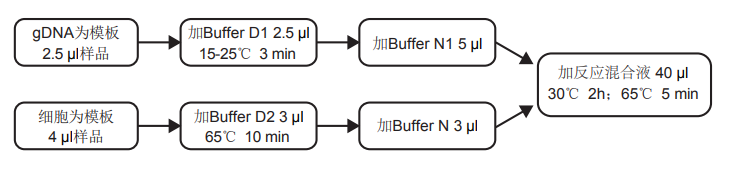
procedure
Cells as templates for amplification
This protocol is suitable for whole genome non-discriminatory amplification using 1-1000 cells as a template. Freshly prepared cell samples should be used to ensure the integrity of the starting genome, and apoptotic cells should not be used.
1. This protocol is suitable for whole genome non-discriminatory amplification using 1-1000 cells as a template. Freshly prepared cell samples should be used to ensure the integrity of the starting genome, and apoptotic cells should not be used.

2. Add 4 μl of cell sample (resuspended in PBS) to the PCR tube. If the sample volume is less than 4 μl, make up to 4 μl using PBS.
3. Add 3 μl of Buffer D2, flick the wall of the tube to mix and centrifuge briefly to collect. Make sure that the cells are not adhering to the wall of the tube, and do not blow with the pipette to avoid the cell sample adhering to the pipette tip.
4. The samples were incubated at 65°C for 10 min.
5. Add 3 μl of Buffer N, flick the walls of the tube to mix and centrifuge briefly. Keep the sample on ice until ready for the next step.
6. Prepare the reaction mixture according to the table below, mix and centrifuge briefly.

7. Immediately add 40 μl of the reaction mixture to the prepared 10 μl DNA sample (step 5), flick the walls of the tube to mix and collect by brief centrifugation.
8. Incubate at 30°C for 2 h. Incubation can be extended to increase yield if needed.
9. Incubate at 65℃ for 5 min to inactivate SC-DNA Polymerase. Note: The amplified product is a high concentration of genomic DNA, please use water or TE to dilute to a suitable concentration for downstream experiments. The amplified product can be widely used in whole genome and exon sequencing, qPCR analysis, gene chip analysis, etc.
Genome as template amplification
This protocol is suitable for non-discriminatory genome-wide amplification of greater than 1 ng of purified genomic DNA as a template, but less starting DNA can be used if the genome is sufficiently complete and pure.
1.Prepare Buffer D1 and N1 (the volumes given in the table below are sufficient for 12 reactions, and may be stored at -20°C if not fully used in one experiment, but should not be stored for more than 3 months).

2.Add 2.5 μl of DNA sample to the PCR tube. If the sample volume is less than 2.5 μl, use water or TE to make up to 2.5 μl.
3.Add 2.5 μl of Buffer D1, flick the tube wall to mix and centrifuge briefly.
4.Incubate at room temperature (15-25°C) for 3 min.
5.Add 5 μl of Buffer N1, flick the walls of the tube to mix and centrifuge briefly. Keep the sample on ice until ready for the next step.
6.Prepare the reaction mixture according to the table below, mix and centrifuge briefly.

7.Immediately add 40 μl of the reaction mixture to the prepared 10 μl DNA sample (step 5), flick the walls of the tube to mix and collect by brief centrifugation.
8.Incubate at 30°C for 2 h. Incubation can be extended to increase yield if needed.
9.SC-DNA Polymerase was inactivated by incubation at 65°C for 5 min.
Note: The amplified product is a highly concentrated genomic DNA, please use water or TE to dilute it to a suitable concentration for downstream experiments. The amplified product can be widely used in whole genome and exon sequencing, qPCR analysis, gene chip analysis and so on.
Usage
The following are examples of conventional PCR reaction systems and conditions, which should be improved and optimized according to the template, primer structure and fragment size.
1. PCR Reaction System All operations should be carried out on ice, and the components should be mixed well after thawing and stored at -20℃ after use.

2. PCR reaction conditions

take note of
1)Priority is given to three-step amplification; if the three-step method fails to amplify the target product or if the primer Tm value is greater than 68°C, try the two-step method.
2)Denaturation: pre-denaturation of simple templates 98°C, 30s-1min, for complex templates, the pre-denaturation time can be extended to 3min.
3)Annealing: In general, the annealing temperature is 3-5℃ lower than the Tm value of the primers. If the desired amplification efficiency cannot be obtained, the annealing temperature should be changed in a gradient to optimize the results; if a non-specific reaction occurs, the annealing temperature should be increased appropriately.
4)Extension: The extension time should be set according to the length of the amplified fragments and the complexity of the template, the amplification efficiency of this product is 3-5 kb/min, for long fragments and templates with high complexity it is recommended that 2-4kb/min.
5)Cycling times: the number of cycles can be set according to the downstream application of the amplification product. If the number of cycles is too small, the amplification amount will be insufficient, and if the number of cycles is too large, the chance of mismatch will be increased, so the number of cycles should be minimized under the premise of guaranteeing the yield of the product.
Comprehensive hazard, handling, storage, and regulatory compliance document.
Download SDS →Lot-specific quality data. Enter your lot number to retrieve the exact COA.
Look up COA →Full quality attributes and acceptance criteria for this grade.
View spec sheet →