
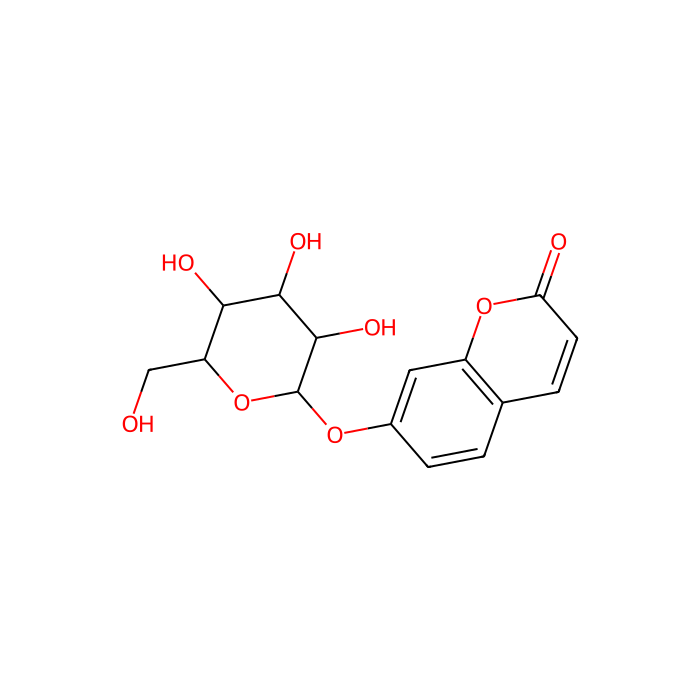
 G2209133
Determine the necessary mass, volume, or concentration for preparing a solution.
| Activity Type | Relation | Activity value | Units | Action Type | Journal | PubMed Id | doi | Assay Aladdin ID |
|---|
analytical standard,Moligand™,≥98% Analytical standard,Moligand™ for sensitive chromatographic and analytical workflows requiring minimal baseline interference.
Store at -20°C Ships Ice chest + Ice pads Check lot-specific COA for exact specifications.
SDS, COA, datasheet, and spec sheet available for download. Lot-specific COA accessible via lot number lookup.
Cited in 0 peer-reviewed publications across chromatography, organic synthesis, and cross-coupling reactions.
| Canonical Smiles | C1=CC(=CC2=C1C=CC(=O)O2)OC3C(C(C(C(O3)CO)O)O)O |
|---|---|
| IUPAC Name | 7-[(2S,3R,4S,5S,6R)-3,4,5-trihydroxy-6-(hydroxymethyl)oxan-2-yl]oxychromen-2-one |
| InChIKey | VPAOSFFTKWUGAD-TVKJYDDYSA-N |
| INCHI | 1S/C15H16O8/c16-6-10-12(18)13(19)14(20)15(23-10)21-8-3-1-7-2-4-11(17)22-9(7)5-8/h1-5,10,12-16,18-20H,6H2/t10-,12-,13+,14-,15-/m1/s1 |
| Isomeric SMILES | C1=CC(=CC2=C1C=CC(=O)O2)O[C@H]3[C@@H]([C@H]([C@@H]([C@H](O3)CO)O)O)O |
| PubChem CID | 99693 |
| Molecular Weight | 324.28 |
Comprehensive hazard, handling, storage, and regulatory compliance document.
Download SDS →Lot-specific quality data. Enter your lot number to retrieve the exact COA.
Look up COA →Full quality attributes and acceptance criteria for this grade.
View spec sheet →Taxonomy Tree
| Kingdom | Organic compounds |
|---|---|
| Superclass | Phenylpropanoids and polyketides |
| Class | Coumarins and derivatives |
| Subclass | Coumarin glycosides |
| Intermediate Tree Nodes | Not available |
| Direct Parent | Coumarin glycosides |
| Alternative Parents | Phenolic glycosides Hexoses O-glycosyl compounds 1-benzopyrans Pyranones and derivatives Benzenoids Oxanes Heteroaromatic compounds Secondary alcohols Lactones Acetals Polyols Oxacyclic compounds Primary alcohols Organic oxides Hydrocarbon derivatives |
| Molecular Framework | Aromatic heteropolycyclic compounds |
| Substituents | Coumarin-7-o-glycoside - Coumarin o-glycoside - Phenolic glycoside - Hexose monosaccharide - Glycosyl compound - O-glycosyl compound - Benzopyran - 1-benzopyran - Pyranone - Monosaccharide - Oxane - Benzenoid - Pyran - Heteroaromatic compound - Lactone - Secondary alcohol - Polyol - Organoheterocyclic compound - Acetal - Oxacycle - Alcohol - Organooxygen compound - Hydrocarbon derivative - Organic oxide - Primary alcohol - Organic oxygen compound - Aromatic heteropolycyclic compound |
| Description | This compound belongs to the class of organic compounds known as coumarin glycosides. These are aromatic compounds containing a carbohydrate moiety glycosidically bound to a coumarin moiety. |
| External Descriptors | Not available |
| Activity Type | Relation | Activity value | Units | Action Type | Journal | PubMed Id | doi | Assay Aladdin ID |
|---|
| Activity Type | Relation | Activity value | Units | Action Type | Journal | PubMed Id | doi | Assay Aladdin ID |
|---|
| Activity Type | Relation | Activity value | Units | Action Type | Journal | PubMed Id | doi | Assay Aladdin ID |
|---|
| Activity Type | Relation | Activity value | Units | Action Type | Journal | PubMed Id | doi | Assay Aladdin ID |
|---|
| Molecular Weight | 324.280 g/mol |
|---|---|
| XLogP3 | -0.700 |
| Hydrogen Bond Donor Count | 4 |
| Hydrogen Bond Acceptor Count | 8 |
| Rotatable Bond Count | 3 |
| Exact Mass | 324.085 Da |
| Monoisotopic Mass | 324.085 Da |
| Topological Polar Surface Area | 126.000 Ų |
| Heavy Atom Count | 23 |
| Formal Charge | 0 |
| Complexity | 466.000 |
| Isotope Atom Count | 0 |
| Defined Atom Stereocenter Count | 5 |
| Undefined Atom Stereocenter Count | 0 |
| Defined Bond Stereocenter Count | 0 |
| Undefined Bond Stereocenter Count | 0 |
| The total count of all stereochemical bonds | 0 |
| Covalently-Bonded Unit Count | 1 |
Our grade selection guide covers purity, stabilizer status, and application suitability for all variants in our catalog.
View Analytical standard grade guide → View Moligand™ grade guide →