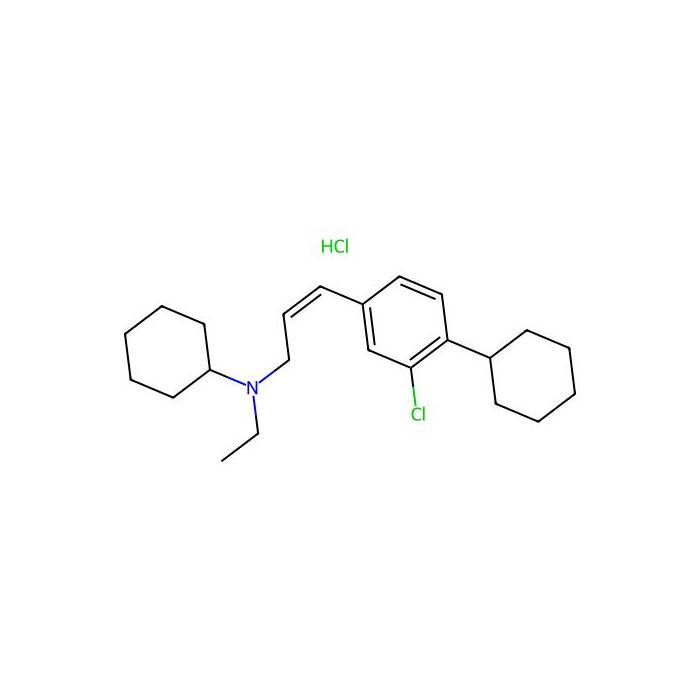
SR-31747 is a sigma ligand with immunosuppressive and anti-inflammatory properties. SR-31747 blocks cell proliferation by inhibiting sterol isomerase
In Vitro
SR-31747 blocks the proliferation of lymphocytes at a concentration of 10 nM. SR-31747 is capable of inhibiting T-cell proliferation when added as late as 24 h after activation. SR-31747 arrests proliferation in yeast cells in a dose-dependent manner. MCE has not independently confirmed the accuracy of these methods. They are for reference only.
In Vivo
In vivo, SR-31747 dramatically blocks lipopolysaccharide-induced production of IL-1, IL-6 and TNF-α in a dose-dependent manner (ED 50 , 2 mg/kg). SR-31747 probably abrogated monokine production through an indirect mechanism that involves endogenous corticosteroids. This conclusion was supported by in vivo experiments that shows that: 1) ablation of corticosteroids by use of Mifepristone or adrenalectomy suppress the effect of SR-31747; 2) administration of SR-31747 induces an enhancement of the corticosterone level. SR-31747 improves the survival of animals with endotoxinic shock as a result of monokine inhibition . MCE has not independently confirmed the accuracy of these methods. They are for reference only.
IC50& Target:Sigma ligand
Specifications
Specifications & Purity
10mM in DMSO
Biochemical and Physiological Mechanisms
SR-31747 is a sigma ligand with immunosuppressive and anti-inflammatory properties. SR-31747 blocks cell proliferation by inhibiting sterol isomerase.
Storage
Desiccated,Store at -80°C
Shipped In
Dry ice packs + Cold packs
This product requires cold chain shipping. Ground and other economy services are not available.
Names and Identifiers
Isomeric SMILES
CCN(C/C=C\C1=CC(=C(C=C1)C2CCCCC2)Cl)C3CCCCC3.Cl
Alternate CAS
132173-06-9
Molecular Weight
396.44
Advanced Data
Certificates (CoA,COO,BSE/TSE and Analysis Chart)
C of A & Other Certificates(BSE/TSE, COO):
Analytical Chart:
Solution Calculators
Molarity Calculator
Determine the necessary mass, volume, or concentration for preparing a solution.
Dilution Calculator
Determine the dilution needed to prepare a stock solution.
Reconstitution Calculator
Reviews
Customer Reviews
Application Protocols
Item-specific
Manufacturer-tested applications are not provided for this item.
General research protocols (not item-specific; adapt to your system)
Stock preparation: Weigh under dry conditions. Prepare a 10–50 mM stock in anhydrous DMSO. Vortex and, if needed, briefly sonicate. Aliquot into low-bind tubes under dry nitrogen/argon and store at −80 °C.
Working solutions: Immediately before use, dilute the DMSO stock into assay buffer or medium with rapid mixing to the desired concentration while keeping final DMSO low (e.g., ≤0.1–1% v/v). Inspect for precipitation.
Plate-based assays: Pre-wet pipette tips with DMSO stock to reduce adsorption. Use serial dilution in DMSO or buffer to prepare concentration–response curves. Include vehicle controls matched for DMSO content.
Analytical qualification: Confirm identity/purity of the working stock by LC–MS and purity by UPLC/UV. For longer assays, assess stability in the relevant matrix (e.g., incubate at 37 °C and re-analyze by LC).
Documentation
Record lot number, preparation date, solvent, and concentration on each aliquot. Link all biological data to the exact lot and preparation to ensure reproducibility.
Biological Roles
General literature perspective (not item-specific; verify primary sources)
Compounds referred to as SR-31747 or SR31747A have been reported as tool molecules interacting with sigma-associated binding sites and the sterol isomerase/emopamil binding protein (EBP) pathway. Such probes are used to interrogate cholesterol/sterol metabolism and sigma-related signaling in cellular systems.
In cell biology, these tools are leveraged to study effects on membrane composition, ER/Golgi function, and stress responses that are influenced by sterol processing. Reported cellular readouts can include changes in sterol intermediates, transcriptional responses to lipid imbalance, and sensitivity of specific cell lines.
Selectivity and off-targets: Literature notes that sigma-binding probes can have polypharmacology. Therefore, target deconvolution (chemoproteomics, CRISPR knockouts, or rescue with pathway intermediates) is recommended to ascribe phenotypes.
Important caveats
The above reflects general literature on SR-31747–class compounds and does not constitute item-specific characterization for this SKU. Batch-specific identity, salt form, and purity must be confirmed from the CoA.
No medical, diagnostic, or therapeutic use is implied. All work should be conducted in vitro or in relevant non-clinical research models consistent with institutional approvals.
Buffer Applications
Not typically applicable
SR-31747 is a small-molecule bioactive, not a buffering agent. It does not serve as a pH buffer component in standard biochemical or biological buffers.
Practical notes for assay buffers (general)
When using SR-31747 in biological assays, choose buffers that maintain compound solubility and target stability. Common systems include HEPES, PBS, or Tris at physiological pH with low organic cosolvent (≤1% DMSO).
Include surfactants (e.g., 0.01–0.05% Tween 20) only if validated not to alter target binding. Assess precipitation by visual inspection or light scattering upon dilution from DMSO stocks.
Green Alternatives
Context
As a bioactive research compound, SR-31747 is not a process solvent or commodity reagent for which green substitutions are typically sought. However, greener practices can be applied to its handling and use.
Greener handling strategies (general)
Minimize DMSO volume and prepare high-concentration stocks to reduce solvent use in assays.
For analytics, consider acetonitrile/water mobile phases with volatile buffers (ammonium formate/acetate) instead of halogenated solvents.
If recrystallization or purification is required in your lab, preferentially use greener solvents (ethyl acetate, 2-MeTHF, IPA, ethanol) where compatible with the compound’s solubility.
Comparison of common solvents for small-molecule stocks (general)
DMSO: Excellent solvency; not readily biodegradable; minimize waste.
Ethanol: Renewable feedstock, lower toxicity; may offer limited solvency for hydrophobic scaffolds.
2-MeTHF/EtOAc: Greener options for workups or preparative steps if you are modifying the scaffold in-house.
Waste reduction
Aliquot and store under inert, dry conditions at −80 °C to extend shelf life and reduce discarded, degraded material.
Utilize microscale assay formats and automated liquid handling to limit solvent consumption and chemical waste.
Pharmaceutical Uses
Context
This product is supplied strictly for research use only. It is not intended for human or animal use in drug, diagnostic, or therapeutic applications.
General formulation considerations for research (not item-specific)
For in vitro studies, DMSO stock solutions are commonly diluted into aqueous media; verify that final excipient levels are compatible with your biological system.
For non-clinical formulation method development (e.g., preformulation screenings), solubilization strategies may include salt formation, cosolvents, pH adjustment, and cyclodextrin inclusion complexes. These are exploratory techniques and not specifications for this item.
Regulatory note
No pharmacopeial monograph or excipient status is provided for SR-31747. Do not use in GMP manufacturing or clinical contexts. For any translational work, procure GMP-grade material with full regulatory documentation.
Physical Properties
Item-specific (from Product Data)
Appearance: Not specified for this item; refer to CoA/Spec Sheet.
Molecular weight: Not specified for this item; refer to CoA/Spec Sheet.
Literature/typical expectations for small-molecule tool compounds (not item-specific)
Aggregated physical constants such as melting point, boiling point, density, pKa/logP, and refractive index are not provided here for this specific item. Where needed for method development or formulation, consult peer-reviewed literature for CAS 132173-07-0 and confirm against your batch by DSC/TGA, Karl Fischer, NMR, and HPLC.
Solubility guidance (general): bioactive amine-containing small molecules are frequently soluble in polar aprotic solvents (DMSO, DMF) and variably soluble in aqueous buffers depending on pH and counterion. For high-throughput screening, 10–50 mM DMSO stocks are commonly prepared, then diluted into assay medium to ≤1% DMSO final; verify actual solubility/compatibility empirically for your system. This guidance is general and not a specification for this item.
Notes for practitioners
If precise physical constants are required (e.g., logD at assay pH, equilibrium solubility, pKa), measure under your exact conditions (shake-flask, potentiometric titration) because literature values can vary with salt form, temperature, and ionic strength.
Solid-state form (free base vs. salt, solvate/hydrate) can materially impact melting point and solubility; confirm with PXRD and TGA when these parameters are critical.
Quality & Grades
Item-specific (from Product Data)
Grade/purity: Not specified for this item; refer to CoA/Spec Sheet.
How to interpret quality for a screening compound (general guidance)
Screening/compound-library grade materials are expected to meet identity and purity thresholds suitable for biochemical and cell-based assays. Typical acceptance criteria include structure-confirming spectroscopic data (1H NMR, MS) and chromatographic purity (e.g., HPLC/UPLC area %). Exact thresholds vary by supplier and lot.
If low-UV or LC–MS compatibility is critical, request detailed chromatograms, residual solvent profiles, and salt/stoichiometry information. For mechanistic studies, orthogonal purity checks (qNMR, high-resolution MS, ICP for metals if catalytic residues are a concern) are recommended.
Stabilizers/additives: None are specified for this item. If stabilizers are present in a given lot, they will be declared on the CoA/spec sheet.
Best practices
Verify lot-specific purity and identity before use in SAR or screening cascades; small impurity changes can confound biological data.
Where possible, aliquot upon receipt (under dry, inert atmosphere) to limit freeze–thaw cycles and moisture exposure that may affect purity over time.
Reaction & Applications
Scope for this product
SR-31747 is supplied as a research tool compound within a small-molecule/compound library context. It is not typically used as a stoichiometric reagent, catalyst, or synthetic solvent.
Research applications (general/literature context; not item-specific)
Literature describes SR-31747-class compounds as pharmacology probes for sigma-related binding sites and sterol-processing pathways. Typical applications include target engagement studies, mechanistic enzymology, and phenotypic screening in cells.
In vitro assay usage commonly relies on DMSO stock solutions, concentration–response curves, and orthogonal readouts (e.g., biochemical vs. cell-based). Always verify purity and identity of the exact lot used to avoid SAR artifacts.
Practical tips
Prepare concentrated, filter-sterilized DMSO stocks (e.g., 10–50 mM) and aliquot to avoid freeze–thaw. Confirm solubility upon dilution into the desired medium.
If binding assays are planned, evaluate nonspecific binding to plastics and serum proteins; adjust plate material and assay buffer components accordingly.
For chemical biology experiments (e.g., pulldown, imaging probes), confirm whether your intended derivatization site is compatible with the scaffold reported in the literature; obtain structural identifiers from the CoA before synthesis of analogs.
Reaction Conditions
Not typically applicable as a reagent
SR-31747 is not generally used to promote or undergo standard named organic reactions as a reagent. Reaction condition guidance below is provided only for handling during assay preparation and analytical workflows.
Assay solution preparation (general)
Dissolution: Prepare concentrated DMSO stock solutions (e.g., 10–50 mM) at room temperature with vortexing and brief sonication if needed. Filter through 0.2 µm PTFE for particulate removal when sterility/clarity is required.
Dilution: Add DMSO stocks to buffer/media with vigorous mixing to prevent local supersaturation; maintain final DMSO ≤1% v/v unless your system tolerates more.
Analytical method development (general)
Chromatography: Reverse-phase LC with water/acetonitrile + 0.1% formic acid or ammonium formate buffers is typical. Begin with a C18 column, gradient 5–95% organic over 5–10 min, and adjust based on observed retention.
Detection: UV 210–254 nm and MS in positive ESI are commonly suitable for amine-containing small molecules. Optimize source settings to minimize in-source fragmentation.
Note
The above parameters are non-specific and must be tailored based on the confirmed structure and behavior of your particular lot.
Safety & Handling
Item-specific (from Product Data)
Hazard information (GHS classification, signal word, H-statements, pictograms): Not specified for this item; refer to SDS.
General laboratory safety (not item-specific; always defer to SDS)
Handle in a fume hood with appropriate PPE: lab coat, safety glasses, and suitable chemically resistant gloves (e.g., nitrile). Avoid inhalation of dust/aerosols and contact with skin/eyes.
Prevent moisture uptake: open only after equilibrating the sealed container to ambient to minimize condensation; promptly reseal under dry inert gas if possible.
Incompatibilities and precautions: Avoid strong oxidizers and strong acids/bases unless specifically required by protocol. For amine-containing organics, peroxides are not typically a concern, but oxidation and adsorption to plastics or glass can occur.
First aid (general): In case of skin contact, wash with soap and water; eye exposure, rinse with water for several minutes; inhalation, move to fresh air; ingestion, seek medical attention. Consult the SDS for substance-specific measures.
Waste disposal: Collect organic waste in appropriate, labeled containers; dispose according to institutional and regulatory requirements. Do not release to drains.
Solvent Selection
Applicability
SR-31747 is a bioactive small molecule and not a solvent. Solvent selection guidance below focuses on preparing stock solutions and assay dilutions for research use.
General solvent guidance (not item-specific specs)
Primary stock solvents: DMSO is commonly used for hydrophobic tool compounds due to broad solvency and assay compatibility. DMF or acetonitrile can be alternatives for certain analytics or sample prep.
Aqueous compatibility: Many small-molecule amines become more water-soluble upon acidification (e.g., with HCl or acetate buffers). If needed, adjust pH of the diluent to keep the compound in solution after DMSO dilution; confirm absence of precipitation by visual inspection or light-scattering.
Dielectric/polarity considerations: Polar aprotics (DMSO, DMF, MeCN) facilitate dissolution and LC–MS sample prep; protic solvents (MeOH, EtOH) may be suitable for short-term use but can participate in hydrogen bonding or transesterification in rare cases.
Adsorption/ carryover: To minimize adsorption to plastics, prepare higher-concentration DMSO stocks and dilute immediately before use; use low-bind polypropylene plates or glass vials for analytical samples.
Quick comparison (general)
DMSO: maximal solubility, broad bioassay compatibility up to ~0.1–1% v/v final.
DMF: excellent solvency; less favored in live-cell assays; good for reaction screening or analytics.
MeOH/EtOH: useful for spectroscopy and certain extractions; assess assay tolerance carefully.
Storage & Reconstitution
Item-specific (from Product Data)
Storage conditions: Desiccated; store at −80 °C.
Shipped in: Dry ice packs + cold packs.
Best practices (general; complement item-specific guidance)
Upon receipt: Keep frozen. Allow the sealed container to equilibrate to room temperature before opening to avoid condensation. Handle quickly under dry air or inert gas.
Aliquoting: Prepare single-use aliquots of solid or concentrated DMSO stock to minimize freeze–thaw and moisture exposure.
Stability: Without item-specific data, assume improved stability when protected from light, oxygen, and moisture at low temperature. Track time out of freezer and avoid repeated bench warmups.
Reconstitution: If solid, dissolve in anhydrous DMSO to the desired concentration. If a salt form is present, it may also dissolve in aqueous buffer depending on pH; verify clarity and stability over the assay timeframe.
Shelf life: Not specified for this item; refer to CoA/Spec Sheet. Reassess purity by LC–MS/UPLC after extended storage or if changes in appearance are observed.
Safety note
Open and reconstitute in a fume hood using appropriate PPE. Dispose of any unused solutions according to institutional hazardous waste procedures.
Structure & Identity
Item-specific (from Product Data)
Product name: SR-31747 (SKU: S656052)
CAS: 132173-07-0
Molecular formula: Not specified for this item; refer to CoA/Spec Sheet.
Molecular weight: Not specified for this item; refer to CoA/Spec Sheet.
SMILES: Not specified for this item; refer to CoA/Spec Sheet.
InChIKey: Not specified for this item; refer to CoA/Spec Sheet.
General/literature context (not item-specific)
SR-31747 (often denoted SR31747A in literature) is described as a small-molecule tool compound reported to interact with sigma-related binding sites and the sterol isomerase/EBP pathway. Structural depictions in the literature typically show a compact, drug-like scaffold with tertiary amine functionality; exact structure and stereochemistry must be verified from primary references for your intended use.
If you require unambiguous structural identifiers (2D/3D structure, SMILES, InChI), consult the Certificate of Analysis (CoA), manufacturer specification sheet, or authoritative databases for CAS 132173-07-0 before experimental planning.
Practical identity guidance
Always match CAS, batch/lot, and spectral/analytical data (NMR/LC–MS/HRMS) from the supplied CoA when qualifying the material for screening or mechanistic studies.
For cheminformatics registration, defer to the exact identifiers provided with your batch to avoid conflating distinct salts, tautomers, or solvates that may appear under similar names in the literature.
Synthetic Utility
Scope
SR-31747 is offered as a bioactive tool compound, not a synthetic building block or reagent. As such, it is not commonly employed as a starting material or intermediate in general organic synthesis.
General commentary (literature)
If pursuing structure–activity relationship (SAR) studies based on the SR-31747 scaffold, synthetic chemists often explore substitutions that modulate basicity, lipophilicity, and sigma/sterol-pathway engagement. This may involve modifications to amine-containing moieties or aryl/heteroaryl regions reported in the literature. The precise positions amenable to diversification depend on the confirmed structure and must be derived from primary references.
Practical advice
Before undertaking analog synthesis, obtain the exact structure (including salt form/stoichiometry) for this item from the CoA to avoid misassignment.
Plan analytical methods upfront (UPLC–MS for purity, qNMR for assayable content), and if necessary, isolate single solid forms (free base vs. salt) to standardize physical properties across analog series.
Target Specificity
Item-specific (from Product Data)
No target, antigen, or binding specificity data are provided for this item.
General literature note (not item-specific)
Compounds designated SR-31747/SR31747A have been discussed in the literature as probes for sigma-associated sites and sterol isomerase/EBP. However, binding profiles can vary by scaffold variant, salt form, and experimental conditions. Do not assume equivalence without primary data.
Recommendation
For target-based studies, obtain or generate binding/functional data for your exact lot (radioligand displacement, SPR/ITC, enzyme assays) and validate with orthogonal methods. Consult the SDS/CoA and primary references for CAS 132173-07-0 for definitive target annotations.
Frequently Asked Questions
How should this product be stored?
Store at ?80 °C, desiccated. Keep the container tightly closed with desiccant — the material is moisture-sensitive.
How is this product shipped?
This product ships frozen with dry ice and cold packs. Unpack on arrival and transfer it to the storage condition stated above; handle dry ice with insulated gloves in a ventilated area.
What are the CAS number, molecular formula and molecular weight?
The CAS Number is 132173-07-0, the molecular formula is C23H35Cl2N, and the molecular weight is 396.44 g/mol.
What documentation is provided?
Available product documentation, including Certificates of Analysis (COA), Safety Data Sheets (SDS), and specification sheets, is shown in the product document area. Document availability and access follow the current site policy.
We use cookies to ensure the website functions properly and, where permitted, to improve your experience. You can manage your preferences at any time in Settings. Learn more in our Cookie Policy.
Shall we send you a message when we have discounts available?
Remind me later
Thank you! Please check your email inbox to confirm.
Products are supplied to verified businesses, institutions, and qualified professionals for research and development use only. Not for use in humans, animals, diagnosis, or therapy.