
Determine the necessary mass, volume, or concentration for preparing a solution.
| Activity Type | Activity Value -log(M) | Mechanism of Action | Activity Reference | Publications (PubMed IDs) |
|---|
Moligand™, 10mM in DMSO Moligand™ for sensitive chromatographic and analytical workflows requiring minimal baseline interference.
Store at -80°C Ships Dry ice packs + Cold packs Check lot-specific COA for exact specifications.
SDS, COA, datasheet, and spec sheet available for download. Lot-specific COA accessible via lot number lookup.
Cited in 2 peer-reviewed publications across chromatography, organic synthesis, and cross-coupling reactions.
Information
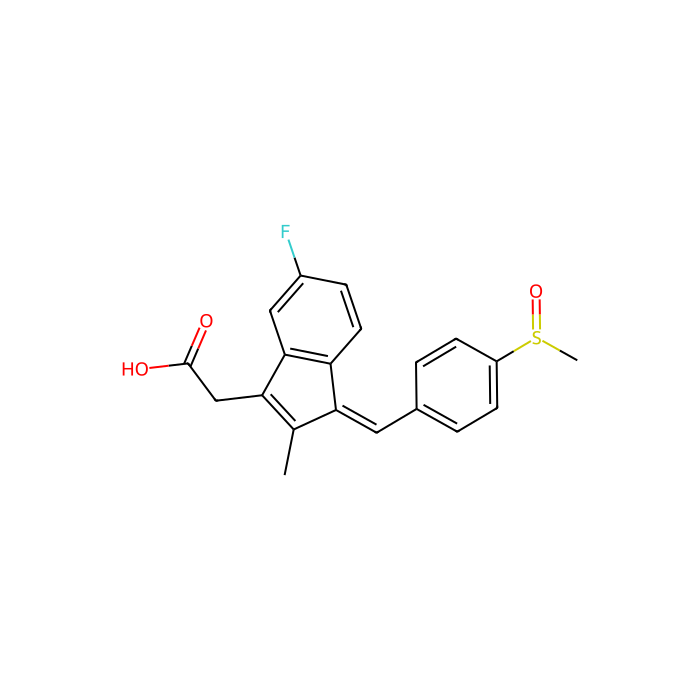
Sulindac Sulindac is a non-steroidal COX inhibitor, which potently inhibits prostaglandin synthesis, used in the treatment of acute or chronic inflammatory conditions.
In vitro
Sulindac and its metabolites sulindac sulfide and sulindac sulfone can also inhibit the NF-kappaB pathway in both colon cancer and other cell lines, due to sulindac-mediated decreases in IKKbeta kinase activity. Sulindac sulfide significantly reduces cell number in both preconfluent and confluent cultures of HT-29 cells with the sulfide showing approximately 4-fold greater potency. Sulindac sulfide inhibits the growth of a variety of tumor cell lines derived from other tissues, as well as normal epithelial cells and fibroblasts. Sulindac sulphide abrogates beta-catenin/TCF-mediated transcription in the CRC cell lines DLD1 and SW480, and decreases the levels of nonphosphorylated beta-catenin.
In vivo
Sulindac not only inhibits tumor formation but decreases small bowel Cox-2 and prostaglandin E(2) to baseline and restored normal levels of apoptosis in a murine modelof familial adenomatous polyposis. [4] Sulindac reduces the tumor number by 95% but does not alter the levels of PGE2 and LTB4 in intestinal tissues in Min/+爉ice. Sulindac reduces tumor number by 82%, whereas eicosanoid levels remained elevates in Min/+ mice. Sulindac causes regression of 70-80% of small intestinal tumors in Min/+ mice within 4 days, but does not have the same impact on colonic lesions.
Cell Data
cell lines:
Concentrations:
Incubation Time:
Powder Purity:≥100%
| ALogP | 3.4 |
|---|
| Isomeric SMILES | CC\1=C(C2=C(/C1=C\C3=CC=C(C=C3)S(=O)C)C=CC(=C2)F)CC(=O)O |
|---|---|
| WGK Germany | 3 |
| RTECS | NK8226000 |
| Alternate CAS | 32004-68-5,38194-50-2,9000-14-0 |
| PubChem CID | 1548887 |
| NSC Number | 757344 |
| MeSH Entry Terms | Aclin;Apo Sulin;Apo-Sulin;Arthrobid;Arthrocine;Chibret;Clinoril;Copal;Kenalin;Klinoril;MK 231;MK-231;MK231;Novo Sundac;Novo-Sundac;Nu Sulindac;Nu-Sulindac;Sulindac;Sulindal |
| Molecular Weight | 356.41 |
Comprehensive hazard, handling, storage, and regulatory compliance document.
Download SDS →Lot-specific quality data. Enter your lot number to retrieve the exact COA.
Look up COA →Full quality attributes and acceptance criteria for this grade.
View spec sheet →| Activity Type | Activity Value -log(M) | Mechanism of Action | Activity Reference | Publications (PubMed IDs) |
|---|
| Activity Type | Activity Value -log(M) | Mechanism of Action | Activity Reference | Publications (PubMed IDs) |
|---|
| Activity Type | Activity Value -log(M) | Mechanism of Action | Activity Reference | Publications (PubMed IDs) |
|---|
| Activity Type | Activity Value -log(M) | Mechanism of Action | Activity Reference | Publications (PubMed IDs) |
|---|
| Activity Type | Activity Value -log(M) | Mechanism of Action | Activity Reference | Publications (PubMed IDs) |
|---|
| Activity Type | Activity Value -log(M) | Mechanism of Action | Activity Reference | Publications (PubMed IDs) |
|---|
| Activity Type | Activity Value -log(M) | Mechanism of Action | Activity Reference | Publications (PubMed IDs) |
|---|
| Melt Point(°C) | 184 °C |
|---|
| 1. Ying Zhang, Xie-an Yu, Yiting Hu, Xuefei Bai, Ran Zhang, Mi Lu, Jianhui Sun, Jiangwei Tian, Bo-Yang Yu. (2020) A polydopamine-polyethyleneimine/quantum dot sensor for instantaneous readout of cell surface charge to reflect cell states. SENSORS AND ACTUATORS B-CHEMICAL, [PMID:] [10.1016/j.snb.2020.128696] |
| 2. Lian Xu, Yan Xiao, Kun Yu, Hongshuo Pan, Jiayi Xu, Yiyun Guan, Mengke Wang, Xiangyu Xu, Hao Wang. (2025) Machine Learning-Assisted Chemical Tongues Based on Dual-channel Inclusion Complexes for Rapid Identification of Nonsteroidal Anti-inflammatory Drugs in Food. ACS Sensors, [PMID:39992799] [10.1021/acssensors.4c02806] |
Our grade selection guide covers purity, stabilizer status, and application suitability for all variants in our catalog.
View Moligand™ grade guide →