Talc - Moligand™, 10 mM in DMSO , CAS No.14807-96-6

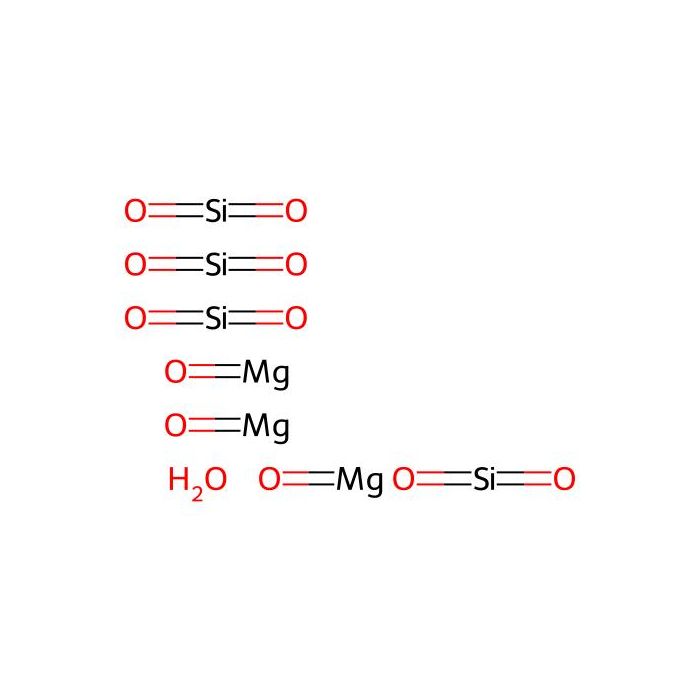
CAS: 14807-96-6 Cat. No.: T1499350 Formula: 3MgO·4SiO2·H2O Molecular Weight: 379.27 EC Number: 238-877-9
AVAILABLE TO ORDER
GRADE & PURITY Moligand™ ? Moligand™ — Aladdin's line of ligands and bioactive small molecules. Use for receptor, pathway, and binding studies needing defined small-molecule tools. 10 mM in DMSO
Storage
Store at -80°C
Shipped In
Dry ice packs + Cold packs
★
Size
USA
Germany (EU)*
Price
Qty
1ml
T1499350-1ml
Made to order · 8–12 wks
$58.90
Enter a quantity for the sizes you want to add.

Overview

Talc, a naturally occurring mineral composed primarily of magnesium, silicon and oxygen, is used in many cosmetics, from baby powder to blush .

Specifications

Specifications & Purity
Moligand™, 10 mM in DMSO
Storage
Store at -80°C
Shipped In
Dry ice packs + Cold packs
This product requires cold chain shipping. Ground and other economy services are not available.
Grade
Moligand™
Names and Identifiers
Isomeric SMILES
O.O=[Mg].O=[Mg].O=[Mg].O=[Si]=O.O=[Si]=O.O=[Si]=O.O=[Si]=O
RTECS
WW2710000
Molecular Weight
379.27

Advanced Data

Certificates (CoA,COO,BSE/TSE and Analysis Chart)
C of A & Other Certificates(BSE/TSE, COO):
Analytical Chart:
Chemical and Physical Properties
Melt Point800°C
Safety and Hazards(GHS)
RTECS
WW2710000
Documents & Articles
Mercapto Silane Coupling Agents: Structural Features, Classification, Applications, and Selection
Titanate Coupling Agents: Structural Features, Classification, Typical Applications, and Differences from Silane Coupling Agents
TCA-KTTS, a Titanate Coupling Agent Suitable for Use in Cosmetics: Basic Information, Application Characteristics, and Differences from 130 and 105
How Matting Agents in Coatings Build Low-Gloss Coating Surfaces: Mechanisms, Formulation Trade-Offs, and Product Selection
Application and Selection Guide for Alkyd Resin Coatings: Advantages, Limitations, Formulation Control, and Modification Directions
Guide to Epoxy Resin Performance Design: System Composition, Key Properties, Process Control, and Application Selection
Fluorocarbon Resin Coating Formulation Design: Resin Selection, Supporting Systems, and Key Application Control Points
Silicone Resin Coating Formulation Design: From Application Conditions to Matching Resins, Pigments and Fillers, Curing, and Substrates
Applications and Selection of Acrylic Resins in Coatings: Analysis of Architectural, Industrial, and Supporting Materials
Vinyl Acetate-Acrylic Emulsion (Vinyl Acrylic Emulsion): A Cost-Performance Balance Solution for Architectural Coatings
PVAc, VAE, and Vinyl Acetate-Based Emulsions: Film-Forming Logic and Performance Boundaries in Architectural Coatings
Phenolic-Modified Alkyd Resin: Performance Enhancement and Applications in Fast-Drying Industrial Coatings
Selection and Formulation Design Guidelines for Phenolic Resins in Coatings: Applicable Scenarios, Application Limitations, and Performance Verification
Application Positioning, Scenario Selection, and Key Use Considerations for Chlorinated Rubber Resin in Coatings
Formulation Design of Chlorinated Rubber Coatings: Component Synergy and Performance Control
Waterborne Resin Application Guide: Formulation Synergy, Troubleshooting, and Technology Development Trends
Mechanisms and Control of Coating Yellowing: From Chromophoric Structure Formation to Source Diagnosis and Formulation Optimization
Resin Polarity in Coating Formulations: From Molecular Structure to Dissolution, Compatibility, Interfacial Interactions, and Formulation Design
Why Do Daily Chemical Products Become Opaque? Formation Mechanisms of Milky Turbidity, Pearlescence, and Coverage, and How to Select the Right Ingredients
Color-Development Mechanisms, Formulation Forms, and Selection/Application Logic of Colorants in Personal Care Products
Analysis of the Production Process of Hydroxypropyl Methylcellulose (HPMC) for Putty: Understanding Differences in Substitution Structure and Gelation Temperature from High-Ratio and Low-Ratio Formulations
Types, Mechanisms of Action, Key Quality Indicators, and Selection and Application of Common Cellulose Ethers in Wall Putty
Influencing Factors and Control Strategies for Blistering in Neutral Wall Putty: An Experimental Analysis Based on HPMC Dosage, Viscosity, and Ground Calcium Carbonate Fineness
How to Select Binding/Gel Materials for Neutral Wall Putty? A Comparison of Pregelatinized Starch, PVA, and Redispersible Polymer Powder Based on Four Application Trials
Causes and Mechanism Analysis of Delamination During Sanding of Water-Resistant Putty
What Are the Differences Between Polyvinyl Alcohol 1788, 2488, and 2699? Understanding Workability, Bonding Strength, and Relative Water Resistance from the Perspective of Degree of Polymerization and Degree of Hydrolysis
Common Problems and Formulation Adjustment Strategies for Neutral Putty Under High Summer Temperatures
Differences and Application Selection of Cassava- and Corn-Based Pregelatinized Starch in Neutral Putty Formulations
The Role, Selection, Cracking Risk Analysis, and Dosage Control of Bentonite in Neutral Putty
Mechanism of Action of Porous Silica in Oil-Control Loose Powder: Pore Structure, Capillary Imbibition, and Surface Modification
What Is Direct Compression? Process Characteristics, Suitability Criteria, and Excipient Selection
Citations of This Product
Solution Calculators
Reviews

Customer Reviews

Shall we send you a message when we have discounts available?

Remind me later

Thank you! Please check your email inbox to confirm.

Oops! Notifications are disabled.