
Determine the necessary mass, volume, or concentration for preparing a solution.
| Activity Type | Relation | Activity value | Units | Action Type | Journal | PubMed Id | doi | Assay Aladdin ID |
|---|
analytical standard, Moligand™ Analytical standard,Moligand™ for sensitive chromatographic and analytical workflows requiring minimal baseline interference.
Store at -20°C Ships Ice chest + Ice pads Check lot-specific COA for exact specifications.
SDS, COA, datasheet, and spec sheet available for download. Lot-specific COA accessible via lot number lookup.
Cited in 8 peer-reviewed publications across chromatography, organic synthesis, and cross-coupling reactions.
Comprehensive hazard, handling, storage, and regulatory compliance document.
Download SDS →Lot-specific quality data. Enter your lot number to retrieve the exact COA.
Look up COA →Full quality attributes and acceptance criteria for this grade.
View spec sheet →Taxonomy Tree
| Kingdom | Organic compounds |
|---|---|
| Superclass | Organic acids and derivatives |
| Class | Organic thiophosphoric acids and derivatives |
| Subclass | Thiophosphoric acid esters |
| Intermediate Tree Nodes | Aryl thiophosphates |
| Direct Parent | Phenyl thiophosphates |
| Alternative Parents | Diarylthioethers Thiophosphate triesters Thiophenol ethers Phenoxy compounds Sulfenyl compounds Organooxygen compounds Hydrocarbon derivatives |
| Molecular Framework | Aromatic homomonocyclic compounds |
| Substituents | Phenyl thiophosphate - Diarylthioether - Phenoxy compound - Aryl thioether - Thiophosphate triester - Thiophenol ether - Benzenoid - Monocyclic benzene moiety - Sulfenyl compound - Thioether - Organic oxygen compound - Hydrocarbon derivative - Organosulfur compound - Organooxygen compound - Aromatic homomonocyclic compound |
| Description | This compound belongs to the class of organic compounds known as phenyl thiophosphates. These are organothiophosphorus compounds that contain a thiophosphoric acid O-esterified with a phenyl group. |
| External Descriptors | Organophosphorus insecticides |
| Activity Type | Relation | Activity value | Units | Action Type | Journal | PubMed Id | doi | Assay Aladdin ID |
|---|
| Activity Type | Relation | Activity value | Units | Action Type | Journal | PubMed Id | doi | Assay Aladdin ID |
|---|
| Activity Type | Relation | Activity value | Units | Action Type | Journal | PubMed Id | doi | Assay Aladdin ID |
|---|
| Activity Type | Relation | Activity value | Units | Action Type | Journal | PubMed Id | doi | Assay Aladdin ID |
|---|
| Activity Type | Relation | Activity value | Units | Action Type | Journal | PubMed Id | doi | Assay Aladdin ID |
|---|
| Activity Type | Relation | Activity value | Units | Action Type | Journal | PubMed Id | doi | Assay Aladdin ID |
|---|
| Activity Type | Relation | Activity value | Units | Action Type | Journal | PubMed Id | doi | Assay Aladdin ID |
|---|
| Activity Type | Relation | Activity value | Units | Action Type | Journal | PubMed Id | doi | Assay Aladdin ID |
|---|
| Activity Type | Relation | Activity value | Units | Action Type | Journal | PubMed Id | doi | Assay Aladdin ID |
|---|
| Activity Type | Relation | Activity value | Units | Action Type | Journal | PubMed Id | doi | Assay Aladdin ID |
|---|
| Activity Type | Relation | Activity value | Units | Action Type | Journal | PubMed Id | doi | Assay Aladdin ID |
|---|
| Activity Type | Relation | Activity value | Units | Action Type | Journal | PubMed Id | doi | Assay Aladdin ID |
|---|
| Activity Type | Relation | Activity value | Units | Action Type | Journal | PubMed Id | doi | Assay Aladdin ID |
|---|
| Activity Type | Relation | Activity value | Units | Action Type | Journal | PubMed Id | doi | Assay Aladdin ID |
|---|
| Activity Type | Relation | Activity value | Units | Action Type | Journal | PubMed Id | doi | Assay Aladdin ID |
|---|
| Activity Type | Relation | Activity value | Units | Action Type | Journal | PubMed Id | doi | Assay Aladdin ID |
|---|
| Activity Type | Relation | Activity value | Units | Action Type | Journal | PubMed Id | doi | Assay Aladdin ID |
|---|
| Activity Type | Relation | Activity value | Units | Action Type | Journal | PubMed Id | doi | Assay Aladdin ID |
|---|
| Activity Type | Relation | Activity value | Units | Action Type | Journal | PubMed Id | doi | Assay Aladdin ID |
|---|
| Activity Type | Relation | Activity value | Units | Action Type | Journal | PubMed Id | doi | Assay Aladdin ID |
|---|
| Activity Type | Relation | Activity value | Units | Action Type | Journal | PubMed Id | doi | Assay Aladdin ID |
|---|
| Activity Type | Relation | Activity value | Units | Action Type | Journal | PubMed Id | doi | Assay Aladdin ID |
|---|
Find and download the COA for your product by matching the lot number on the packaging.
| Lot Number | Certificate Type | Date | Item |
|---|---|---|---|
 I2403037 | Certificate of Analysis | Jun 09, 2026 | T113675 |
| H2231897 | Certificate of Analysis | Mar 10, 2026 | T113675 |
| K2506814 | Certificate of Analysis | Nov 07, 2025 | T113675 |
| H2231766 | Certificate of Analysis | Jun 20, 2024 | T113675 |
| H2231877 | Certificate of Analysis | Jun 20, 2024 | T113675 |
| Melt Point(°C) | 30-31°C |
|---|---|
| Molecular Weight | 466.500 g/mol |
| XLogP3 | 6.000 |
| Hydrogen Bond Donor Count | 0 |
| Hydrogen Bond Acceptor Count | 9 |
| Rotatable Bond Count | 10 |
| Exact Mass | 465.99 Da |
| Monoisotopic Mass | 465.99 Da |
| Topological Polar Surface Area | 145.000 Ų |
| Heavy Atom Count | 27 |
| Formal Charge | 0 |
| Complexity | 474.000 |
| Isotope Atom Count | 0 |
| Defined Atom Stereocenter Count | 0 |
| Undefined Atom Stereocenter Count | 0 |
| Defined Bond Stereocenter Count | 0 |
| Undefined Bond Stereocenter Count | 0 |
| The total count of all stereochemical bonds | 0 |
| Covalently-Bonded Unit Count | 1 |
The following protocols are general, literature-based examples for working with temephos as an analytical standard; they are NOT product specifications. Adjust to your laboratory’s SOPs and instrument requirements.
Always include procedural blanks, matrix spikes, and surrogate/internal standards where applicable.
Temephos is an organophosphorothioate compound whose primary biological activity (literature) is inhibition of acetylcholinesterase in insects, disrupting cholinergic neurotransmission. As a research analyte, it is used to:
Notes:
No medical or therapeutic applications are implied. For lab research use only (Product Data).
Temephos is a hydrophobic, non-ionic organophosphorothioate and is not used to prepare aqueous buffer systems. It is practically insoluble in water and has no relevant acid/base buffering capacity in typical biological pH ranges.
Practical note: If an aqueous phase is required for an analytical workflow (e.g., LC), prepare organic-rich diluents (MeCN/H2O) or use miscible co-solvents to keep the analyte in solution. Otherwise, refer to Solvent Selection for suitable organic media.
For this analytical standard, “green” considerations focus on solvent and sample-prep choices rather than replacing the analyte itself.
Greener solvent choices (literature guidance):
Small comparison (general):
Operational improvements:
Trade-offs: Greener solvents can slightly alter recovery, retention, or detector response. Validate method performance (linearity, recovery, precision) during substitution to maintain data quality.
This product is not an excipient or pharmaceutical ingredient in this catalog context. No pharmacopeial monograph is indicated in the Product Data.
Research-related handling only:
If your laboratory operates under GMP or GLP when handling analytical standards, consult your QA unit for qualification procedures and document control of standards (e.g., receipt, storage at −20 °C, working solution preparation, and expiration management).
Item-specific physico-chemical specifications are not provided in the Product Data for this SKU. The following are general literature values for temephos to aid method development; they are NOT product specifications.
Item-specific values (water content, residual solvents, stabilizers, UV cutoff, metal content, etc.): Not specified for this item; refer to CoA/Spec Sheet.
What to expect for an analytical standard (general guidance):
Use considerations:
Primary use for this SKU is as an analytical standard for environmental and residue analysis rather than as a synthetic reagent.
Analytical applications (literature; expand on Manufacturer Applications):
Practical tips:
Note: While temephos is a functional organophosphate, it is not typically employed as a reagent in routine synthetic transformations due to its specialized structure and toxicity profile.
As an analytical standard, “reaction conditions” primarily pertain to sample preparation and instrumental conditions. The following are literature-based, non-binding examples to aid method development; they are NOT product specifications.
Validation targets (method): Typical LOQs in water matrices can reach low ng/L with tandem MS or ECD; confirm linearity, recovery, matrix effects, and stability in your specific setup.
Item-specific GHS classification, pictograms, and H-statements are not provided in the Product Data. Always consult the SDS supplied with the lot for authoritative information.
General organophosphorothioate safety considerations (literature; not product-specific):
Product Data—logistics and storage:
Environmental note: Prevent release to drains. Collect residues as hazardous organic waste per institutional and local regulations.
Temephos is a highly hydrophobic organophosphorothioate analyte. Solvent choice is central to accurate preparation of standards and to extraction/cleanup in environmental matrices.
Comparison (literature guidance):
Item-specific storage and shipping:
General handling for analytical standards (apply to this SKU unless superseded by CoA/SDS):
Reconstitution guidance:
Item-specific specifications for stabilizers, peroxide content, water content, or retest/expiry: Not specified for this item; refer to CoA/Spec Sheet.
For research use only (Product Data).
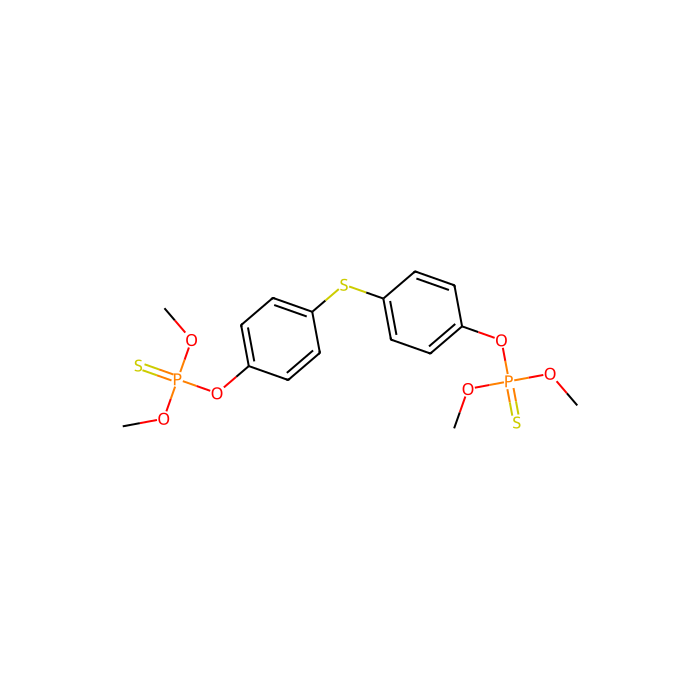
Temephos is an organophosphorothioate insecticide featuring two phosphorothioate moieties tethered to a central thioether-bridged para-phenylene unit (a para–phenylenethiobis core). Functionally, it contains dialkyl phosphorothioate esters and aryl–thioether linkages.
Structural description (2D):
Identity notes:
All item-specific identifiers supplied with shipped material (label, CoA) should be considered authoritative for this catalog SKU (Analytical standard, Moligand™).
Temephos is not commonly used as a building block or reagent in preparative organic synthesis due to its specialized organophosphorothioate structure and toxicity profile. Accordingly, its synthetic utility in standard transformations is limited.
However, in a research context (literature):
For practical synthetic operations (e.g., as a reagent or protecting group carrier), alternative, safer phosphorus reagents (dialkyl chlorophosphates, phosphoramidites, H-phosphonates) are strongly preferred. For uses centered on analysis, see Reaction & Applications and Application Protocols.
Not applicable. This product is a small-molecule analytical standard, not a biological targeting reagent (e.g., antibody, enzyme inhibitor supplied for bioassays with defined selectivity claims). No antigen/epitope, clone, isotype, or species reactivity data are relevant.
Our grade selection guide covers purity, stabilizer status, and application suitability for all variants in our catalog.
View Analytical standard grade guide → View Moligand™ grade guide →