Determine the necessary mass, volume, or concentration for preparing a solution.
≥99% for sensitive chromatographic and analytical workflows requiring minimal baseline interference.
Store at -80°C Ships Dry ice packs + Cold packs Check lot-specific COA for exact specifications.
SDS, COA, datasheet, and spec sheet available for download. Lot-specific COA accessible via lot number lookup.
Cited in 0 peer-reviewed publications across chromatography, organic synthesis, and cross-coupling reactions.
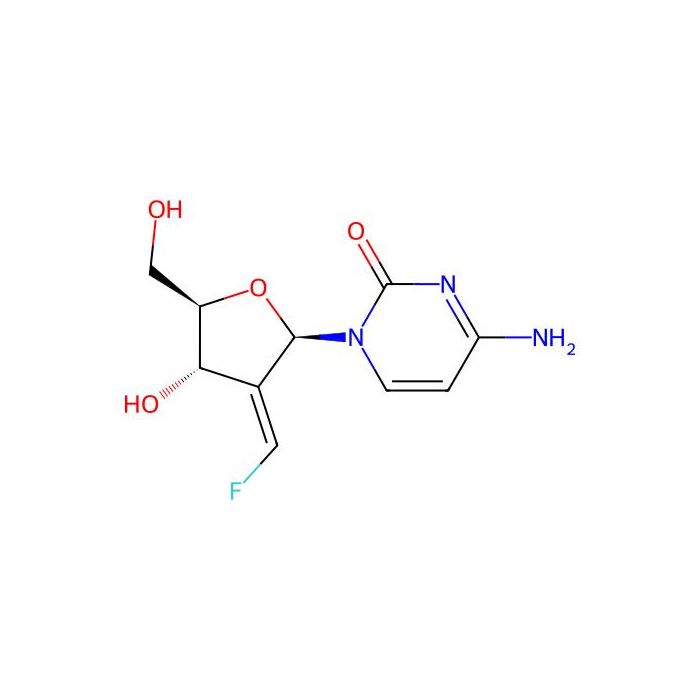
Tezacitabine is a cytostatic and cytotoxic antimetabolite and a nucleoside analogue . Tezacitabine irreversibly inhibits the ribonucleotide reductase and interferes with DNA replication and repair . Tezacitabine effectively induces cells apoptotic . Tezacitabine has the potential for leukemias and solid tumors (carcinomas) treatment
In Vitro
Tezacitabine (0.01-10 µM; 24 hours; CCRF-SB, KG-1, Jurkat, COLO-205, MCF-7 and PC-3 cells) treatment induces the G1 and S-phase leaky block of the cell cycle. Tezacitabine (0.01-10 µM; 24 hours; CCRF-SB, KG-1, Jurkat, COLO-205, MCF-7 and PC-3 cells) treatment apoptotic death of cells by the caspase 3/7 pathway in a concentration-dependent manner. Tezacitabine has strong cytostatic and cytotoxic properties. Cytotoxic effect of Tezacitabine reveals not only as apoptosis, but also as a change in protein metabolism. MCE has not independently confirmed the accuracy of these methods. They are for reference only. Cell Cycle AnalysisCell Line: CCRF-SB, KG-1, Jurkat, COLO-205, MCF-7 and PC-3 cells Concentration: 0.01 µM, 0.1 µM, 1.0 µM, and 10 µM Incubation Time: 24 hours Result: Induced the G1 (at concentrations higher than 10 nM) and S-phase (at low concentration) leaky block of the cell cycle. Apoptosis AnalysisCell Line: CCRF-SB, KG-1, Jurkat, COLO-205, MCF-7 and PC-3 cells Concentration: 0.01 µM, 0.1 µM, 1.0 µM, and 10 µM Incubation Time: 24 hours Result: Induced apoptotic death of cells by the caspase 3/7 pathway in a concentration-dependent manner.
In Vivo
Tezacitabine (100 mg/kg; intraperitoneal injection; daily; female nude mice) treatment inhibits tumor growth in HCT 116 tumor xenografts. MCE has not independently confirmed the accuracy of these methods. They are for reference only. Animal Model: Female nude mice (7-9-week-old) injected with HCT 116 cellsDosage: 100 mg/kg Administration: Intraperitoneal injection; daily; 14 days Result: Inhibited tumor growth in HCT 116 tumor xenografts.
Form:Solid
IC50& Target:Ribonucleotide reductase
| Canonical Smiles | C1=CN(C(=O)N=C1N)C2C(=CF)C(C(O2)CO)O |
|---|---|
| IUPAC Name | 4-amino-1-[(2R,3E,4S,5R)-3-(fluoromethylidene)-4-hydroxy-5-(hydroxymethyl)oxolan-2-yl]pyrimidin-2-one |
| InChIKey | GFFXZLZWLOBBLO-ASKVSEFXSA-N |
| INCHI | 1S/C10H12FN3O4/c11-3-5-8(16)6(4-15)18-9(5)14-2-1-7(12)13-10(14)17/h1-3,6,8-9,15-16H,4H2,(H2,12,13,17)/b5-3+/t6-,8+,9-/m1/s1 |
| Isomeric SMILES | C1=CN(C(=O)N=C1N)[C@H]2/C(=C/F)/[C@@H]([C@H](O2)CO)O |
| Alternate CAS | 130306-02-4,171233-40-2,171176-43-5 |
| PubChem CID | 6435808 |
| MeSH Entry Terms | 2'-deoxy-2'-(fluoromethylene)cytidine;MDL 101,731;MDL 101731;MDL-101,731;MDL-101731;tezacitabine |
| Molecular Weight | 257.22 |
Comprehensive hazard, handling, storage, and regulatory compliance document.
Download SDS →Lot-specific quality data. Enter your lot number to retrieve the exact COA.
Look up COA →Full quality attributes and acceptance criteria for this grade.
View spec sheet →Taxonomy Tree
| Kingdom | Organic compounds |
|---|---|
| Superclass | Organoheterocyclic compounds |
| Class | Diazines |
| Subclass | Pyrimidines and pyrimidine derivatives |
| Intermediate Tree Nodes | Not available |
| Direct Parent | Pyrimidones |
| Alternative Parents | Aminopyrimidines and derivatives Hydropyrimidines Imidolactams Tetrahydrofurans Heteroaromatic compounds Secondary alcohols Vinyl fluorides Azacyclic compounds Oxacyclic compounds Fluoroalkenes Organic oxides Hydrocarbon derivatives Organofluorides Organopnictogen compounds Primary alcohols Primary amines |
| Molecular Framework | Aromatic heteromonocyclic compounds |
| Substituents | Aminopyrimidine - Pyrimidone - Hydropyrimidine - Imidolactam - Tetrahydrofuran - Heteroaromatic compound - Secondary alcohol - Vinyl fluoride - Vinyl halide - Oxacycle - Haloalkene - Fluoroalkene - Azacycle - Hydrocarbon derivative - Organic oxide - Organopnictogen compound - Primary amine - Primary alcohol - Organooxygen compound - Organonitrogen compound - Organofluoride - Alcohol - Amine - Organic nitrogen compound - Organic oxygen compound - Organohalogen compound - Aromatic heteromonocyclic compound |
| Description | This compound belongs to the class of organic compounds known as pyrimidones. These are compounds that contain a pyrimidine ring, which bears a ketone. Pyrimidine is a 6-membered ring consisting of four carbon atoms and two nitrogen centers at the 1- and 3- ring positions. |
| External Descriptors | Not available |
| Solubility | DMSO : 200 mg/mL (777.54 mM; Need ultrasonic) H2O : 200 mg/mL (777.54 mM; Need ultrasonic) |
|---|---|
| Molecular Weight | 257.220 g/mol |
| XLogP3 | -2.300 |
| Hydrogen Bond Donor Count | 3 |
| Hydrogen Bond Acceptor Count | 5 |
| Rotatable Bond Count | 2 |
| Exact Mass | 257.081 Da |
| Monoisotopic Mass | 257.081 Da |
| Topological Polar Surface Area | 108.000 Ų |
| Heavy Atom Count | 18 |
| Formal Charge | 0 |
| Complexity | 448.000 |
| Isotope Atom Count | 0 |
| Defined Atom Stereocenter Count | 3 |
| Undefined Atom Stereocenter Count | 0 |
| Defined Bond Stereocenter Count | 1 |
| Undefined Bond Stereocenter Count | 0 |
| The total count of all stereochemical bonds | 1 |
| Covalently-Bonded Unit Count | 1 |