
Determine the necessary mass, volume, or concentration for preparing a solution.
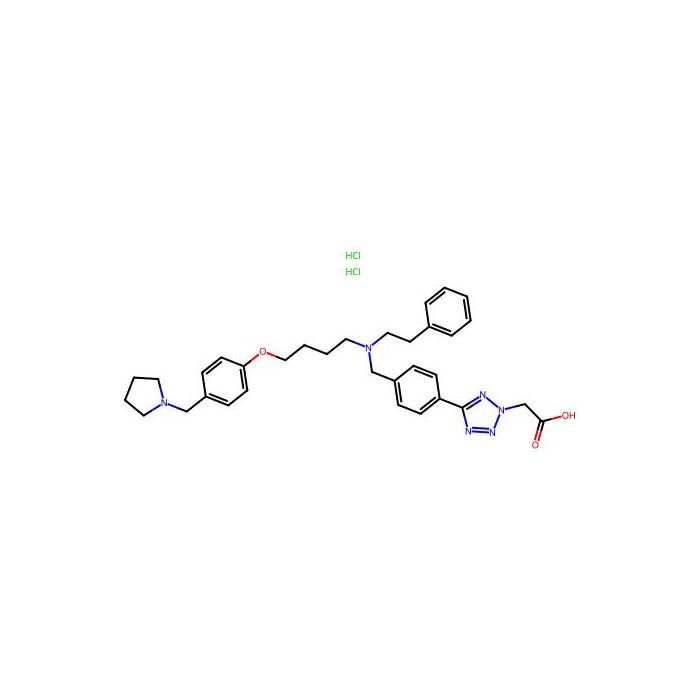
TH1834 dihydrochloride - ≥99% , CAS No.2108830-09-5
AVAILABLE TO ORDER
GRADE & PURITY ≥99%
Storage
Store at 2-8°C,Desiccated
Shipped In
Wet ice
≥99% for sensitive chromatographic and analytical workflows requiring minimal baseline interference.
Store at 2-8°C,Desiccated Ships Wet ice Check lot-specific COA for exact specifications.
SDS, COA, datasheet, and spec sheet available for download. Lot-specific COA accessible via lot number lookup.
Cited in 0 peer-reviewed publications across chromatography, organic synthesis, and cross-coupling reactions.
TH1834 dihydrochloride is a specific Tip60 (KAT5) histone acetyltransferase inhibitor. TH1834 dihydrochloride induces apoptosis and increases DNA damage in breast cancer. TH1834 dihydrochloride does not affect the activity of related histone acetyltransferase MOF. Anticancer activity.
In Vitro
TH1834 dihydrochloride (0-500 μM; 1 hour; MCF7 cells) treatment significantly reduces the viability of MCF7 cells. TH1834 dihydrochloride (0-500 μM; 1 hour; MCF7 cells) treatment highly significant increase in cytotoxicity. TH1834 dihydrochloride (500 μM; 1 hour; MCF7 cells) treatment induces caspase 3 activation in MCF7 cells. TH1834 dihydrochloride significantly inhibits Tip60 activity in vitro and treating cells with TH1834 results in apoptosis and increased unrepaired DNA damage in breast cancer. MCE has not independently confirmed the accuracy of these methods. They are for reference only. Cell Viability AssayCell Line: MCF7 cells Concentration: 0 μM, 0.5 μM, 5 μM, 50 μM and 500 μM Incubation Time: 1 hour Result: Significantly reduced the viability of MCF7 cells. Cell Cytotoxicity AssayCell Line: MCF7 cells Concentration: 0 μM, 0.5 μM, 5 μM, 50 μM and 500 μM Incubation Time: 1 hour Result: Highly significant increase in cytotoxicity at all concentrations used. Western Blot AnalysisCell Line: MCF7 cells Concentration: 500 μM Incubation Time: 1 hour Result: Marked caspase 3 activation was observed in MCF7 cells in an independent assay.
Form:Solid
| Canonical Smiles | C1CCN(C1)CC2=CC=C(C=C2)OCCCCN(CCC3=CC=CC=C3)CC4=CC=C(C=C4)C5=NN(N=N5)CC(=O)O.Cl.Cl |
|---|---|
| IUPAC Name | 2-[5-[4-[[2-phenylethyl-[4-[4-(pyrrolidin-1-ylmethyl)phenoxy]butyl]amino]methyl]phenyl]tetrazol-2-yl]acetic acid;dihydrochloride |
| InChIKey | HYXIFSOROZPMMU-UHFFFAOYSA-N |
| INCHI | 1S/C33H40N6O3.2ClH/c40-32(41)26-39-35-33(34-36-39)30-14-10-28(11-15-30)25-38(22-18-27-8-2-1-3-9-27)21-6-7-23-42-31-16-12-29(13-17-31)24-37-19-4-5-20-37;;/h1-3,8-17H,4-7,18-26H2,(H,40,41);2*1H |
| Isomeric SMILES | C1CCN(C1)CC2=CC=C(C=C2)OCCCCN(CCC3=CC=CC=C3)CC4=CC=C(C=C4)C5=NN(N=N5)CC(=O)O.Cl.Cl |
| PubChem CID | 91826511 |
| Molecular Weight | 641.63 |
Comprehensive hazard, handling, storage, and regulatory compliance document.
Download SDS →Lot-specific quality data. Enter your lot number to retrieve the exact COA.
Look up COA →Full quality attributes and acceptance criteria for this grade.
View spec sheet →Taxonomy Tree
| Kingdom | Organic compounds |
|---|---|
| Superclass | Organoheterocyclic compounds |
| Class | Azoles |
| Subclass | Tetrazoles |
| Intermediate Tree Nodes | Not available |
| Direct Parent | Phenyltetrazoles and derivatives |
| Alternative Parents | Alpha amino acids and derivatives Phenethylamines Phenylmethylamines Phenoxy compounds Phenol ethers Benzylamines Alkyl aryl ethers Aralkylamines N-alkylpyrrolidines Heteroaromatic compounds Trialkylamines Amino acids Monocarboxylic acids and derivatives Carboxylic acids Azacyclic compounds Carbonyl compounds Hydrocarbon derivatives Hydrochlorides Organic oxides |
| Molecular Framework | Aromatic heteromonocyclic compounds |
| Substituents | Phenyltetrazole - Alpha-amino acid or derivatives - Phenethylamine - Phenoxy compound - Phenol ether - Phenylmethylamine - Benzylamine - Alkyl aryl ether - Aralkylamine - Monocyclic benzene moiety - Benzenoid - N-alkylpyrrolidine - Heteroaromatic compound - Pyrrolidine - Tertiary amine - Tertiary aliphatic amine - Amino acid - Amino acid or derivatives - Azacycle - Carboxylic acid derivative - Carboxylic acid - Ether - Monocarboxylic acid or derivatives - Amine - Organic oxygen compound - Carbonyl group - Organic nitrogen compound - Hydrocarbon derivative - Organic oxide - Organonitrogen compound - Organooxygen compound - Hydrochloride - Aromatic heteromonocyclic compound |
| Description | This compound belongs to the class of organic compounds known as phenyltetrazoles and derivatives. These are compounds containing a phenyltetrazole skeleton, which consists of a tetrazole bound to a phenyl group. |
| External Descriptors | Not available |
| Solubility | H2O : 100 mg/mL (155.85 mM; Need ultrasonic) DMSO : ≥ 100 mg/mL (155.85 mM) |
|---|