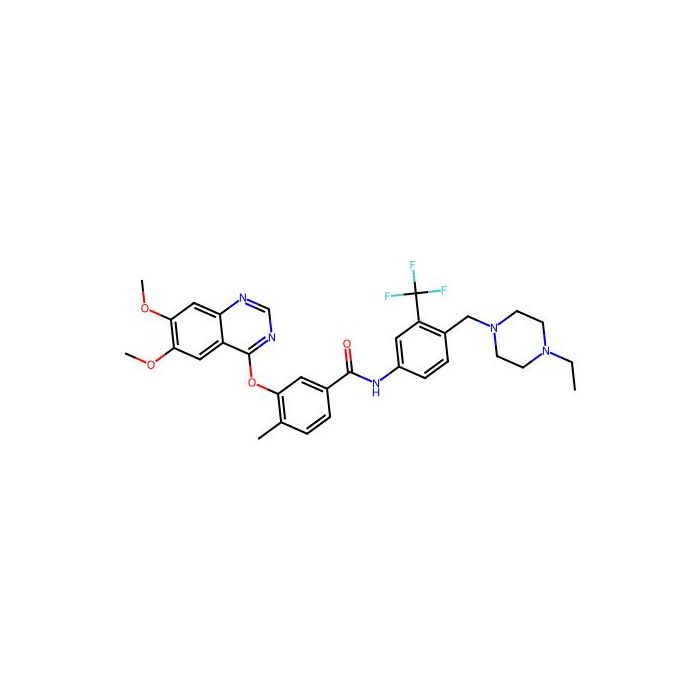
10mM in DMSO for sensitive chromatographic and analytical workflows requiring minimal baseline interference.
🌡
Storage & shipping
Store at -80°C Ships Dry ice packs + Cold packs Check lot-specific COA for exact specifications.
📋
Quality documents
SDS, COA, datasheet, and spec sheet available for download. Lot-specific COA accessible via lot number lookup.
📚
Literature proof
Cited in 0 peer-reviewed publications across chromatography, organic synthesis, and cross-coupling reactions.
Overview
TL02-59 is an orally active, selective Src-family kinase Fgr inhibitor with an IC 50 of 0.03 nM. TL02-59 inhibits Lyn and Hck with IC 50 s of 0.1 nM and 160 nM, respectively. TL02-59 potently suppresses acute myelogenous leukemia (AML) cell growth
In Vitro
TL02-59 (0.1-1000 nM; 6 hours) potently inhibits Fgr autophosphorylation in TF-1 cells, with paritial inhibition at 0.1-1 nM and complete inhibition above 10 nM. Hck, Lyn and Flt3 are inhibited in the 100 to 1000 nM range. TL02-59 inhibits the growth and induced apoptosis of AML cell lines expressing this kinase with single-digit nM potency. TL02-59 induces growth arrest in primary AML bone marrow samples. MCE has not independently confirmed the accuracy of these methods. They are for reference only. Western Blot AnalysisCell Line: TF-1 myeloid cells Concentration: 0.1, 1, 10, 100, 1000 nM Incubation Time: 6 hours Result: Inhibited Fgr autophosphorylation in TF-1 cells.
In Vivo
TL02-59 (oral administration; 1 and 10 mg/kg; for three weeks) completely eliminates AML cells from the spleen and peripheral blood in a mouse model of AML, while dramatically suppressing bone marrow involvement . TL02-59 has a t 1/2 of 5.7 h by i.v injection and 6.5 h by p.o. administration, respectively . MCE has not independently confirmed the accuracy of these methods. They are for reference only. Animal Model: NOD.Cg-Prkdc scid Il2rg tm1Wjl /SzJ (NSG) mice with human MV4-11 AML cells Dosage: 1 and 10 mg/kg Administration: Oral; for three weeks Result: Eliminated AML cells from the spleen and peripheral blood in a mouse model of AML, while dramatically suppressing bone marrow involvement.
TL02-59 is an orally active, selective Src-family kinase Fgr inhibitor with an IC 50 of 0.03 nM. TL02-59 inhibits Lyn and Hck with IC 50 s of 0.1 nM and 160 nM, respectively. TL02-59 potently suppresses acute myelogenous leukemia (AML) cell growth.
Storage
Store at -80°C
Shipped In
Dry ice packs + Cold packs
This product requires cold chain shipping. Ground and other economy services are not available.
Determine the necessary mass, volume, or concentration for preparing a solution.
Dilution Calculator
Determine the dilution needed to prepare a stock solution.
Reconstitution Calculator
Reviews
Customer Reviews
Application Protocols
No tested application protocols are provided for this item. The following are general, non-item-specific workflows commonly used for small-molecule screening compounds.
Stock preparation:
Dissolve TL02-59 in anhydrous DMSO to 10 mM (or as solubility allows). Vortex and, if needed, gently warm (<40°C) briefly. Filter through 0.22 μm PTFE if particulates persist.
Aliquot into low-bind tubes or 384-well source plates to minimize freeze–thaw.
Assay dilution:
Prepare serial dilutions in DMSO (e.g., 1:3 or 1:2) and transfer to assay buffer to achieve the desired top concentration while keeping final DMSO at 0.1–0.5% v/v.
Controls:
Include vehicle controls matching final DMSO. If applicable, include detergent controls (0.01% Tween-20) to check for aggregation artifacts and spectral controls for optical interference.
Storage of working solutions:
Store master DMSO stocks at −80°C (per item storage guidance) in aliquots. Short-term working plates can be held at −20°C in desiccated conditions. Avoid repeated freeze–thaw.
QC:
Verify concentration by UV (if chromophore is known) or gravimetry/qNMR; confirm integrity by LC–MS before and after assays.
Note: These are general practices; adapt to your assay’s sensitivity, readout modality, and institutional SOPs.
Biological Roles
Item-specific biological function or target engagement for TL02-59 is not provided in the Product Data.
Endogenous role: None indicated. As a catalog screening compound, TL02-59 is not described as a natural metabolite or cofactor.
Mechanism/target: Not specified for this item; refer to literature searches keyed to CAS 1315330-17-6 or CID 71254350 if available.
General considerations for biological studies (non-item-specific):
Assay design: Start with a concentration-response design (e.g., 8–12 points, half-log spacing) with a maximum DMSO of 0.1–0.5% v/v in the assay well.
Interference mitigation: Evaluate potential for fluorescence or absorbance overlap with assay readouts; run no-enzyme/no-cell and vehicle controls; include detergent (e.g., 0.01% Tween-20) to check for aggregation artifacts when appropriate.
Stability in biological media: Test for hydrolysis/oxidation by incubating in assay buffer or cell culture media and monitoring by LC–MS over time.
Nonspecific binding: Assess adsorption to plastics/serum proteins; consider low-bind plates and protein-free buffers for biochemical assays.
Caveat: No medical, diagnostic, or therapeutic use is implied. All work should be conducted under institutional biosafety approvals and guided by the SDS/CoA for this specific item.
Buffer Applications
TL02-59 is a small-molecule screening compound and is not itself a buffering agent. Therefore, classic buffer-system guidance (pKa, buffering ranges, recipe formulations) is not applicable to this product.
Practical notes for assay buffers (general, non-item-specific):
Vehicle control: Maintain consistent DMSO (or chosen vehicle) across all wells/tubes (e.g., 0.1–0.5% v/v) to isolate compound effects from solvent effects.
Surfactant use: For aggregation-prone chemotypes, a minimal nonionic surfactant (e.g., 0.01% Tween-20) may reduce false positives; verify compatibility with the assay.
Protein content: Serum proteins can bind hydrophobic compounds and shift apparent potency; compare protein-free vs protein-containing conditions when relevant.
pH: If the compound is ionizable (structure-dependent), small pH shifts can dramatically affect solubility and target engagement. Determine ionization behavior once structural information is available.
Green Alternatives
In the absence of item-specific synthesis or process context, green considerations focus on solvent choices and handling during screening and analysis (general guidance).
Comparison of common vehicles (literature/general):
DMSO
Pros: Broad solvency, low vapor pressure, widely accepted in bioassays; relatively benign compared to amide solvents.
Cons: Sulfur odor; biological membrane effects at higher %; challenging to remove by lyophilization.
Cons: Narrow solvency window; can denature proteins at modest %; flammable.
Acetonitrile
Pros: Excellent for LC; low UV cut-off.
Cons: Toxicity and disposal considerations; petroleum-derived.
Water with minimal cosolvent
Pros: Ideal green medium if compound solubility/assay allows.
Cons: Limited by compound hydrophobicity and ionization.
Greener practices:
Use miniaturized assay volumes and pre-plated aliquots to reduce waste.
Favor ethanol/water for cleaning over chlorinated solvents when compatible.
For preparative purification of analogs, consider ethanol/ethyl acetate/heptane systems as alternatives to acetonitrile/DMF/THF where chromatographic performance permits.
Implement closed-cap systems and solvent recycling for LC-grade acetonitrile usage.
Note: Without the structure of TL02-59, selection of green reaction media or biocatalytic routes cannot be assessed; consult the CoA or structural data to identify tailored green options.
Pharmaceutical Uses
No pharmacopeial status or excipient role is provided for TL02-59, and the product is designated for research use only.
Regulatory status: Not specified for this item; refer to CoA/Spec Sheet. Not intended for human or veterinary use.
Typical use in the lab: Investigational screening compound for discovery research, not for inclusion in finished dosage forms.
General considerations (non-item-specific):
Preformulation assessments (if translational studies are contemplated in vitro): Determine polymorph/solvate state, stability profile (thermal, oxidative, photolytic), and solubility-pH profile. These are not provided for this item and must be developed by the researcher.
Impurity controls: For any advanced research use, augment purity assessment with orthogonal techniques (qNMR, HRMS) and monitor degradation products under storage and assay conditions.
Disclaimer: No clinical, diagnostic, or therapeutic claims are made or should be inferred. TL02-59 is provided strictly for laboratory research.
Physical Properties
Item-specific physicochemical data are not disclosed in the Product Data. Where precise specifications are required, please consult the CoA/Spec Sheet for your lot.
Appearance: Not specified for this item; refer to CoA/Spec Sheet.
Molecular weight: Not specified for this item; refer to CoA/Spec Sheet.
Melting point: Not specified for this item; refer to CoA/Spec Sheet.
Boiling point: Not specified for this item; refer to CoA/Spec Sheet.
Density: Not specified for this item; refer to CoA/Spec Sheet.
Refractive index: Not specified for this item; refer to CoA/Spec Sheet.
Solubility: Not specified for this item; refer to CoA/Spec Sheet.
LogP / LogD: Not specified for this item; refer to CoA/Spec Sheet.
pKa: Not specified for this item; refer to CoA/Spec Sheet.
UV/Vis characteristics: Not specified for this item; refer to CoA/Spec Sheet.
General guidance (literature/practice, not item-specific):
Screening compounds are commonly formulated as 10–50 mM stocks in DMSO due to broad solubilizing capability and assay compatibility.
If aqueous use is required, evaluate cosolvent systems (e.g., DMSO 0.1–1% v/v in buffer), inclusion of nonionic surfactants at very low levels (e.g., 0.01% Tween-20), or pH adjustment contingent on compound ionization behavior (requires structure).
Verify solubility and stability by small-scale trials and analytical checks (HPLC/UPLC, UV, or LC–MS).
Quality & Grades
Grade/Purity: Not specified for this item; refer to CoA/Spec Sheet.
Context for screening-compound quality (general guidance):
Screening-grade small molecules are typically supplied with identity confirmation (e.g., LC–MS, HPLC purity) appropriate for HTS/HCS workflows. The exact analytical panel and acceptance criteria vary; consult the CoA for your lot.
HPLC/UPLC purity reporting: When provided, this commonly reflects UV-based area % at one or more wavelengths. Note that non-UV impurities and salts may not fully register; orthogonal methods (qNMR, HRMS) can complement purity assessment if needed.
Salt form / solvate state: If not specified, verify by LC–MS and, if critical, elemental analysis or qNMR to determine free-base vs salt content for accurate molarity preparation.
Stabilizers/inhibitors: None are specified in the Product Data. If stabilizers are present, they will be declared on the label/CoA; their presence can influence UV background and bioassay readouts.
Batch records and traceability: Retain CoA, lot number, and any spectral data for audit trails and reproducibility. For SAR or medicinal chemistry follow-up, request additional analytical data as necessary (e.g., chiral purity when stereochemistry is relevant).
Reaction & Applications
Manufacturer applications: Not provided in the Product Data for this SKU. TL02-59 is supplied as part of a small-molecule/compound library for research screening.
Research applications (general, non-item-specific):
High-throughput screening (HTS/HCS): Provision of DMSO stock plates (e.g., 10 mM) for primary screens in biochemical or cell-based assays.
Hit validation and profiling: Secondary assays, orthogonal assay formats, and counter-screens to deconvolute assay interference (fluorescence, redox cycling, aggregation). Employ PAINS/REOS filters and orthogonal analytics as appropriate.
SAR by catalog: Combine TL02-59 results with close analogs (if available) to build preliminary SAR prior to custom synthesis campaigns.
Target deconvolution workflows: If active, apply CETSA, DARTS, chemoproteomics, or affinity-based pull-downs using derivatized analogs (requires synthetic tractability; structure needed).
Practical notes:
Plate handling: Minimize freeze–thaw by aliquoting into single-use vials or source plates; store under inert atmosphere if sensitivity is suspected.
Analytical QC before screening: Confirm purity and identity (LC–MS or UPLC) to avoid false positives/negatives due to degradation.
Assay interference checks: Evaluate compound absorbance/emission in the assay windows; run detergent controls to assess aggregation. Include redox/thiol reactivity counter-screens if the chemotype suggests potential liabilities (requires structure).
Reaction Conditions
This product is not supplied as a reagent for performing named synthetic reactions, and no item-specific reactivity or catalytic behavior is provided.
General notes for handling during assay preparation (non-item-specific):
Stock solutions: Commonly prepared at 10–50 mM in anhydrous DMSO. Filter sterilization (0.22 μm PTFE) can be applied if particulate is observed; confirm no adsorption losses.
Plate preparation: Equilibrate frozen plates to room temperature in a desiccated environment before opening to prevent condensation. Mix thoroughly before dispensing to ensure homogeneity.
Stability checks: Monitor by LC–MS or UPLC at t = 0 and after assay incubation to ensure compound integrity under test conditions (buffer composition, temperature, light exposure).
If TL02-59 is to be used in chemical reactions for probe synthesis or bioconjugation, reaction conditions will depend entirely on its (undisclosed) functional groups. Establish conditions empirically based on structural information from the CoA or literature references keyed to CAS 1315330-17-6.
Safety & Handling
Safety information specific to TL02-59 is not provided in the Product Data. Treat as a research chemical of unknown hazards and consult the SDS for authoritative guidance.
GHS classification: Not specified for this item; refer to SDS.
Pictograms / Signal word / H-statements: Not specified for this item; refer to SDS.
Research use: For research use only. Not for human or veterinary use.
General laboratory precautions (good practice for screening compounds):
Engineering controls: Handle in a chemical fume hood. Avoid aerosolization during weighing or plate dispensing.
PPE: Laboratory coat, safety glasses or chemical splash goggles, and appropriate chemical-resistant gloves (e.g., disposable nitrile). Consider double-gloving for DMSO stock handling.
Avoid contact/inhalation/ingestion. Prevent exposure to skin and eyes.
Storage incompatibilities: Until specific data are known, segregate from strong oxidizers and strong acids/bases. Keep away from ignition sources and moisture as a precaution.
First aid (overview; defer to SDS): Inhalation—move to fresh air. Skin—wash with soap and water. Eyes—rinse with water for several minutes; remove contact lenses if easy. Ingestion—rinse mouth; seek medical attention in all cases of significant exposure.
Spill response: Absorb liquid spills with inert material; for solids, avoid dust generation. Dispose of waste as hazardous chemical waste in accordance with institutional and local regulations.
Analytical verification: Confirm identity and purity before biological testing to minimize unknown hazard exposure.
Solvent Selection
With no item-specific solubility data provided, start with broadly compatible solvents used for screening compounds.
Primary solvent (general best practice):
DMSO: Favored for compound libraries due to high solvency for diverse chemotypes, miscibility with water, low volatility, and wide assay compatibility up to 0.1–1% v/v in biological buffers.
Secondary options (when DMSO is suboptimal):
DMF or DMAc (greater solvency; consider cytotoxicity and extraction risks in bioassays).
Ethanol or isopropanol (volatile, easier removal; lower solvency for highly lipophilic or strongly H-bonding analytes).
Acetonitrile (analytical compatibility; limited for hydrophobes at neutral pH).
Aqueous vehicles:
For assays, prepare DMSO stocks (e.g., 10 mM), then dilute into buffer maintaining ≤0.5% DMSO final. Consider 0.01% nonionic surfactant to minimize adsorption/aggregation if assay allows.
Small comparison (literature/general):
DMSO: high solvency, low vapor pressure, assay friendly; can permeabilize cells at high %.
DMF: excellent solvency; higher toxicity; less favored in live-cell assays.
Verify solubility visually and by analytical injection (UPLC/LC–MS). If precipitation occurs upon dilution, increase DMSO carryover modestly or adjust pH if ionizable groups exist (requires knowledge of structure).
Adsorption mitigation: Use low-bind plastics or precondition wells with dilute DMSO.
Storage & Reconstitution
Item-specific conditions:
Storage temperature: Store at −80°C (per Product Data).
Appearance: Not specified for this item; refer to CoA/Spec Sheet.
Reconstitution (general guidance; not item-specific):
Solvent: Use anhydrous DMSO for initial stock solutions unless compound-specific guidance indicates otherwise.
Concentration: Prepare 10–50 mM stocks when solubility permits. If limited solubility is observed, reduce concentration or consider co-solvents (DMF, ethanol) with caution for downstream assay compatibility.
Technique: Allow vial to warm in a desiccator to avoid condensation. Add measured solvent volume, vortex, and sonicate briefly if needed. Avoid prolonged heating or exposure to light if the structure suggests photosensitivity (unknown here; exercise caution).
Storage practice:
Aliquot into single-use volumes to minimize freeze–thaw. Store tightly sealed under inert gas if oxidation is a concern (not specified; use caution as a general practice).
Working solutions: Keep at ≤−20°C for short-term use; return promptly to cold storage after dispensing. Track cumulative freeze–thaw cycles.
Stability: Not specified for this item; refer to CoA/Spec Sheet. Verify integrity periodically by LC–MS or HPLC.
Research use note: For research use only.
Structure & Identity
Brief overview: TL02-59 (SKU T656775) is a cataloged small-molecule screening compound offered as part of our small-molecule and compound library category.
Product name: TL02-59 (catalog code T656775)
CAS: 1315330-17-6
PubChem CID: 71254350
Category: Small molecules and compound libraries (research screening compound)
Molecular formula: Not specified for this item; refer to CoA/Spec Sheet.
Molecular weight: Not specified for this item; refer to CoA/Spec Sheet.
SMILES: Not specified for this item; refer to CoA/Spec Sheet.
InChIKey: Not specified for this item; refer to CoA/Spec Sheet.
Synonyms: Not specified for this item; refer to CoA/Spec Sheet.
Structural features (general note):
Item-specific functional groups, ring systems, stereochemistry, and ionization states are not provided in the Product Data. For structure-enabled workflows (e.g., docking, chemoinformatics), retrieve structure from the CoA/Spec Sheet or databases using the CAS or CID listed above.
2D structure description:
Not provided in the Product Data. If structural depiction is required for records or ELN, consult CoA/Spec Sheet or authoritative databases keyed to CAS 1315330-17-6 / CID 71254350.
Synthetic Utility
TL02-59 is offered as a screening compound within a small-molecule library and is not positioned as a general synthetic reagent or building block in the Product Data.
Functional group compatibility, reactivity, and derivatization routes cannot be discussed without structural disclosure. If synthetic elaboration or probe development is intended, obtain the structure and confirm the presence of suitable handles (e.g., amines, phenols, halides) for linker installation.
General guidance for derivative synthesis (literature/practice, not item-specific):
If a tagging or immobilization strategy is planned (e.g., for chemoproteomics), identify positions tolerant to modification via SAR or docking, and employ mild coupling chemistry (amide formation, click ligation) to preserve activity.
For analog expansion, prioritize vectors that minimally perturb key pharmacophore features (H-bond donors/acceptors, aromatic stacking motifs, basic centers) once identified by SAR.
Purification/analytics: Use UPLC–MS and, where relevant, chiral separation to control enantiopurity. Validate identity with HRMS and, if needed, 1D/2D NMR.
Conclusion: Without item-specific structure, TL02-59 should be treated primarily as a finished screening entity rather than a synthetic building block.
Target Specificity
Target/Pathway: Not specified for this item; refer to CoA/Spec Sheet or primary literature associated with CAS 1315330-17-6 / CID 71254350.
Species selectivity: Not specified for this item; refer to CoA/Spec Sheet.
Assay-validated applications: Not specified for this item; refer to CoA/Spec Sheet.
General guidance (non-item-specific):
If activity is observed in a screen, follow with orthogonal assays and counter-screens to eliminate mechanism-independent artifacts (fluorescent interference, redox cycling, aggregation, covalent promiscuity).
Use concentration-response curves, time-dependence profiling, and, when relevant, kinetic assays to define mode of action.
Apply target engagement techniques (e.g., CETSA, NanoBRET, pull-down with derivatized analogs) to substantiate specificity claims.
We use cookies to ensure the website functions properly and, where permitted, to improve your experience. You can manage your preferences at any time in Settings. Learn more in our Cookie Policy.
Shall we send you a message when we have discounts available?
Remind me later
Thank you! Please check your email inbox to confirm.
Products are supplied to verified businesses, institutions, and qualified professionals for research and development use only. Not for use in humans, animals, diagnosis, or therapy.