GRADE & PURITYMoligand™?Moligand™ — Aladdin's line of ligands and bioactive small molecules. Use for receptor, pathway, and binding studies needing defined small-molecule tools.10 mM in DMSO
Moligand™, 10 mM in DMSO Moligand™ for sensitive chromatographic and analytical workflows requiring minimal baseline interference.
🌡
Storage & shipping
Protected from light,Argon charged,Store at -80°C Ships Dry ice packs + Cold packs Check lot-specific COA for exact specifications.
📋
Quality documents
SDS, COA, datasheet, and spec sheet available for download. Lot-specific COA accessible via lot number lookup.
📚
Literature proof
Cited in 53 peer-reviewed publications across chromatography, organic synthesis, and cross-coupling reactions.
Overview
TMPD dihydrochloride, a readily oxidizable compound, is an enzymatically convert redox active substrate molecule. TMPD dihydrochloride is also an electron donor and serves as a reducing cosubstrate for heme peroxidases . TMPD dihydrochloride is also a complex IV substrate.
Specifications
Specifications & Purity
Moligand™, 10 mM in DMSO
Storage
Protected from light,Argon charged,Store at -80°C
Shipped In
Dry ice packs + Cold packs
This product requires cold chain shipping. Ground and other economy services are not available.
Grade
Moligand™
Names and Identifiers
Isomeric SMILES
CN(C)C1=CC=C(C=C1)N(C)C.Cl.Cl
WGK Germany
3
PubChem CID
71561
Molecular Weight
237.17
Beilstein
7442241
Reaxy-Rn
5132096
Documentation
📋 Safety Data Sheet (SDS)
Comprehensive hazard, handling, storage, and regulatory compliance document.
Determine the necessary mass, volume, or concentration for preparing a solution.
Dilution Calculator
Determine the dilution needed to prepare a stock solution.
Reconstitution Calculator
Reviews
Customer Reviews
Application Protocols
No item-specific, tested application protocols or recommended dilutions are provided in the Product Data for this SKU. For general research planning, consult primary literature for protocols employing TMPD dihydrochloride as a redox mediator in:
Qualitative oxidase tests
Enzyme-coupled spectrophotometric assays
Mediated electrochemical measurements
Always adapt conditions to your system and verify performance experimentally.
Biological Roles
This product is supplied strictly for research use only. The following describes general biochemical behavior of TMPD in laboratory systems (literature/general), not physiological or clinical effects.
Redox mediator behavior:
TMPD is a small-molecule electron donor/acceptor pair via its reversible one-electron oxidation to the Wurster’s Blue radical cation. In biochemical assays, it can shuttle electrons between oxidases or redox-active proteins and molecular oxygen or electrodes.
Relevance to enzyme studies:
Frequently used to probe terminal oxidases (e.g., cytochrome c oxidase activity tests) and to accelerate electron transfer in peroxidase/laccase assay cascades by providing a rapid, diffusible mediator.
Spectroscopic marker:
The formation/decay of the blue radical cation provides a convenient kinetic handle in UV-Vis studies of redox enzymes, enabling stopped-flow or steady-state measurements of electron transfer.
pH and speciation effects:
Protonation state modulates redox potential and binding interactions with protein environments. The dihydrochloride ensures protonated starting material in neutral water, while mild alkalinity increases the fraction of neutral amine, altering reactivity.
Limitations/artifacts:
Auto-oxidation by dissolved O2 and light can complicate baseline signals; antioxidants or inert atmospheres may be needed for precise kinetic interpretations.
Note: No claims are made regarding in vivo biological roles; use only in controlled laboratory research.
Buffer Applications
TMPD dihydrochloride is not a buffering agent and is not typically used to control pH. It is generally employed as a redox mediator in aqueous buffer systems prepared from conventional buffers (e.g., phosphate, HEPES, MOPS). For practical work:
Choose a buffer with minimal absorbance in the visible region if monitoring the blue radical cation spectroscopically.
Maintain moderate ionic strength to stabilize potential and kinetics; avoid strong oxidants in the buffer.
No item-specific buffer recipes or pKa data are provided for this product; consult standard buffer references for system selection.
Green Alternatives
Consider greener or more stable mediators depending on your application and solvent system. Selection should balance EHS profile, stability, and performance.
General sustainability considerations (literature/general):
TMPD is an aromatic amine salt with air/light sensitivity; solutions may generate colored oxidative byproducts and require inert handling and cold, dark storage—factors that increase energy and waste.
Potential alternatives and trade-offs:
| Mediator (literature) | Advantages | Trade-offs vs TMPD |
| --- | --- | --- |
| ABTS (2,2′-azino-bis(3-ethylbenzothiazoline-6-sulfonic acid)) | High aqueous stability; strong visible chromophore; often used with peroxidases | Different redox potential and kinetics; may be less suitable for some oxidases; sulfonated dye waste |
| DCPIP (2,6-dichlorophenolindophenol) | Robust colorimetric redox dye; stable in buffer | Distinct E° and mechanism; may not match TMPD speed with certain enzymes |
| Ferro/ferricyanide | Air-stable, low-cost mediator couple | Cyanoferrate handling/waste considerations; spectral features differ; possible metal complexation |
| Ascorbate or NADH (bioreductants) | Benign byproducts; greener reagents | Enzyme-specific; weaker visible readout; potential side reactions |
Greener solvent choices:
Favor water or water/alcohol mixtures over chlorinated/aprotic dipolar solvents where feasible.
Process recommendations:
Prepare minimal volumes fresh; use amberware; purge with N2/Ar to reduce waste from auto-oxidation; validate lower-concentration protocols to minimize mass used.
Note: Performance equivalence must be validated experimentally for each system.
Pharmaceutical Uses
No pharmaceutical or clinical uses are specified or implied for this product. TMPD dihydrochloride is offered strictly for research use only (analytical, synthetic, or biochemical laboratory workflows).
Excipient/formulation role: Not commonly used as an excipient. No pharmacopeial monograph is cited for this item.
Manufacturing utilities (general/literature): Aromatic redox mediators like TMPD may be used in process analytics or instrumentation calibration in R&D environments, not in finished dosage forms.
Any application in regulated contexts would require independent qualification and validation; none is provided here.
Physical Properties
Only item-specific values supplied in Product Data should be considered specifications. All values below are literature/general unless explicitly noted as item-specific.
Appearance (item-specific): Not specified for this item; refer to CoA/Spec Sheet.
Less polar/aprotic solvents: limited to low–moderate (salt form is ionic).
pKa (literature): Anilinium pKa values are typically in the range 4–6 for mono-protonation; as a dihydrochloride, exists predominantly as dication in neutral water. Precise values vary with ionic strength and are not specified for this item.
Partition (logP) (literature expectation): very low for the salt (highly ionic); not specified for this item.
Radical cation (“Wurster’s Blue”): strong band in the visible (blue coloration); exact λmax depends on medium and is not specified for this item.
Density, refractive index, vapor pressure: Not specified for this item; refer to CoA/Spec Sheet.
Caution: Physical behavior is strongly redox- and pH-dependent; handle solutions under inert atmosphere and subdued light to minimize auto-oxidation.
Quality & Grades
Item-specific grade: Moligand™ (as given in Product Data). No additional specifications are provided in the Product Data for this SKU.
Interpretation (general guidance):
Moligand™ is an Aladdin designation used for small-molecule/ligand libraries intended for research screening and discovery workflows. Typical expectations for such grade include identity verification and handling controls aligned with library-quality compounds. However, absent explicit numerical specs (purity %, water, residual metals, stabilizers), no assumptions should be made for this specific item.
What this means in practice (for professional users):
For redox-mediating applications (e.g., oxidase assays, electrochemical studies), confirm suitability by reviewing the CoA/SDS and, if necessary, running a quick QC (UV-Vis of radical cation formation, HPLC area% in your solvent system).
If ultra-low UV background or trace-metal constraints are critical (e.g., kinetic spectrophotometry, catalytic studies), verify with the CoA/Spec Sheet; otherwise: Not specified for this item; refer to CoA/Spec Sheet.
Stabilizers/additives: Not specified for this item; refer to CoA/Spec Sheet.
Regulatory/packaging notes: Manufactured and shipped as a research-use-only chemical (see Research Use Note).
Reaction & Applications
Key utility of TMPD dihydrochloride lies in its fast, reversible one-electron redox chemistry. The salt form facilitates handling and dissolution for assays and electrochemical studies.
Redox mediator (literature/general):
Forms the Wurster’s Blue radical cation upon 1e− oxidation (E° depends on medium, commonly near +0.2 to +0.3 V vs NHE in water; consult primary sources for exact conditions). Serves as an efficient electron donor to oxidases (e.g., cytochrome c oxidase qualitative tests) and as a mediator for peroxidase and laccase systems.
Analytical chemistry:
Used as a chromogenic/electrochromic reagent; the blue radical cation allows rapid visual or spectroscopic readouts. Employed in enzyme-coupled assays and rapid oxidase screens (research use only).
Electrochemistry:
Benchmark reversible redox couple for testing electrodes and mediating electron transfer between redox enzymes and electrodes. Useful in mediated electron-transfer studies in aqueous or mixed solvents.
Practical tips (general):
Prepare fresh, deoxygenated solutions to control baseline; protect from light to limit photoinitiated oxidation.
Monitor oxidation state via UV-Vis (growth/decay of blue band) or cyclic voltammetry; avoid excess oxidants that irreversibly over-oxidize the diamine.
pH affects speciation and kinetics: protonated vs free-base forms exhibit different redox potentials and reactivities; maintain consistent ionic strength.
Limitations:
Air sensitivity (auto-oxidation) can confound quantitative kinetics if not controlled; competing side reactions with strong oxidants can yield intractable byproducts.
Reaction Conditions
The following are literature/general guidance ranges for research planning; they are not item-specific specifications.
Atmosphere: deoxygenated when measuring baseline; controlled O2 when oxygen is the terminal oxidant.
Electrochemistry:
Solvents: water, methanol, or acetonitrile; supporting electrolyte as appropriate (e.g., 0.1 M KCl in water or TBAPF6 in MeCN).
Working potentials: scan around the reversible 1e− couple of TMPD/Wurster’s Blue; exact E° depends on medium/ionic strength (consult primary electrochemical literature for your solvent/electrolyte).
Spectroscopy:
Monitor visible band of the radical cation for kinetic traces; use quartz cuvettes and nitrogen-purged solutions to extend lifetime.
Oxidants/reductants:
Mild oxidants (e.g., ferricyanide, enzyme-generated intermediates) produce the blue cation cleanly; strong oxidants can over-oxidize to quinonediimines/polymerized products—use stoichiometric control and short contact times.
Note: Reaction times and expected yields are highly system-dependent; validate under your exact conditions.
Safety & Handling
GHS classification, pictograms, signal word, H-statements (item-specific): Not specified for this item; refer to the SDS for authoritative safety information.
General laboratory hazards (literature/general):
Aromatic amine salts may cause irritation to skin, eyes, and respiratory tract; TMPD can auto-oxidize producing colored radicals and potentially reactive oxygen species under certain conditions.
Oxidation products may stain and can be hazardous; avoid ingestion and inhalation of dust.
PPE and engineering controls (best practice):
Wear lab coat, nitrile gloves, and safety glasses; handle solids in a fume hood to avoid dust inhalation.
Prepare solutions under inert gas and subdued light when oxidation state control is critical.
Incompatibilities and special precautions (general):
Strong oxidizers (uncontrolled reaction or rapid color change); strong bases/acids may alter redox state and speciation.
Air/light sensitivity: solutions readily turn blue on exposure to air (formation of Wurster’s Blue radical cation). Protect from light and oxygen to maintain reduced form.
Do not mix with nitrosating agents; aromatic amines can undergo nitrosation under acidic nitrosative conditions.
First-aid overview (general guidance; defer to SDS):
Skin/eye contact: Rinse with water for ≥15 minutes; remove contaminated clothing; seek medical attention if irritation persists.
Inhalation: Move to fresh air, monitor breathing, seek medical attention if symptoms occur.
Ingestion: Rinse mouth; do not induce vomiting; seek medical attention.
Waste: Collect TMPD-containing solutions as hazardous organic waste; minimize air exposure to limit oxidative byproducts; dispose according to institutional and local regulations.
Solvent Selection
TMPD dihydrochloride is an ionic aromatic amine salt; solvent choice is driven by desired redox state, solubility, and downstream assay compatibility.
Polarity and miscibility (literature/general):
Highly soluble in water and polar protic solvents (e.g., methanol, ethanol). Solubility in polar aprotics (DMF/DMSO) is moderate to good; in nonpolar solvents it is limited.
The dihydrochloride is best handled in aqueous buffers at near-neutral pH when used as an electron donor/mediator; raising pH increases the fraction of neutral amine, which can change kinetics and spectral properties.
Selection guidance:
Aqueous assays: Use deoxygenated water or buffer (pH 6.5–7.5) to minimize spontaneous oxidation; prepare fresh.
Spectroscopy: Choose solvents with low absorbance in the visible range if monitoring Wurster’s Blue; water, phosphate buffer, or methanol are typical.
Electrochemistry: Water, methanol, or acetonitrile with suitable supporting electrolyte; note that the salt enhances ionic conductivity in aqueous media.
Comparisons (general):
Versus ABTS or DCPIP: TMPD offers rapid electron transfer and a distinct blue radical cation, but is more air/light sensitive; ABTS is more stable in aqueous buffers.
Versus ferro/ferricyanide: TMPD provides strong visible color change upon single-electron oxidation and interacts well with oxidases; ferro/ferricyanide are more inert to autoxidation but can complex metals and have different spectral signatures.
Note: No solvent specification is provided for this item; optimize empirically for your system.
Storage & Reconstitution
Item-specific storage (from Product Data):
Store at −80 °C
Protected from light
Argon charged
Shipped on dry ice packs + cold packs
Item-specific reconstitution: Not specified for this item; refer to CoA/Spec Sheet.
General guidance (literature/practice; not a specification):
Prepare solutions immediately before use in deoxygenated water or buffer; protect from light to limit auto-oxidation to Wurster’s Blue.
Work under inert atmosphere (N2/Ar). If stock solutions are needed, filter-sterilize, dispense into amber, inert-gas–blanketed aliquots, and freeze; avoid repeated freeze–thaw.
Observe for color changes: blue coloration indicates oxidation; discard if baseline absorbance or performance drifts.
Stability notes (general):
The solid salt is less air-sensitive than solutions but can slowly darken upon prolonged light/air exposure; keep tightly sealed, cold, and protected from light as per item-specific instructions.
Structure & Identity
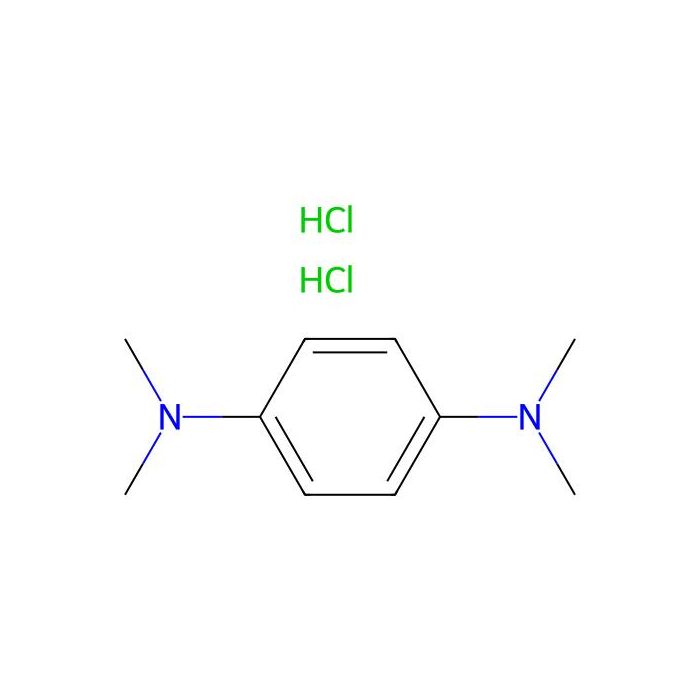
Overview: TMPD dihydrochloride is the doubly protonated salt of N,N,N′,N′-tetramethyl-p-phenylenediamine (a highly electron-rich para-phenylenediamine derivative), commonly known to form the blue radical cation (“Wurster’s Blue”) upon one-electron oxidation.
Item-specific identifiers (from Product Data)
SKU: T1500427
CAS: 637-01-4
CID: 71561
InChIKey: Not specified for this item; refer to CoA/Spec Sheet.
SMILES: Not specified for this item; refer to CoA/Spec Sheet.
Literature structural identifiers (reference/general)
Preferred name (literature): N,N,N′,N′-Tetramethyl-p-phenylenediamine dihydrochloride
Molecular formula (dihydrochloride, literature): C10H18Cl2N2
Molecular weight (literature): ~237.17 g/mol
Core scaffold: para-disubstituted benzene bearing two para-opposed dimethylamino groups (–N(CH3)2) that are protonated in the dihydrochloride salt.
Functional groups: two anilinium centers (as dihydrochloride), aromatic ring; can reversibly form a delocalized radical cation on single-electron oxidation.
2D structural description (general)
A benzene ring with –N(CH3)2 at the para positions; in the dihydrochloride, both nitrogens are protonated (–N(H)(CH3)2)+, with two counterions Cl−. The molecule is symmetric (para) and planar in the aromatic core; lone pairs on nitrogen participate in redox chemistry when deprotonated/neutral or act as anilinium centers when protonated (salt form).
Note: Exact stereochemistry is not applicable (achiral).
Synthetic Utility
From a synthetic chemistry perspective (literature/general), TMPD dihydrochloride is a valuable redox mediator and electron-rich aniline derivative.
Key functional motifs:
Para-phenylenediamine core with four N-methyl substituents; readily undergoes one-electron oxidation to a delocalized radical cation, enabling rapid outer-sphere electron transfer.
Uses in synthesis and analysis:
Mediated oxidations/reductions: Facilitates electron transfer between substrates and oxidants/catalysts (e.g., in laccase- or peroxidase-mediated oxidations in chemoenzymatic settings; research-only).
Electro-organic synthesis: Serves as a redox shuttle to improve rates/selectivity under controlled potential conditions.
Diagnostic/redox probe: Convenient visible readout allows tracking of redox events during reaction development.
Retrosynthetic/derivatization value:
Can be a precursor to quinoid species under strong oxidation; para-quinonediimine-type intermediates are accessible but may be over-oxidation pathways rather than synthetic targets.
The free base can be N-derivatized or quaternized to tune redox potential and solubility in bespoke mediator design.
Practical notes:
Maintain an inert atmosphere and subdued light to minimize background oxidation; titrate redox equivalents carefully to avoid irreversible degradation to tarry byproducts.
Target Specificity
Not applicable for this small-molecule redox mediator. No antigen, epitope, clone, isotype, or species reactivity data are relevant or provided for this product.
We use cookies to ensure the website functions properly and, where permitted, to improve your experience. You can manage your preferences at any time in Settings. Learn more in our Cookie Policy.
Shall we send you a message when we have discounts available?
Remind me later
Thank you! Please check your email inbox to confirm.
Products are supplied to verified businesses, institutions, and qualified professionals for research and development use only. Not for use in humans, animals, diagnosis, or therapy.