≥98% for sensitive chromatographic and analytical workflows requiring minimal baseline interference.
🌡
Storage & shipping
Store at -20°C Ships Ice chest + Ice pads Check lot-specific COA for exact specifications.
📋
Quality documents
SDS, COA, datasheet, and spec sheet available for download. Lot-specific COA accessible via lot number lookup.
📚
Literature proof
Cited in 0 peer-reviewed publications across chromatography, organic synthesis, and cross-coupling reactions.
Overview
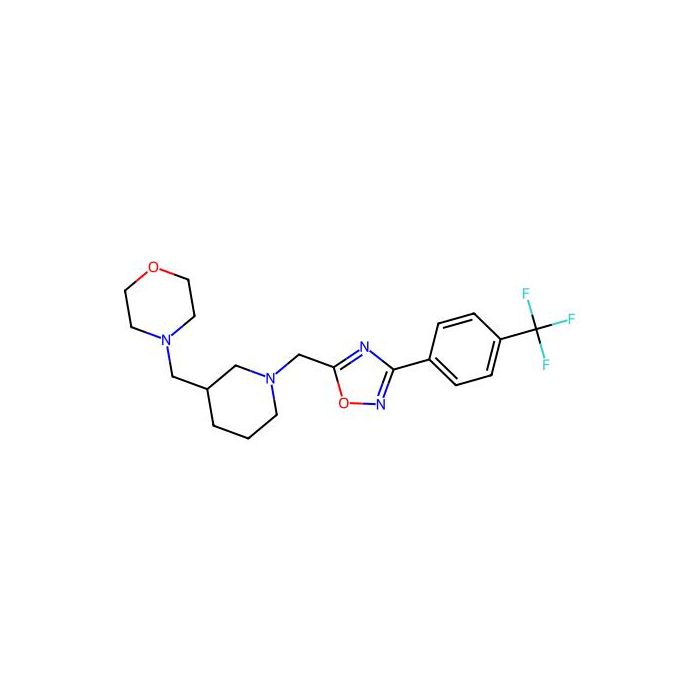
V-0219 (Compound 9) is an orally active, positive allosteric modulator (PAM) of the Glukagon-like peptide-1 receptor (GLP-1R) . V-0219 can be used for obesity-associated diabetes research
Form:Oil
IC50& Target:GLP-1R
Specifications
Specifications & Purity
≥98%
Biochemical and Physiological Mechanisms
V-0219 (Compound 9) is an orally active, positive allosteric modulator (PAM) of the Glukagon-like peptide-1 receptor (GLP-1R) . V-0219 can be used for obesity-associated diabetes research.
Storage
Store at -20°C
Shipped In
Ice chest + Ice pads
This product requires cold chain shipping. Ground and other economy services are not available.
Purity
≥98%
Names and Identifiers
Molecular Weight
410.43
Documentation
📋 Safety Data Sheet (SDS)
Comprehensive hazard, handling, storage, and regulatory compliance document.
Determine the necessary mass, volume, or concentration for preparing a solution.
Dilution Calculator
Determine the dilution needed to prepare a stock solution.
Reconstitution Calculator
Reviews
Customer Reviews
Application Protocols
Item-specific facts
No validated application protocols are provided for this item.
General screening protocol template (not item-specific)
Stock preparation: Dissolve the compound in anhydrous DMSO to 10 mM. Vortex/sonicate briefly. Filter (0.22 µm) if particulate persists.
Plate handling: Aliquot into 96/384-well source plates under low humidity; seal to prevent evaporation. Store sealed plates at −20°C when possible.
Serial dilution: Perform half-log or 3-fold serial dilutions in DMSO, then dilute into assay buffer to the desired final concentration (maintain consistent final DMSO across wells).
Controls: Include vehicle controls, known actives/inactives where applicable, and detergent-containing counterscreens to detect aggregation artifacts.
QC: Verify well identity and concentration by LC–MS spot checks on representative wells; track freeze–thaw cycles.
Adjust specifics to your assay format and always consult your institutional SOPs.
Biological Roles
Item-specific facts
No biological target, pathway, or mechanism information is provided for this item.
General considerations (not item-specific)
As an undetailed library compound, V-0219 may be deployed in phenotypic or target-based screening to uncover activity trends, but no biological role should be assumed without data.
If a structure becomes available, in silico annotations (substructure class, calculated physicochemical properties, toxicity alerts) can guide hypothesis generation. Follow up with orthogonal biochemical assays and counterscreens to exclude assay interference.
For cell-based studies, confirm cytotoxicity windows and vehicle tolerance independently; avoid extrapolations to in vivo relevance. This product is for research use only.
Buffer Applications
This product is not a buffering reagent, and no pKa/acid–base information is available for buffer design.
General handling in buffered systems (not item-specific)
Prepare concentrated DMSO stocks, then dilute into assay buffer (e.g., PBS, HEPES, or Tris) with vigorous mixing to mitigate precipitation.
Maintain final DMSO ≤1–2% v/v when possible; include 0.01–0.05% nonionic surfactant if compatible.
If the compound is weakly basic/acidic (unknown here), minor pH adjustments near its pKa can enhance solubility; confirm chemical stability versus pH before use.
Green Alternatives
Item-specific facts
No solvent or process specifics are provided for this item.
General greener handling options (not item-specific)
Stock solutions: Prefer DMSO over chlorinated solvents; DMSO is low volatility and broadly accepted in screening.
Avoid dichloromethane or benzene for routine handling; use ethyl acetate or 2-MeTHF for extractions where feasible.
Replace DMF/NMP in workups when possible with MeCN, EtOAc, or alcohols; if DMF/NMP are necessary for dissolution, minimize volumes and ensure proper waste segregation.
Comparison (general)
DMSO vs DMF: DMSO offers lower inhalation risk and is commonly tolerated in assays; DMF is more problematic toxicologically.
MeCN vs MeOH/EtOH: MeOH/EtOH are greener but may reduce solubility for very lipophilic compounds; MeCN provides stronger elution in LC.
2-MeTHF/CPME vs THF: greener ethers with improved safety profiles for extractions and certain reactions.
Document chosen solvents and concentrations to support green chemistry metrics (E-factor, PMI) in your workflows.
Pharmaceutical Uses
No excipient or pharmacopeial status is provided for this item, and it is sold strictly for research use only.
General notes (not item-specific)
In early discovery, library compounds like V-0219 are used for screening and SAR development rather than for formulation or clinical manufacturing.
If formulation studies are performed for research purposes, characterize solid form (amorphous/crystalline), salt form, and hygroscopicity, and evaluate simple enabling vehicles (captisol, PEG400, lipidic systems) strictly within preclinical research confines.
No medical, diagnostic, or therapeutic applications are claimed or supported for this product.
Physical Properties
Item-specific facts (from Product Data)
Appearance: Not specified for this item; refer to CoA/Spec Sheet.
Storage recommendation: Store at −20°C (provided).
Not specified for this item; refer to CoA/Spec Sheet
Melting point (MP): Not specified for this item; refer to CoA/Spec Sheet.
Boiling point (BP): Not specified for this item; refer to CoA/Spec Sheet.
Density: Not specified for this item; refer to CoA/Spec Sheet.
Refractive index: Not specified for this item; refer to CoA/Spec Sheet.
Solubility profile (water/organic): Not specified for this item; refer to CoA/Spec Sheet.
LogP/logD, pKa(s): Not specified for this item; refer to CoA/Spec Sheet.
General guidance (literature/practice, not item-specific)
For library compounds with unknown solubility, begin with anhydrous DMSO to prepare concentrated stocks (e.g., 10–50 mM), then perform aqueous dilution with co-solvent below 1–2% DMSO to minimize precipitation in assays.
If crystallinity or poor wettability is observed, use brief sonication and gentle warming (<40°C) to assist dissolution; avoid prolonged heating to prevent decomposition.
When the structure becomes available, estimate ionization behavior (pKa) to select between basic (e.g., 0.1 M HCl), neutral (buffer), or basic (e.g., 0.1 M NaOH) aqueous vehicles for solubility screening.
Quality & Grades
Item-specific facts
Grade/Purity: Not specified for this item; refer to CoA/Spec Sheet.
What this means in practice
For screening library members, vendors typically confirm identity (e.g., LC–MS, 1H NMR) and report purity by HPLC/UPLC at a given wavelength. Because neither the analytical method nor the threshold is provided here, request the current CoA for identity methods, solvent system, detection wavelength, and purity result.
If UV cutoff or low-UV suitability is important (e.g., LC detection at 210–220 nm), ensure the analytical method matches your application.
Trace residual solvents, water content (Karl Fischer), and salt form (free base/acid vs. TFA salt) can affect mass balance and solubility. Confirm on the CoA.
Stabilizers and form
Stabilizer/antioxidant and specific form (neat vs. salt, hydrate/solvate) are not specified for this item; refer to CoA/Spec Sheet.
For regulated uses or quantitation, consider in-house verification (orthogonal LC–MS, qNMR) prior to deployment in screening campaigns.
Reaction & Applications
Item-specific application note
Manufacturer Applications: Not specified for this item.
General research uses for library members (not item-specific)
High-throughput screening (HTS) and fragment/lead discovery in biochemical or cell-based assays.
Assay development and validation as a non-specific chemical probe or negative control, once behavior is characterized.
Physicochemical profiling: kinetic solubility, logD, pKa, permeability, and stability in microsomes/hepatocytes (if relevant to your project).
Practical tips
Prepare a master DMSO stock (e.g., 10 mM), verify by LC–MS, and aliquot to avoid freeze–thaw cycles.
Track plate maps and compound IDs meticulously (CAS 878453-71-5, SKU V649961) to prevent misannotation.
If the structure is disclosed later, integrate substructure alerts (PAINS/REOS/aggregators) to contextualize screening hits and implement counter-screens (e.g., detergent sensitivity, redox interference, fluorescence artifacts).
In the absence of a disclosed target or chemical class, initial deployments should emphasize orthogonal assay confirmation and artifact control.
Reaction Conditions
No reaction conditions are specified for this item. As the chemical structure and functional groups are not provided, there is no reliable basis for recommending synthetic conditions.
General guidance (not item-specific)
If you obtain the structure and plan chemical modifications, match conditions to the functional groups present (e.g., amide couplings with HATU/EDC; Suzuki couplings for aryl boronates/halides; click chemistry for azide/alkyne pairs).
Verify stability under heat, base/acid, and common catalytic environments on milligram scale before scale-up. Employ LC–MS to monitor conversion and impurity profiles.
For purification, choose methods compatible with the compound’s polarity and stability (normal-phase, reverse-phase, or crystallization) and record solvent systems to facilitate reproducibility.
Safety & Handling
Item-specific hazard data
Signal Word: Not specified for this item; refer to SDS.
H-Statements: Not specified for this item; refer to SDS.
GHS Classification/Pictograms: Not specified for this item; refer to SDS.
General laboratory precautions (not item-specific; defer to SDS)
Handle in a fume hood with appropriate PPE: lab coat, safety glasses, and nitrile gloves. Avoid inhalation of dust/vapors and contact with skin/eyes.
Unknown reactivity: segregate from strong oxidizers, strong acids/bases, and reducing agents until incompatibilities are known.
Avoid open flames and sources of ignition if the compound is volatile or contains flammable functional groups (unknown here—exercise caution).
First aid (general): on skin contact, wash with soap/water; eye contact, rinse with water for ≥15 min and seek medical attention; inhalation, move to fresh air; ingestion, rinse mouth—seek medical attention. Always follow your institution’s EH&S policies.
Waste disposal: Collect as organic hazardous waste unless the SDS indicates a specialized stream. Label containers clearly with CAS and SKU.
Always consult the product-specific SDS for authoritative hazard, toxicity, and exposure limit information before use.
Solvent Selection
Item-specific facts
No solvent recommendations are provided for this item; refer to CoA/Spec Sheet.
General strategy for small-molecule library compounds (not item-specific)
Primary stock solvent: DMSO is preferred due to high polarity, broad solvency, low volatility, and assay compatibility at ≤1–2% v/v.
Secondary solvents for recalcitrant analytes: DMF, NMP, or mixtures with MeCN, MeOH, or EtOH. For hydrophobic compounds, add a co-solvent (PEG-400, propylene glycol) or employ cosolvent–buffer blends.
Aqueous work: After making a concentrated DMSO stock, dilute into assay buffer with vigorous mixing to reduce precipitation. Include nonionic surfactant (e.g., 0.01–0.05% Tween 20) if compatible with the assay to aid dispersion.
Chromatography: choose MeCN/H2O or MeOH/H2O with a volatile buffer (ammonium formate/acetate) for LC–MS compatibility.
Because no structure is provided, verify solubility empirically and document the final vehicle used in assays.
Storage & Reconstitution
Item-specific facts (from Product Data)
Storage Conditions: Store at −20°C.
Shipping: Ice chest + ice pads.
Not specified for this item; refer to CoA/Spec Sheet
Hydration state/salt form, stabilizers, and exact reconstitution solvent are not specified.
General guidance (not item-specific)
Upon receipt: Allow the sealed container to equilibrate to room temperature before opening to prevent moisture condensation.
Reconstitution: For small-molecule library members, prepare concentrated DMSO stocks (e.g., 10–50 mM) in clean, dry vials. If needed, gently warm (<40°C) and sonicate to aid dissolution. Record final concentration and solvent.
Aliquoting: Dispense into single-use aliquots to avoid repeated freeze–thaw. Store aliquots at −20°C (or as per CoA) and protect from light if chromophores are suspected.
Stability: Without item-specific data, perform a small stability check (freeze–thaw, short-term bench exposure, and 1–2 week storage LC–MS) before committing to large experiments.
For authoritative stability limits and reconstitution solvents specific to this lot, consult the product CoA and SDS.
Structure & Identity
Item-specific facts (from Product Data)
SKU: V649961
Product Name: V-0219
CAS: 878453-71-5
Category: Small-molecule/compound library member (research use only)
Not specified for this item; refer to CoA/Spec Sheet
Molecular formula: Not specified for this item; refer to CoA/Spec Sheet.
Molecular weight: Not specified for this item; refer to CoA/Spec Sheet.
SMILES: Not specified for this item; refer to CoA/Spec Sheet.
InChI / InChIKey: Not specified for this item; refer to CoA/Spec Sheet.
Stereochemistry/functional groups: Not specified for this item; refer to CoA/Spec Sheet.
General notes
Without a disclosed structure, downstream properties (pKa, logP, H-bonding profile) and chemical class cannot be inferred. For structure-dependent decisions (assay design, solubility strategy, stability risk), please request the latest CoA/SDS or structural disclosure from Aladdin Scientific support.
Synthetic Utility
Without a disclosed structure, functional group–specific reactivity and named-reaction participation cannot be described for this item.
General considerations (not item-specific)
If V-0219 is to be derivatized or immobilized for probe development, obtain structural information to plan handles for coupling (e.g., amine, carboxyl, halide, alkyne/azide) and assess synthetic feasibility.
For SAR expansion, confirm the compound’s chemotype, then design vectors that tolerate substitution without abolishing activity; validate via parallel synthesis and rapid LC–MS QC.
Absent structural data, treat the compound as a finished screening entity rather than a building block.
Target Specificity
Item-specific facts
No target, epitope, or selectivity profile is provided for this item.
Given the lack of disclosed biological target information, treat V-0219 as an unannotated small molecule for exploratory screening. Implement broad counterscreens to identify assay interference or nonspecific effects before drawing conclusions about specificity.
Frequently Asked Questions
What is the purity of this product?
This product is supplied at ≥98% purity (chemical assay). Lot-specific values are stated on the Certificate of Analysis.
How should this product be stored?
Store at ?20 °C. Freezer storage is required to maintain the specified shelf life.
How is this product shipped?
This product ships in an insulated container with ice pads. Unpack on arrival and transfer it to the storage condition stated above.
What are the CAS number, molecular formula and molecular weight?
The CAS Number is 878453-71-5, the molecular formula is C20H25F3N4O2, and the molecular weight is 410.43 g/mol.
What documentation is provided?
Available product documentation, including Certificates of Analysis (COA), Safety Data Sheets (SDS), and specification sheets, is shown in the product document area. Document availability and access follow the current site policy.
We use cookies to ensure the website functions properly and, where permitted, to improve your experience. You can manage your preferences at any time in Settings. Learn more in our Cookie Policy.
Shall we send you a message when we have discounts available?
Remind me later
Thank you! Please check your email inbox to confirm.
Products are supplied to verified businesses, institutions, and qualified professionals for research and development use only. Not for use in humans, animals, diagnosis, or therapy.