Determine the necessary mass, volume, or concentration for preparing a solution.
Dilution Calculator
Determine the dilution needed to prepare a stock solution.
Reconstitution Calculator
Reviews
Customer Reviews
Application Protocols
No assay protocols are specified for this item. As a small-molecule monomer/reagent, usage is highly method-dependent.
General starting points (literature guidance; adjust to your system):
Cyclic voltammetry standard:
Prepare ~1 mM Vinylferrocene in dry MeCN with 0.1 M TBAPF6; use glassy carbon working electrode, Pt counter, Ag/AgCl reference; scan 0–0.8 V to observe Fc/Fc+ redox.
Test radical polymerization:
Dissolve Vinylferrocene (2–4 M) in toluene; add AIBN (1 mol%); degas (freeze–pump–thaw ×3); polymerize at 70 °C for 6–12 h; precipitate polymer into methanol; dry under vacuum.
Thiol–ene surface grafting:
Mix Vinylferrocene with thiol-bearing substrate and 1 wt% photoinitiator (DMPA) in acetonitrile; irradiate at 365 nm for 5–15 min under N2; rinse thoroughly with solvent to remove unreacted species.
These outlines are illustrative only. Optimize initiator loading, temperature, and solvent to match your equipment, safety constraints, and performance goals.
Biological Roles
This product is intended for research and materials science; it is not a biological metabolite or buffer component.
General (literature context):
Vinylferrocene and ferrocene derivatives are not endogenous to biological systems. Ferrocene units are widely used as redox-active tags in bioelectrochemistry due to the reversible Fc/Fc+ couple and well-defined potentials.
In biosensing, ferrocenyl labels on nucleic acids, peptides, or polymers provide electrochemical readouts in assays and interfaces; Vinylferrocene can be polymerized or thiol–ene grafted onto biomaterial surfaces to impart redox functionality.
Conjugation strategies typically involve radical thiol–ene ligation to cysteine-containing peptides, hydrosilylation on silicone-based biomaterials, or post-polymer modification of Vinylferrocene-containing copolymers.
Caveats:
No claims are made regarding biocompatibility, toxicity, or therapeutic efficacy. Any biological testing must be designed and validated by the user. Handle strictly for research use; not for use in humans or clinical diagnostics.
Buffer Applications
Vinylferrocene is a hydrophobic, neutral organometallic monomer and is not used to prepare aqueous buffer systems. It lacks acid/base functionality appropriate for buffering.
Practical note: If incorporating Vinylferrocene into biomaterials or electrochemical assays operated in buffers (e.g., PBS), introduce the ferrocenyl functionality via a compatible polymer or surface modification step, then rinse thoroughly to remove organic solvents and unreacted monomer.
Green Alternatives
While Vinylferrocene itself is the target monomer/reagent, greener choices can be made in its use and transformation.
Replace DCM/chloroform with toluene, ethyl acetate, 2-MeTHF, or cyclopentyl methyl ether (CPME) when compatible with reactivity.
Use acetonitrile or ethanol for photoinitiated thiol–ene reactions where solubility permits.
Polymerizations:
Consider bulk polymerization (solvent-free) or high-solids formulations to reduce VOCs.
RAFT or ATRP variants in greener media (e.g., aqueous emulsions with surfactants) can reduce organic solvent load if monomer dispersibility allows.
Catalysis:
For hydrosilylation, explore base-metal catalysts (Fe, Co) reported for alkene Si–H additions in place of Pt, acknowledging potential trade-offs in activity/selectivity.
Cross-metathesis: employ second-generation Ru catalysts at the lowest practical loading; recover catalysts by immobilization when possible.
Trade-offs to consider:
Ferrocene-containing polymers may challenge end-of-life recycling; design for depolymerization or reversible linkages where possible.
Switching to greener solvents can affect polymer molecular weight control and kinetics; validate with small-scale trials.
Quick comparison (qualitative):
THF vs 2-MeTHF: similar reactivity for hydroboration/polymerization; 2-MeTHF is bio-based and less volatile.
DCM vs toluene: DCM offers fast kinetics in some additions but is a chlorinated solvent; toluene is less hazardous and higher boiling, aiding conversion.
Pharmaceutical Uses
No pharmacopeial or excipient status is indicated for this item. It is supplied strictly for research use only.
General (literature context; not a claim for this item):
Ferrocenyl motifs have been explored in medicinal chemistry as redox-active scaffolds and probes; however, Vinylferrocene itself is primarily a synthetic intermediate/monomer for research materials.
In formulation science, ferrocene-containing polymers can serve as redox-responsive materials for investigative delivery systems or sensing interfaces in vitro.
User guidance:
Do not use in human or veterinary applications. For any regulated use, consult appropriate pharmacopeial monographs and regulatory guidance; none are specified for this product.
Physical Properties
Item-specific specifications:
Appearance: Not specified for this item; refer to CoA/Spec Sheet.
Grade/Purity: Not specified for this item; refer to CoA/Spec Sheet.
Storage and shipping (from Product Data):
Storage Conditions: Room temperature
Shipped In: Normal
Literature/general properties (for reference; not item-specific specs):
Physical state/color (literature): typically orange, air-stable organometallic liquid or low-melting solid depending on sample/purity.
Solubility (qualitative): soluble in common organic solvents such as hexanes, toluene, dichloromethane, THF, and chloroform; essentially insoluble in water.
Redox behavior: exhibits a reversible one-electron Fc/Fc+ couple; E1/2 typically near ~0.40–0.50 V vs Ag/AgCl (exact value depends on solvent/electrolyte).
UV–Vis (qualitative): ferrocene π–π*/d–d features in the visible lead to orange coloration; vinyl substitution slightly perturbs band positions.
Density, refractive index, bp/mp, logP, pKa: Not specified here for this item. Consult primary literature or the product’s CoA/SDS for numeric values if needed.
Notes for use:
As a redox-active alkene, the material is stable to ambient conditions but can undergo radical or cationic polymerization under initiating conditions. Ensure solvent choice is compatible with intended transformation and downstream purification.
Quality & Grades
Item-specific quality information:
Grade/Purity: Not specified for this item; refer to CoA/Spec Sheet.
Stabilizers/Inhibitors: Not specified for this item; refer to CoA/Spec Sheet.
Context and guidance:
Research-grade vinylferrocene is commonly supplied at high purity for polymerization, redox, and materials applications. If polymerization control or electroanalytical reproducibility is critical, request specifications for:
GC/HPLC purity and identity confirmation (1H/13C NMR, MS).
Residual inhibitor content (e.g., MEHQ, BHT) if any are used—these can profoundly affect radical polymerizations and should be removed (e.g., by alumina filtration) if ultra-clean initiation is needed.
Water content and non-volatile residue (NVR) for precision polymerizations.
Grades (general definitions):
“Analytical” or “AR” grade emphasizes low inorganic/organic impurities for quantitative analysis.
“Polymerization” or “Monomer” grade focuses on inhibitor profile and low peroxide content.
“Electrochemical” suitability often implies low background redox-active impurities and UV-absorbers.
Recommendation:
For use as a redox-active monomer or as a calibration/label in electrochemistry, verify inhibitor status and purity on the CoA. For chromatographic or electroanalytical applications, pre-test by cyclic voltammetry and GC to confirm background cleanliness.
Reaction & Applications
Vinylferrocene is a versatile redox-active alkene and monomer. Its ferrocene core imparts reversible electrochemistry, thermal stability, and unique electronic effects to polymers and small molecules.
Key reaction families (literature examples):
Radical polymerization to poly(vinylferrocene) and copolymers (AIBN, thermal, or photoinitiated). Provides electroactive macromolecules for charge-storage, antistatic coatings, and sensing.
Thiol–ene click additions to the terminal alkene (photoinitiated, or with radical initiators) to graft thiols onto a ferrocenyl backbone.
Hydroboration–oxidation to ferrocenylethanol derivatives; alternative oxidative workups tailor functionality (e.g., amination via Suzuki–Miyaura after further modification).
Ozonolysis/oxidative cleavage of the vinyl group to give ferrocenecarboxaldehyde (formylferrocene), a valuable intermediate for ligands and materials.
Epoxidation (peracids) and dihydroxylation (OsO4) to access oxidized derivatives useful in chiral resolution or further functionalization.
Cross-metathesis with electron-poor alkenes (Grubbs/Hoveyda catalysts) to extend the olefin handle.
Heck-type arylations (Pd catalysis) using the alkene as coupling partner to append aryl fragments onto the ferrocenyl framework.
Applications in materials science:
Redox polymers and block copolymers for charge storage and electrochromism.
Electrochemical labeling of biomaterials (through post-polymer modification), sensor interfaces, and molecular electronics.
Practical tips:
Remove radical inhibitors (if present) prior to controlled polymerizations.
Maintain inert atmosphere when radical/cationic processes are intended; oxygen commonly retards radical reactions.
Monitor redox integrity by CV; Fc/Fc+ ratio is sensitive to impurities.
Reaction Conditions
The following are literature/general conditions useful for planning workups and optimizations (not item-specific specifications):
Radical polymerization of Vinylferrocene:
Initiators: AIBN (0.5–2 mol%) or peroxide initiators.
Solvent/medium: toluene, xylene, THF, ethyl acetate, or bulk.
Temperature: 60–90 °C typical for AIBN; inert atmosphere recommended.
Notes: remove inhibitors (if present); control conversion to tune molecular weight; copolymerize with styrenics or acrylates for property tuning.
Thiol–ene additions:
Photoinitiation (365–405 nm) with Type I photoinitiators (e.g., DMPA, 0.5–2 wt%) at ambient temperature; oxygen can inhibit—degass or use nitrogen blanket.
Thermal initiation with AIBN at 60–80 °C also feasible.
Hydrosilylation:
Catalyst: Karstedt’s Pt (5–100 ppm Pt) in toluene or neat; 25–80 °C.
Alternatives: base-metal (Fe/Co) catalysts reported; may require higher loadings/temperatures.
Hydroboration–oxidation:
BH3·THF or 9-BBN in THF/2-MeTHF, 0–25 °C; oxidative workup with H2O2/NaOH affords ferrocenylethanol.
Ozonolysis of vinyl group → ferrocenecarboxaldehyde:
O3 at −78 to 0 °C in DCM/MeOH, followed by reductive workup (Me2S) or oxidative quench per target functionality.
Heck/cross-coupling (alkene partner):
Pd(OAc)2/PPh3 or preformed Pd catalysts; base (Et3N, K2CO3); DMF, DMAc, or greener polar solvents; 80–120 °C.
Electrochemistry:
Solvent: dry MeCN with 0.1 M TBAPF6; scan rate 50–200 mV/s; observe reversible Fc/Fc+ couple as internal or system probe.
Safety & Handling
Item-specific hazard data:
Signal Word: Not specified for this item; refer to SDS.
H-Statements: Not specified for this item; refer to SDS.
GHS Classification/Pictograms: Not specified for this item; refer to SDS.
General safety guidance (literature/Good Laboratory Practice; defer to SDS as authoritative):
Likely hazards: organic liquids bearing terminal alkenes are commonly flammable and may cause irritation upon contact; ferrocene derivatives are typically of low acute toxicity but should be handled as potentially harmful.
PPE: safety glasses or face shield, lab coat, and appropriate chemical-resistant gloves (e.g., nitrile). Work in a fume hood to avoid inhalation of vapors and to control solvent/initiator fumes used alongside this reagent.
Handling cautions:
Avoid sources of ignition and strong oxidizers.
Prevent unintended polymerization: do not expose to radical initiators, peroxides, or UV light unless polymerization is intended; keep away from strong acids for cationic polymerizations.
For electrochemical work, use inert atmosphere and dry solvents to ensure reproducible redox potentials.
First-aid overview:
Inhalation: move to fresh air; seek medical advice if symptoms persist.
Skin/eye contact: rinse with water for at least 15 minutes; remove contaminated clothing; obtain medical attention if irritation develops.
Ingestion: rinse mouth; do not induce vomiting; seek medical attention.
Spill/Fire response: absorb small spills with inert material; for fires use CO2, dry chemical, or foam. Water spray may be used to cool containers.
Waste: collect as halogen-free organic waste unless mixed; follow institutional and local regulations.
Solvent Selection
Vinylferrocene behaves as a hydrophobic, neutral organometallic alkene. Solvent choice is driven by the intended transformation (polymerization, addition to the double bond, cross-coupling, or electrochemistry).
Highly soluble in nonpolar to moderately polar aprotic solvents: hexane, toluene, diethyl ether, MTBE, THF, DCM, chloroform, acetonitrile.
Negligible solubility in water.
Typical selections by application:
Radical polymerization: toluene, benzene alternatives (toluene/xylene), or bulk/solution in ethyl acetate; THF for lower viscosity.
Thiol–ene photochemistry: acetonitrile, MeOH/DCM mixtures (if thiol soluble), or neat conditions; ensure oxygen control for efficient radical capture.
Hydrosilylation: toluene, xylene, or Pt-catalyst compatible silicones; sometimes neat.
Hydroboration–oxidation: THF or 2-MeTHF; aqueous workup with H2O2/NaOH.
Heck/cross-coupling to functionalize conjugated systems: DMF, DMAc, NMP, or green alternatives like Cyrene with appropriate base.
Electrochemistry: dry acetonitrile or DCM with 0.1 M supporting electrolyte (e.g., TBAPF6) for well-defined Fc/Fc+ waveforms.
Comparison notes:
THF vs 2-MeTHF: similar solvency; 2-MeTHF offers better green metrics and water immiscibility for extraction.
DCM vs toluene: DCM provides faster mass transfer but is less green; toluene affords higher boiling point for polymerizations.
Always match solvent to catalyst/initiator solubility and desired temperature profile; purge with N2/Ar as needed.
Storage & Reconstitution
From Product Data:
Storage Conditions: Room temperature
Shipped In: Normal
Item-specific stabilizers/inhibitors: Not specified for this item; refer to CoA/Spec Sheet.
General guidance (literature/best practice):
Store tightly sealed in amber glass at ambient temperature, away from direct light and sources of ignition.
If long-term storage is planned or if polymerization sensitivity is a concern, consider blanketing the headspace with inert gas (N2 or Ar) and avoiding prolonged exposure to UV light.
Keep separate from strong oxidizers and radical initiators unless in controlled use.
Reconstitution: Not applicable; the product is supplied neat. If purification from inhibitors is required, pass through a short basic alumina column immediately before use and verify by NMR/GC.
For electrochemical applications, dry over molecular sieves or distill compatible solvents; the monomer itself is generally air-stable, but rigorous dryness of the medium improves reproducibility.
Always consult the product’s CoA and SDS for definitive handling and storage instructions.
Structure & Identity
Vinylferrocene is a ferrocene derivative bearing a terminal vinyl substituent on one cyclopentadienyl ring, yielding an organometallic, redox-active alkene suited for materials chemistry and polymer science.
Item-specific identifiers from Product Data:
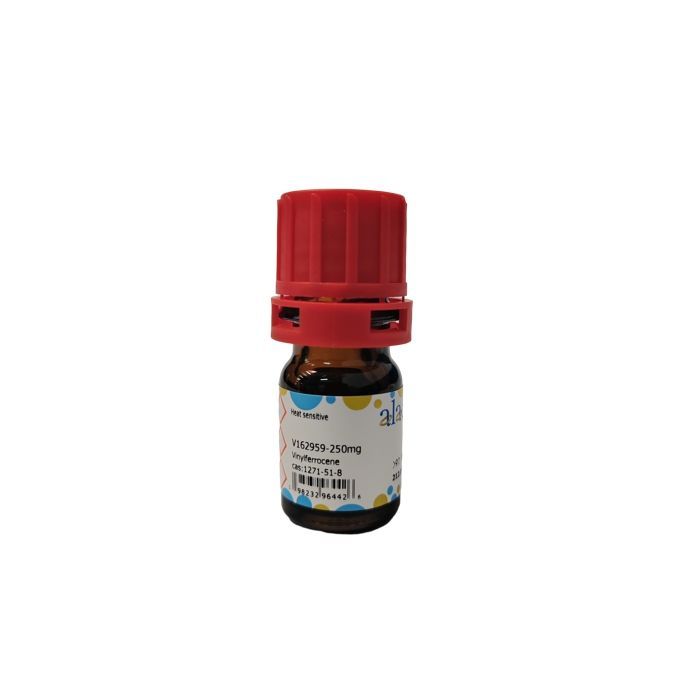
SKU: V162959
Product Name: Vinylferrocene
CAS: 1271-51-8
InChIKey: Not specified for this item; refer to CoA/Spec Sheet.
SMILES: Not specified for this item; refer to CoA/Spec Sheet.
Literature/computed identity (for reference; not item-specific specs):
Molecular formula (literature): C12H12Fe
Molecular weight (literature): ~212.07 g/mol
Core scaffold: sandwich complex with Fe(II) coordinated to two η5-cyclopentadienyl rings; one ring bears a –CH=CH2 substituent (vinyl) at a ring carbon.
Oxidation state: Fe(II) in neutral Fc (ferrocene) framework; readily oxidized reversibly to ferrocenium.
2D structural description (general):
The molecule consists of an iron center sandwiched between two parallel cyclopentadienyl rings. One ring is monosubstituted by a vinyl group (–CH=CH2), creating a terminal alkene conjugated through the Cp ring/metal system. No stereocenters are present; the alkene is terminal (no E/Z isomerism).
Transition-metal catalysis: hydrosilylation (Pt, base metals), cross-metathesis (Ru), Heck additions (Pd) as an alkene partner.
Ferrocene core (η5-Cp) imparts:
Robust thermal/air stability and reversible one-electron redox behavior.
An electron-rich arene-like platform; ring functionalization by EAS is feasible on the unsubstituted Cp ring, enabling orthogonal substitution patterns (e.g., acylation, lithiation–electrophile trapping).
Retrosynthetic value:
Vinylferrocene serves as a convergent handle to access:
Ferrocenyl alcohols/amines via hydroboration → oxidation or hydroamination sequences.
Ferrocenecarboxaldehyde via ozonolysis/oxidation of the vinyl group (analogous to styrene → benzaldehyde), a key intermediate for ligands and further derivatization (e.g., Schiff bases, phosphines).
Redox-active polymers through controlled radical polymerization (e.g., RAFT) or post-polymer modification after copolymerization with comonomers.
Synthesis planning tips:
Use the alkene for rapid diversification while preserving the ferrocene core; select conditions that avoid over-oxidation to ferrocenium unless desired.
For multi-step routes, leverage orthogonality: perform alkene transformations first, then execute EAS/lithiation on the unmodified Cp ring to introduce a second functionality.
Target Specificity
Not applicable. This product is a small-molecule organometallic reagent/monomer and does not have biological target specificity data (e.g., antigen/epitope, clone, isotype).
Frequently Asked Questions
What is the purity of this product, and how is it determined?
This product is supplied at ≥97% purity, determined by gas chromatography (GC). Lot-specific values are stated on the Certificate of Analysis.
How should this product be stored?
Store at room temperature.
How is this product shipped?
This product ships under standard ambient conditions. No temperature-controlled packaging is required.
What are the CAS number, molecular formula and molecular weight?
The CAS Number is 1271-51-8, the molecular formula is C12H12Fe, and the molecular weight is 212.07 g/mol.
What documentation is provided?
Available product documentation, including Certificates of Analysis (COA), Safety Data Sheets (SDS), and specification sheets, is shown in the product document area. Document availability and access follow the current site policy.
We use cookies to ensure the website functions properly and, where permitted, to improve your experience. You can manage your preferences at any time in Settings. Learn more in our Cookie Policy.
Shall we send you a message when we have discounts available?
Remind me later
Thank you! Please check your email inbox to confirm.
Products are supplied to verified businesses, institutions, and qualified professionals for research and development use only. Not for use in humans, animals, diagnosis, or therapy.

 H2604736