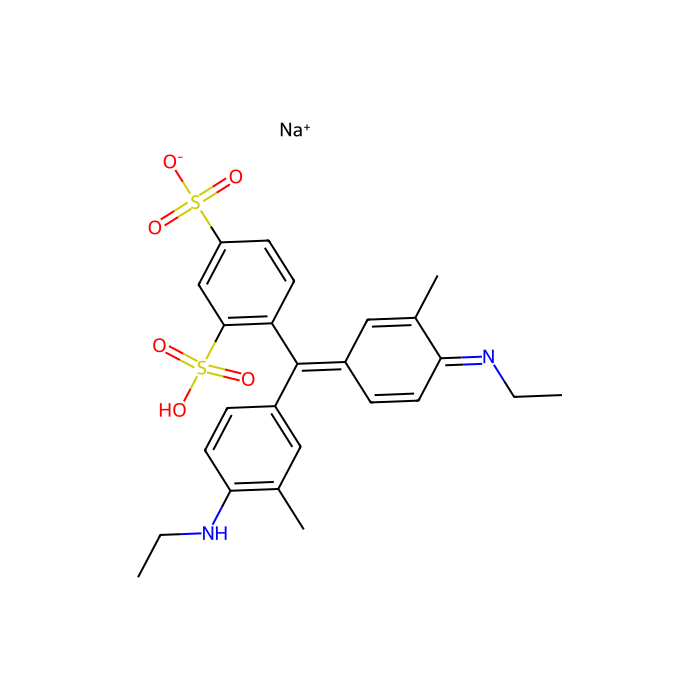
Xylene Cyanol FF - Suitable for molecular biology , CAS No.2650-17-1

CAS: 2650-17-1 Cat. No.: X105504 Molecular Weight: 538.61 EC Number: 220-167-5 PubChem CID: 23687514
AVAILABLE TO ORDER
GRADE & PURITY Suitable for molecular biology ? Molecular-biology grade — free of nucleases and contaminants that degrade DNA/RNA. Use in cloning, PCR, and nucleic-acid work needing clean reagents.
Synonyms
Xylene Cyanol FF | Acid blue 147 | Xylene cyanole FF | AMY22431 | MFCD00019481 | XYLENECYANOLFF | 1,3-Benzenedisulfonic acid, 4-[[4-(ethylamino)-3-methylphenyl][4-(ethylimino)-3-methyl-2,5-cyclohexadien-1-ylidene]methyl]-, sodium salt (1:1) | Sodium 4-((4
Storage
Room temperature
Shipped In
Normal
 ·  off list, applied to all prices below.
Size
Status
Price
Qty
1g
X105504-1g
3
$11.90
5g
X105504-5g
3
$38.90
25g
X105504-25g
4
$171.90
100g
X105504-100g
3
$615.90
Enter a quantity for the sizes you want to add.
🧪

Why this grade

Suitable for molecular biology Suitable for molecular biology for sensitive chromatographic and analytical workflows requiring minimal baseline interference.

🌡

Storage & shipping

Room temperature Ships Normal Check lot-specific COA for exact specifications.

📋

Quality documents

SDS, COA, datasheet, and spec sheet available for download. Lot-specific COA accessible via lot number lookup.

📚

Literature proof

Cited in 1 peer-reviewed publications across chromatography, organic synthesis, and cross-coupling reactions.

Overview

Xylene cyanol is often used as a tracking dye during agarose or polyacrylamide gel electrophoresis. It has a slight negative charge and will migrate the same direction as DNA, allowing the user to monitor the progress of molecules moving through the gel. The rate of migration varies with gel composition.

Xylene Cyanol FF is used as a:
· histological stain and as tracker dye in DNA sequencing and electrophoresis 
· gel-loading dye
· formamide RNA loading dye
· tracking dye in native polyacrylamide gel electrophoresis (PAGE) loading buffer

Specifications

Synonyms
Xylene Cyanol FF | Acid blue 147 | Xylene cyanole FF | AMY22431 | MFCD00019481 | XYLENECYANOLFF | 1, 3-Benzenedisulfonic acid, 4-[[4-(ethylamino)-3-methylphenyl][4-(ethylimino)-3-methyl-2, 5-cyclohexadien-1-ylidene]methyl]-, sodium salt (1:1) | Sodium 4-((4
Specifications & Purity
Suitable for molecular biology
Biochemical and Physiological Mechanisms
Xylene Cyanol FF acts as nucleic acid stain.Tracking dye commonly used for nucleic acids. Used in both agarose or polyacrylamide gel electrophoresis. It has a slight negative charge and will migrate in the same direction as DNA, allowing the user to monit
Storage
Room temperature
Shipped In
Normal
Grade
Suitable for molecular biology
Note
Wherever possible, you should prepare and use solutions on the same day. However, if you need to make up stock solutions in advance, we recommend that you store the solution as aliquots in tightly sealed vials at -20°C. Generally, these will be useable for up to one month. Before use, and prior to opening the vial we recommend that you allow your product to equilibrate to room temperature for at least 1 hour. Need more advice on solubility, usage and handling? Please visit our frequently asked questions (FAQ) page for more details.
Names and Identifiers
Pubchem Sid488200535
Pubchem Sid Urlhttps://pubchem.ncbi.nlm.nih.gov/substance/488200535
Canonical SmilesCCNC1=C(C=C(C=C1)C(=C2C=CC(=NCC)C(=C2)C)C3=C(C=C(C=C3)S(=O)(=O)[O-])S(=O)(=O)O)C.[Na+]
IUPAC Namesodium;4-[(Z)-[4-(ethylamino)-3-methylphenyl]-(4-ethylimino-3-methylcyclohexa-2,5-dien-1-ylidene)methyl]-3-sulfobenzenesulfonate
InChIKeyVVLFAAMTGMGYBS-VARVZIDFSA-M
INCHI1S/C25H28N2O6S2.Na/c1-5-26-22-11-7-18(13-16(22)3)25(19-8-12-23(27-6-2)17(4)14-19)21-10-9-20(34(28,29)30)15-24(21)35(31,32)33;/h7-15,26H,5-6H2,1-4H3,(H,28,29,30)(H,31,32,33);/q;+1/p-1/b25-19-,27-23?;
Isomeric SMILES CCNC1=C(C=C(C=C1)/C(=C/2\C=CC(=NCC)C(=C2)C)/C3=C(C=C(C=C3)S(=O)(=O)[O-])S(=O)(=O)O)C.[Na+]
WGK Germany 3
PubChem CID 23687514
Molecular Weight 538.61

Documentation

📋 Safety Data Sheet (SDS)

Comprehensive hazard, handling, storage, and regulatory compliance document.

Download SDS →

✅ Certificate of Analysis (COA)

Lot-specific quality data. Enter your lot number to retrieve the exact COA.

Look up COA →

📊 Datasheet

Quick-reference summary of product specifications and applications.

View datasheet →

🔬 Specification Sheet

Full quality attributes and acceptance criteria for this grade.

View spec sheet →

Advanced Data

Taxonomic Classification

Taxonomy Tree

KingdomOrganic compounds
SuperclassBenzenoids
ClassBenzene and substituted derivatives
SubclassDiphenylmethanes
Intermediate Tree Nodes Not available
Direct ParentDiphenylmethanes
Alternative Parents Monocyclic monoterpenoids  Benzenesulfonic acids and derivatives  Aromatic monoterpenoids  Benzenesulfonyl compounds  1-sulfo,2-unsubstituted aromatic compounds  Phenylalkylamines  Aniline and substituted anilines  Aminotoluenes  Secondary alkylarylamines  Sulfonyls  Secondary ketimines  Organosulfonic acids  Azomethines  Propargyl-type 1,3-dipolar organic compounds  Organopnictogen compounds  Organic zwitterions  Organic sodium salts  Organic oxides  Hydrocarbon derivatives  Carbonyl compounds  
Molecular FrameworkAromatic homomonocyclic compounds
Substituents Diphenylmethane - Benzenesulfonate - Monoterpenoid - Monocyclic monoterpenoid - Aromatic monoterpenoid - Benzenesulfonyl group - 1-sulfo,2-unsubstituted aromatic compound - Arylsulfonic acid or derivatives - Aminotoluene - Phenylalkylamine - Aniline or substituted anilines - Toluene - Secondary aliphatic/aromatic amine - Sulfonyl - Organosulfonic acid - Organosulfonic acid or derivatives - Organic sulfonic acid or derivatives - Secondary ketimine - Azomethine - Organic alkali metal salt - Organic 1,3-dipolar compound - Propargyl-type 1,3-dipolar organic compound - Secondary amine - Organic nitrogen compound - Organic oxygen compound - Organopnictogen compound - Organic oxide - Hydrocarbon derivative - Organic sodium salt - Organic salt - Organic zwitterion - Organosulfur compound - Organonitrogen compound - Carbonyl group - Amine - Aromatic homomonocyclic compound
DescriptionThis compound belongs to the class of organic compounds known as diphenylmethanes. These are compounds containing a diphenylmethane moiety, which consists of a methane wherein two hydrogen atoms are replaced by two phenyl groups.
External Descriptors Not available
3D Structure
Interactive Chemical Structure Model


Certificates(CoA,COO,BSE/TSE and Analysis Chart)
C of A & Other Certificates(BSE/TSE, COO):
Analytical Chart:

Find and download the COA for your product by matching the lot number on the packaging.

20 results found

Lot NumberCertificate TypeDateItem
F2602128Certificate of AnalysisJun 08, 2026 X105504
F2224060Certificate of AnalysisDec 10, 2025 X105504
F2224082Certificate of AnalysisDec 10, 2025 X105504
E2528785Certificate of AnalysisMay 15, 2025 X105504
E2528786Certificate of AnalysisMay 15, 2025 X105504
E2528788Certificate of AnalysisMay 15, 2025 X105504
E2528794Certificate of AnalysisMay 15, 2025 X105504
E2613058Certificate of AnalysisMay 15, 2025 X105504
E2627090Certificate of AnalysisMay 15, 2025 X105504
E2312266Certificate of AnalysisFeb 11, 2025 X105504
D2328050Certificate of AnalysisFeb 11, 2025 X105504
J2408247Certificate of AnalysisOct 14, 2024 X105504
J2421267Certificate of AnalysisOct 09, 2024 X105504
I2423664Certificate of AnalysisOct 09, 2024 X105504
J2120038Certificate of AnalysisJul 11, 2023 X105504
J2120039Certificate of AnalysisJul 11, 2023 X105504
J2120040Certificate of AnalysisJul 11, 2023 X105504
L2007122Certificate of AnalysisSep 19, 2022 X105504
F2224078Certificate of AnalysisMay 28, 2022 X105504
C2406055Certificate of AnalysisMay 28, 2022 X105504

Show more ⌵

Chemical and Physical Properties
SolubilitySoluble in water.
SensitivityHygroscopic
Melt Point(°C)295°C
Molecular Weight538.600 g/mol
XLogP3
Hydrogen Bond Donor Count2
Hydrogen Bond Acceptor Count8
Rotatable Bond Count7
Exact Mass538.121 Da
Monoisotopic Mass538.121 Da
Topological Polar Surface Area153.000 Ų
Heavy Atom Count36
Formal Charge0
Complexity1120.000
Isotope Atom Count0
Defined Atom Stereocenter Count0
Undefined Atom Stereocenter Count0
Defined Bond Stereocenter Count1
Undefined Bond Stereocenter Count0
The total count of all stereochemical bonds1
Covalently-Bonded Unit Count2
Documents & Articles
Citations of This Product
References
1. Ting Zeng, Jie Yin, Ziwen Liu, Zhaoxing Li, Yu Zhang, Yang Lv, Mei-Ling Lu, Min Luo, Meirong Chen, Yibei Xiao.  (2023)  Mechanistic insights into transposon cleavage and integration by TnsB of ShCAST system.  Cell Reports,      [PMID:37379212] [10.1016/j.celrep.2023.112698]
Solution Calculators
Reviews

Customer Reviews

Need help choosing the grade?

Our grade selection guide covers purity, stabilizer status, and application suitability for all variants in our catalog.

View Suitable for molecular biology grade guide →

Shall we send you a message when we have discounts available?

Remind me later

Thank you! Please check your email inbox to confirm.

Oops! Notifications are disabled.