0.3 N in H2O for sensitive chromatographic and analytical workflows requiring minimal baseline interference.
🌡
Storage & shipping
Room temperature Ships Check lot-specific COA for exact specifications.
📋
Quality documents
SDS, COA, datasheet, and spec sheet available for download. Lot-specific COA accessible via lot number lookup.
📚
Literature proof
Cited in 4 peer-reviewed publications across chromatography, organic synthesis, and cross-coupling reactions.
Overview
Application
Used in conjunction with barium hydroxide to deproteinize via barium sulfate precipitation whole blood, plasma, or serum samples which are colored or turbid. The resulting supernatant or filtrate is then available for subsequent analysis of glucose by Somogi-Nelson method.
Transition metal sulfate - Inorganic oxide - Inorganic salt
Description
This compound belongs to the class of inorganic compounds known as transition metal sulfates. These are inorganic compounds in which the largest oxoanion is sulfate, and in which the heaviest atom not in an oxoanion is a transition metal.
External Descriptors
zinc molecular entity - metal sulfate
1. Djoumbou Feunang Y, Eisner R, Knox C, Chepelev L, Hastings J, Owen G, Fahy E, Steinbeck C, Subramanian S, Bolton E, Greiner R, and Wishart DS. ClassyFire: Automated Chemical Classification With A Comprehensive, Computable Taxonomy. Journal of Cheminformatics, 2016, 8:61.
Determine the necessary mass, volume, or concentration for preparing a solution.
Dilution Calculator
Determine the dilution needed to prepare a stock solution.
Reconstitution Calculator
Reviews
Customer Reviews
Application Protocols
No assay-validated protocols are provided for this item. Typical laboratory uses are method- and concentration-dependent.
General guidance
For preparation of working standards: Gravimetrically dilute with high-purity water; use class A volumetrics; record temperature and density if high accuracy is required.
For electrochemistry: Prepare electrolyte under CO2-minimized conditions if pH drift is critical; filter (0.2 µm) to remove particulates.
For precipitation reactions: Adjust pH first, then add ZnSO4 slowly with stirring to avoid local supersaturation and inhomogeneous precipitate.
For any application, consult the CoA/SDS for lot-specific concentration and safety details.
Biological Roles
General information about zinc and sulfate in biology (for research context only; no medical/clinical claims):
Zinc (Zn2+)
Essential trace element; structural and catalytic cofactor in numerous enzymes (e.g., zinc fingers, metalloproteases, dehydrogenases). Participates in transcriptional regulation via Zn-finger proteins.
Does not undergo redox cycling in vivo (stable d10), making it a structural stabilizer in proteins and enzyme active sites.
Cellular handling involves transporters (ZIP, ZnT families) and metallothioneins that buffer labile Zn2+ pools.
Sulfate (SO4 2−)
Major inorganic anion in biological fluids; participates in sulfation reactions after activation to PAPS (3′-phosphoadenosine-5′-phosphosulfate) for detoxification and biosynthesis of sulfated biomolecules.
Experimental considerations (lab use)
Zn2+ binds strongly to histidyl/cysteinyl sites; exogenous zinc can inhibit metalloenzymes or alter protein conformation—control for free Zn2+ with buffers/chelators (e.g., EDTA, not if Zn2+ activity is desired).
In cell-free systems, adjust ionic strength and pH; Zn2+ hydrolysis increases at higher pH leading to precipitation and reduced bioavailability.
For spectroscopy/enzymology, specify total zinc, estimated free Zn2+, and buffering components to ensure reproducibility.
Buffer Applications
Zinc sulfate is not a buffering agent and does not establish a defined pH buffering range. However, practical notes may help when incorporating it into buffered systems:
Not typically applicable as a primary buffer. Use established buffers (e.g., acetate pH 4–5.5, HEPES pH 6.8–8.2, phosphate pH 6–8) and add ZnSO4 to achieve a target free Zn2+ activity.
Be aware of precipitation risks with phosphate, carbonate, borate, or high pH; zinc phosphates and hydroxides are sparingly soluble.
Control chelation: Many Good’s buffers and additives (e.g., Tris, citrate) can complex Zn2+ and reduce free metal concentration; use metal-buffering models (e.g., MINEQL, Visual MINTEQ) to predict speciation.
Filter solutions after mixing if haze forms; adjust pH before final zinc addition to minimize hydrolysis artifacts.
Green Alternatives
Zinc sulfate solutions are water-based and free of volatile organic solvents, aligning with several green chemistry principles. Consider the following when evaluating alternatives:
Environmental profile (general)
Advantages: Aqueous medium; sulfate is non-volatile and non-flammable; low worker exposure to organics.
Cautions: Zinc is hazardous to aquatic life; minimize releases and ensure appropriate waste treatment.
Alternative zinc sources (trade-offs)
Zinc acetate (aqueous): More biodegradable counterion (acetate), but introduces organics and can complex substrates, altering reaction selectivity.
Zinc chloride: Typically more acidic/corrosive and introduces chloride waste; avoid if halides are undesirable.
Zinc nitrate: Oxidizing anion; additional safety and waste considerations.
Process choices for greener use
Use only the minimal zinc concentration required; recycle or recover zinc from process liquors via precipitation (e.g., Zn(OH)2 then reuse as Zn salts).
Employ closed-loop rinse systems to prevent aquatic release.
Zn(OAc)2(aq): Aqueous, mild odor; organic load and potential complexation.
ZnCl2(aq): Aqueous, corrosive; chloride corrosion/waste issues.
Select based on downstream compatibility, corrosion, and waste treatment infrastructure.
Pharmaceutical Uses
No therapeutic or clinical claims are made. The following are research/formulation-oriented notes only.
Roles in pharmaceutical R&D/manufacturing (general)
Reagent-grade ZnSO4 solutions can serve as process aids (e.g., salt metathesis to form zinc carboxylates/phosphates), pH/ionic strength adjusters in development studies, or as reference standards in analytical methods.
In excipient screening, divalent cations may modulate protein aggregation or stability; Zn2+ can induce oligomerization/precipitation in certain biologics—use only in early research screens with appropriate controls.
Regulatory status
Pharmacopeial monographs exist for zinc sulfate salts (e.g., USP/Ph. Eur. for anhydrous/monohydrate/heptahydrate); applicability to a specific solution depends on its concentration, purity, and manufacturing controls. For this item, any pharmacopeial grade is Not specified; refer to CoA/Spec Sheet.
Practical considerations
Verify bioburden/endotoxin and particulates if considering contact with biological drug substances (research only, non-GMP unless specified).
Avoid chloride-sensitive processes with zinc chloride; zinc sulfate offers a halide-free alternative.
Physical Properties
Item-specific physicochemical specifications (concentration, density, pH, conductivity, impurities) are not provided for this catalog entry.
Item-specific values
Concentration: Not specified for this item; refer to CoA/Spec Sheet.
pH (as supplied): Not specified for this item; refer to CoA/Spec Sheet.
Density (solution): Not specified for this item; refer to CoA/Spec Sheet.
Refractive index (solution): Not specified for this item; refer to CoA/Spec Sheet.
Solubility: Completely miscible with water (qualitative; solution form). Quantitative solubility limit not specified for this item; refer to CoA/Spec Sheet.
Literature values (for reference; not item specifications)
Solubility of ZnSO4·7H2O in water: ~1,000 g/L at 20 °C; solubility increases with temperature (literature, approximate; varies by hydrate and ionic strength).
Hydrolysis: Aqueous Zn2+ solutions are typically mildly acidic (pH ~4–5 at moderate concentrations) due to metal-aqua hydrolysis (literature trend).
Practical notes (general)
Viscosity and density rise with concentration; conductivity is high at moderate-to-high concentrations.
Sulfate can form weak ion pairs in highly concentrated solutions; activity coefficients deviate from ideality (consider ionic strength corrections in speciation/complexation modeling).
Quality & Grades
Item-specific grade/purity: Not specified for this item; refer to CoA/Spec Sheet.
Interpreting possible grades (general guidance)
ACS/AR grade solutions meet defined assay and impurity limits suitable for analytical work.
Reagent grade solutions are appropriate for most synthesis and routine lab use but may not meet low-trace specifications.
Trace-metal or ICP standards are prepared with high-purity salts/water and certified analyte concentrations for instrumental calibration.
Cell culture or molecular biology grades would include bioburden/endotoxin limits and filtration specifications.
What to check on receipt (practical)
Labeled zinc concentration and uncertainty, solution pH, conductivity (if provided), lot-specific metals/non-volatile residue, and absence of turbidity/precipitate.
Stabilizers/anti-microbial agents: Not specified for this item; refer to CoA/Spec Sheet.
UV-Vis background and organics
If using for spectroscopy, confirm low organic/UV background where relevant. For electrochemistry, confirm chloride level (if critical) and counter-ion purity (sulfate speciation).
Reaction & Applications
Applications below are general for zinc sulfate solutions; concentration- and grade-specific suitability should be verified for your use case.
Inorganic/analytical chemistry
Standard solution for zinc assays, titrations, and instrument calibration (e.g., ICP-OES/ICP-MS when prepared from high-purity stocks).
Precipitation/qualitative analysis: Zn2+ forms insoluble salts with sulfide, carbonate, hydroxide—useful in separations or confirmatory tests.
Catalysis and synthesis (literature/general)
Lewis-acid catalysis: ZnSO4·xH2O reported as a mild, water-compatible Lewis acid for acetal/ketal hydrolysis and certain dehydration or protection/deprotection steps under aqueous/solvent-free conditions.
Phase and media effects: In carbohydrate chemistry, sulfate electrolytes influence mutarotation equilibria and glycosidic cleavage rates; ionic strength effects can be tuned with ZnSO4.
Salt metathesis: Source of Zn2+ for generating other zinc salts (e.g., with carboxylates, phosphates) under controlled pH.
Materials/electrochemistry
Electrolyte component for zinc electrodeposition and zinc-based batteries; sulfate minimizes halide corrosion and is compatible with many anodes/cathodes.
Biochemistry workflows (non-clinical)
Protein capture/precipitation screens: Divalent salts, including ZnSO4, modulate protein solubility and nucleic acid co-precipitation; optimize empirically with pH control.
Practical tips
Avoid mixing with bases/carbonates unless precipitation is intended.
For catalysis, report hydrate/solution concentration and pH to ensure reproducibility.
Degassing is generally unnecessary; however, CO2 absorption can slowly shift pH and induce basic carbonate precipitation if strong bases are present.
Reaction Conditions
Representative conditions from the literature for zinc sulfate as a promoter or reagent (for guidance only; not item specifications):
Acetal/ketal hydrolysis (literature)
Catalyst: ZnSO4·xH2O (typically 5–20 mol% relative to substrate) in water or aqueous alcohol.
Temperature: Ambient to 60 °C; reaction time 1–12 h depending on substrate protection pattern and sterics.
Notes: Maintain mildly acidic pH; avoid strong bases. Workup by extraction; remove zinc by aqueous wash or chelation.
Salt metathesis to zinc carboxylates/phosphates (general)
Combine stoichiometric ZnSO4(aq) with sodium/potassium carboxylate/phosphate at pH 5–6 (carboxylate) or controlled pH for phosphate to prevent Zn(OH)2.
Temperature: Ambient; time: minutes to hours until precipitation/complexation completes.
Isolation: Filter precipitated zinc salt; wash with cold water; dry under vacuum.
Electrodeposition electrolyte makeup (general)
ZnSO4 concentration: 0.1–1.0 M typical; additives (e.g., boric acid, brighteners) per bath design.
Temperature: 20–40 °C; agitation to maintain mass transport.
pH: ~3–5; maintain with dilute acid to prevent hydroxide formation.
Always verify compatibility of counter-ions and buffers; use high-purity water. Report lot and concentration for reproducibility.
Safety & Handling
Follow institutional chemical hygiene plans and the product SDS for authoritative guidance. Item-specific hazard classifications are not provided in the Product Data; the following notes summarize common properties of zinc sulfate solutions.
GHS information (literature, for zinc sulfate salts; not item-specific)
May cause serious eye irritation; harmful if swallowed; very toxic to aquatic life with long-lasting effects. Common pictograms: GHS07 (exclamation), GHS09 (environment). Exact classification depends on concentration; consult SDS for this item.
Personal protective equipment
Wear lab coat, safety glasses or chemical splash goggles, and appropriate chemical-resistant gloves (e.g., nitrile). Use in a well-ventilated area; avoid aerosol generation.
Handling and hygiene
Avoid contact with eyes/skin and ingestion. Do not discharge to drains; collect spills to prevent aquatic release. Wash thoroughly after handling.
Incompatibilities (general)
Strong bases (precipitates Zn(OH)2), strong reducing agents (may generate zinc metal under some conditions), sulfide sources (forms ZnS precipitate), carbonates (ZnCO3 precipitation), and chelators (e.g., EDTA) that can strip Zn2+.
First-aid overview (general)
Eye/skin contact: Rinse with water for at least 15 minutes; remove contaminated clothing. Inhalation of mists: move to fresh air. Ingestion: rinse mouth; seek medical attention. Always follow the SDS.
Environmental note
Zinc salts are hazardous to aquatic organisms; prevent release to the environment. Collect and dispose according to local regulations.
Solvent Selection
This product is an aqueous zinc sulfate solution; solvent selection is typically not applicable unless you are diluting or formulating.
Polarity and miscibility (general)
Water is the native solvent; fully miscible with water. Miscibility with common organics is limited by the salt; addition of alcohols (MeOH, EtOH) may reduce solubility and can induce salting-out or precipitation at higher organic content.
When to choose aqueous ZnSO4 vs alternatives
Choose ZnSO4(aq) when you need a controlled source of Zn2+ and sulfate with minimal organic content (e.g., electrolyte makeup, analytical standards, protein precipitation screens, ion-exchange calibration).
If chloride interference is a concern (e.g., Ag+, Hg2+ systems), sulfate is a non-coordinating alternative to chloride or nitrate in many cases.
Comparison (general)
Zinc chloride: more acidic and more coordinating; hygroscopic; can be more corrosive—use when chloride complexation is desired.
Zinc nitrate: oxidizing anion; avoid with reducing substrates.
Zinc acetate: more buffering/complexing tendency; acetate introduces organic content and can shift pH.
Practical tips
Use high-purity water for dilutions to avoid precipitation with carbonates/phosphates. Filter through 0.2 µm if particulate forms. Adjust pH cautiously; base addition will precipitate zinc hydroxides/carbonates.
Storage & Reconstitution
Storage conditions (from Product Data)
Store at room temperature. Protect from contamination and evaporation. Keep container tightly closed.
Shipping
Shipped in: Not specified for this item; refer to CoA/Spec Sheet.
Stability (general guidance)
Aqueous ZnSO4 solutions are typically stable at ambient temperature. Over time, evaporation may increase concentration; CO2 ingress does not usually cause issues unless mixed with bases.
Precipitation can occur if contaminated with carbonate/phosphate or upon pH increase; warming and gentle mixing may redissolve if within solubility limits.
Reconstitution
Not applicable; product is supplied as a solution. For dilutions, use freshly prepared, high-purity water. Record final concentration and pH.
Freeze–thaw
Generally unnecessary; avoid freezing unless validated, as crystallization may cause stratification or container stress.
Shelf-life
Not specified for this item; refer to CoA/Spec Sheet.
Container compatibility
Store in compatible plastics (e.g., HDPE, PP) or glass. Avoid contact with reactive metals. Label with concentration, lot, and preparation/expiry dates if aliquoted.
Structure & Identity
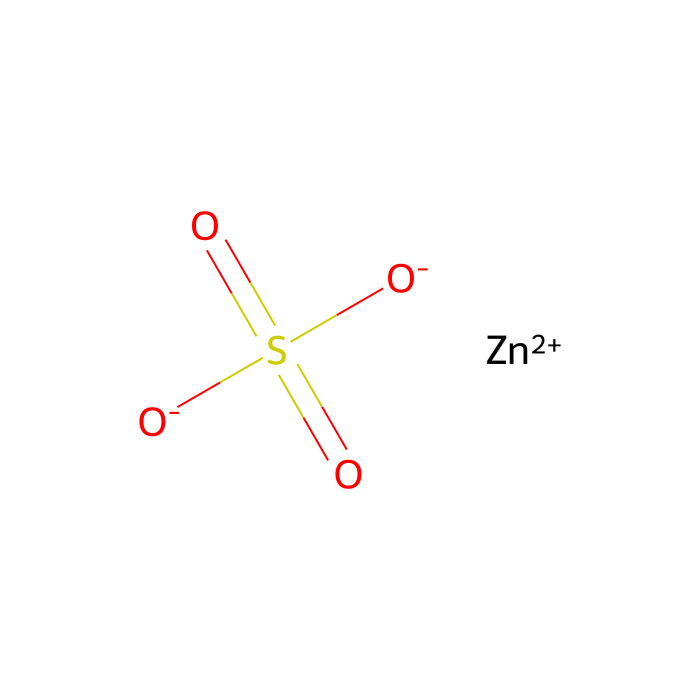
Aqueous solution of an inorganic zinc salt, typically containing Zn2+ and sulfate (SO4 2−); exact concentration and hydration state of the starting salt are not provided for this catalog item.
Item-specific identifiers (from Product Data)
SKU: Z433897
Product name: Zinc sulfate solution
CAS: 7733-02-0 (zinc sulfate; commonly used for anhydrous or hydrates in general indexing)
CID: 24424 (zinc sulfate, literature reference)
InChIKey: 249806 (as provided)
SMILES: Not specified for this item; refer to CoA/Spec Sheet.
Molecular formula: Not specified for this item; refer to CoA/Spec Sheet.
Molecular weight: Not specified for this item; refer to CoA/Spec Sheet.
Structural features (general chemistry knowledge)
Composed of divalent zinc cations (Zn2+) and tetrahedral sulfate anions (SO4 2−) in water.
In solution, Zn2+ is typically aqua-coordinated (e.g., [Zn(H2O)6]2+) with ligand exchange dynamics; sulfate exists as a fully dissociated anion under most conditions, with possible weak ion pairing at higher ionic strengths.
Solid zinc sulfate exists in multiple hydrates (e.g., monohydrate, heptahydrate), but the solution identity depends on concentration and pH rather than a fixed hydrate.
2D description in words (general)
A central Zn2+ ion solvated by water molecules; separate sulfate anion consisting of a central S(VI) atom double-bonded to four oxygen atoms (tetrahedral), two (or more) of which may be hydrogen-bonded to water.
Synthetic Utility
Zinc sulfate solution is a convenient, water-based source of Zn2+ and sulfate for inorganic transformations and as a mild Lewis acid in certain aqueous-compatible organic reactions.
Functional roles (general/literature)
Lewis acid promoter for hydrolysis of acetals/ketals and dehydration-type transformations under aqueous or solvent-free conditions using hydrated ZnSO4.
Salt metathesis: Prepares zinc salts of carboxylates, phosphates, and other anions by mixing with corresponding sodium/potassium salts at controlled pH, with sulfate displaced as a spectator anion.
Electrochemistry: Supplies Zn2+ for deposition and zinc-mediated redox systems; sulfate minimizes halide-driven corrosion.
Retrosynthetic value
As an inexpensive Zn2+ source, enables formation of zinc-containing catalysts or materials (e.g., Zn-based MOFs with additional ligands under solvothermal conditions; sulfate typically replaced in situ).
Workup utility
In some protocols, ZnSO4 is used to scavenge anionic species or to adjust ionic strength, aiding phase separation or protein/nucleic acid precipitation in bio-organic separations.
Notes
For organic transformations, define concentration, pH, and temperature precisely; speciation of Zn2+ changes with conditions.
Precipitation of Zn(OH)2 above pH ~7–8 can terminate Lewis-acid activity; maintain mildly acidic conditions for catalysis.
Target Specificity
Not applicable. This product is an inorganic salt solution and is not an antibody, enzyme, or affinity reagent. No target/epitope/isotype information applies.
We use cookies to ensure the website functions properly and, where permitted, to improve your experience. You can manage your preferences at any time in Settings. Learn more in our Cookie Policy.
Shall we send you a message when we have discounts available?
Remind me later
Thank you! Please check your email inbox to confirm.
Products are supplied to verified businesses, institutions, and qualified professionals for research and development use only. Not for use in humans, animals, diagnosis, or therapy.

 F2618054