Determine the necessary mass, volume, or concentration for preparing a solution.
| Activity Type | Relation | Activity value | Units | Action Type | Journal | PubMed Id | doi | Assay Aladdin ID |
|---|

Suitable for molecular biology, ≥99%(T) Suitable for molecular biology for sensitive chromatographic and analytical workflows requiring minimal baseline interference.
Room temperature,Argon charged Ships Normal Check lot-specific COA for exact specifications.
SDS, COA, datasheet, and spec sheet available for download. Lot-specific COA accessible via lot number lookup.
Cited in 429 peer-reviewed publications across chromatography, organic synthesis, and cross-coupling reactions.
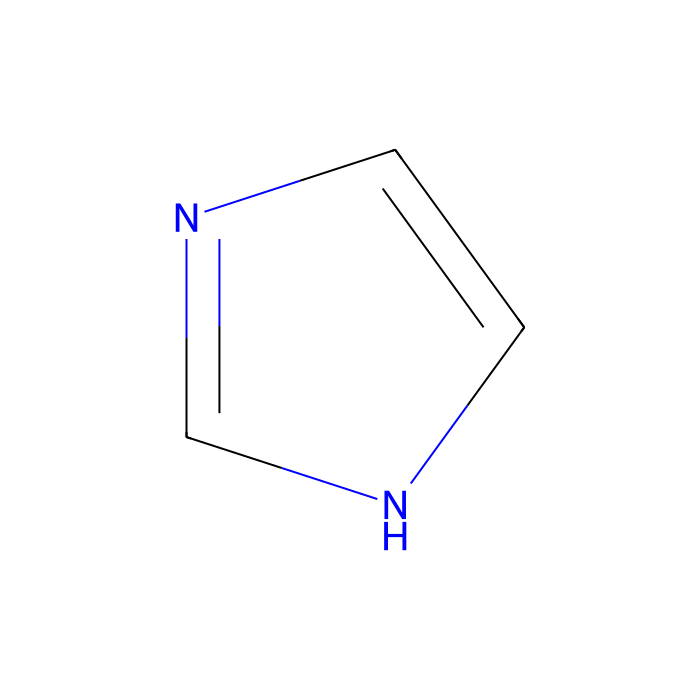
Imidazole is a heterocyclic compound with a five-membered planar ring. It is amphoteric and highly polar. The pharmacophore of imidazole exists in bioactive compounds including amino acids, plant growth regulators and therapeutic agents.Imidazole has been usedin the lysis, wash and elution buffer for the purification of histidine tagged Sonic Hedgehog(shh-N) proteinin elution buffer in stepwise gradient for the purification of histidine tagged aldo keto reductases using nickel affinity chromatographyas a component of homogenization buffer for the purification of phagosomal compartments from dendritic cellsExcellent for buffers in the range of pH 6.2-7.8
General description
Imidazole, also known as ethoxyquin, is an aromatic heterocyclic diazole and a key biological buffer with a pH range of 6.2 to 7.8 at 25°C. It has a wide range of applications in molecular biology, biochemistry, proteomics, and other fields. In proteomics, imidazole is crucial for eluting histidine-tagged proteins from IMAC columns. It is a strong chelator of divalent cations, such as nickel and zinc, disrupting the interaction between the His tag and the metal ions, allowing for efficient elution of purified proteins.
Imidazole is also essential for improving protein purity. It is widely used in preparing buffer solutions for downstream cleanup column optimization. Imidazole solutions are also effective eluents and cleaning agents throughout the protein purification process. Furthermore, imidazole can be used in horseradish peroxidase (HRP) assays and reverse staining of SDS-PAGE gels for protein detection. Imidazole is a valuable biological reagent with a wide range of applications. It is a key component of many buffers and is also used in protein purification and detection protocols.
| Pubchem Sid | 528770852 |
|---|---|
| Sonrisas canónicas | C1=CN=CN1 |
| IUPAC Name | 1H-imidazole |
| InChIKey | RAXXELZNTBOGNW-UHFFFAOYSA-N |
| INCHI | 1S/C3H4N2/c1-2-5-3-4-1/h1-3H,(H,4,5) |
| Isómeros SMILES | C1=CN=CN1 |
| WGK Alemania | 1 |
| RTECS | NI3325000 |
| Número ONU | 2923 |
| Peso molecular | 68.08 |
| Beilstein | 103853 |
| Reaxy-Rn | 103853 |
| Reaxys-RN_link_address | https://www.reaxys.com/reaxys/secured/hopinto.do?context=S&query=IDE.XRN=103853&ln= |
Comprehensive hazard, handling, storage, and regulatory compliance document.
Download SDS →Lot-specific quality data. Enter your lot number to retrieve the exact COA.
Look up COA →Full quality attributes and acceptance criteria for this grade.
View spec sheet →Taxonomy Tree
| Kingdom | Organic compounds |
|---|---|
| Superclass | Organoheterocyclic compounds |
| Clase | Azoles |
| Subclass | Imidazoles |
| Intermediate Tree Nodes | Not available |
| Direct Parent | Imidazoles |
| Alternative Parents | Heteroaromatic compounds Azacyclic compounds Organopnictogen compounds Organonitrogen compounds Hydrocarbon derivatives |
| Molecular Framework | Aromatic heteromonocyclic compounds |
| Substituents | Heteroaromatic compound - Imidazole - Azacycle - Organic nitrogen compound - Organopnictogen compound - Hydrocarbon derivative - Organonitrogen compound - Aromatic heteromonocyclic compound |
| Descripción | This compound belongs to the class of organic compounds known as imidazoles. These are compounds containing an imidazole ring, which is an aromatic five-member ring with two nitrogen atoms at positions 1 and 3, and three carbon atoms. |
| External Descriptors | an aromatic compound |
| Activity Type | Relation | Activity value | Units | Action Type | Journal | PubMed Id | doi | Assay Aladdin ID |
|---|
| Activity Type | Relation | Activity value | Units | Action Type | Journal | PubMed Id | doi | Assay Aladdin ID |
|---|
| Activity Type | Relation | Activity value | Units | Action Type | Journal | PubMed Id | doi | Assay Aladdin ID |
|---|
| Activity Type | Relation | Activity value | Units | Action Type | Journal | PubMed Id | doi | Assay Aladdin ID |
|---|
| Activity Type | Relation | Activity value | Units | Action Type | Journal | PubMed Id | doi | Assay Aladdin ID |
|---|
| Activity Type | Relation | Activity value | Units | Action Type | Journal | PubMed Id | doi | Assay Aladdin ID |
|---|
| Activity Type | Relation | Activity value | Units | Action Type | Journal | PubMed Id | doi | Assay Aladdin ID |
|---|
| Activity Type | Relation | Activity value | Units | Action Type | Journal | PubMed Id | doi | Assay Aladdin ID |
|---|
| Activity Type | Relation | Activity value | Units | Action Type | Journal | PubMed Id | doi | Assay Aladdin ID |
|---|
| Activity Type | Relation | Activity value | Units | Action Type | Journal | PubMed Id | doi | Assay Aladdin ID |
|---|
| Activity Type | Relation | Activity value | Units | Action Type | Journal | PubMed Id | doi | Assay Aladdin ID |
|---|
| Activity Type | Relation | Activity value | Units | Action Type | Journal | PubMed Id | doi | Assay Aladdin ID |
|---|
| Activity Type | Relation | Activity value | Units | Action Type | Journal | PubMed Id | doi | Assay Aladdin ID |
|---|
| Activity Type | Relation | Activity value | Units | Action Type | Journal | PubMed Id | doi | Assay Aladdin ID |
|---|
| Activity Type | Relation | Activity value | Units | Action Type | Journal | PubMed Id | doi | Assay Aladdin ID |
|---|
| Activity Type | Relation | Activity value | Units | Action Type | Journal | PubMed Id | doi | Assay Aladdin ID |
|---|
| Activity Type | Relation | Activity value | Units | Action Type | Journal | PubMed Id | doi | Assay Aladdin ID |
|---|
| Activity Type | Relation | Activity value | Units | Action Type | Journal | PubMed Id | doi | Assay Aladdin ID |
|---|
| Activity Type | Relation | Activity value | Units | Action Type | Journal | PubMed Id | doi | Assay Aladdin ID |
|---|
| Activity Type | Relation | Activity value | Units | Action Type | Journal | PubMed Id | doi | Assay Aladdin ID |
|---|
| Activity Type | Relation | Activity value | Units | Action Type | Journal | PubMed Id | doi | Assay Aladdin ID |
|---|
Find and download the COA for your product by matching the lot number on the packaging.
| Lot Number | Certificate Type | Fecha | Articulo |
|---|---|---|---|
 L2315095 L2315095 | Certificate of Analysis | Sep 07, 2026 | I485681 |
| L2315096 | Certificate of Analysis | Sep 07, 2026 | I485681 |
| L2315097 | Certificate of Analysis | Sep 07, 2026 | I485681 |
| E2609143 | Certificate of Analysis | May 15, 2026 | I485681 |
| E2609148 | Certificate of Analysis | May 13, 2026 | I485681 |
| I2526095 | Certificate of Analysis | Sep 30, 2025 | I485681 |
| Solubilidad | water: 500mg/mL, clear, colorless to very faintly yellow |
|---|---|
| Sensibilidad | Air sensitive;Moisture sensitive |
| Punto de inflamación (°C) | 145℃ |
| Punto de ebullición (°C) | 257°C |
| Punto de fusión (°C) | 90-91°C |
| Peso molecular | 68.080 g/mol |
| XLogP3 | -0.100 |
| Hydrogen Bond Donor Count | 1 |
| Hydrogen Bond Acceptor Count | 1 |
| Rotatable Bond Count | 0 |
| Exact Mass | 68.0374 Da |
| Monoisotopic Mass | 68.0374 Da |
| Topological Polar Surface Area | 28.700 Ų |
| Heavy Atom Count | 5 |
| Formal Charge | 0 |
| Complexity | 28.100 |
| Isotope Atom Count | 0 |
| Defined Atom Stereocenter Count | 0 |
| Undefined Atom Stereocenter Count | 0 |
| Defined Bond Stereocenter Count | 0 |
| Undefined Bond Stereocenter Count | 0 |
| The total count of all stereochemical bonds | 0 |
| Covalently-Bonded Unit Count | 1 |
Our grade selection guide covers purity, stabilizer status, and application suitability for all variants in our catalog.
View Suitable for molecular biology grade guide →