≥98% for sensitive chromatographic and analytical workflows requiring minimal baseline interference.
🌡
Storage & shipping
Store at 2-8°C Ships Wet ice Check lot-specific COA for exact specifications.
📋
Quality documents
SDS, COA, datasheet, and spec sheet available for download. Lot-specific COA accessible via lot number lookup.
📚
Literature proof
Cited in 1 peer-reviewed publications across chromatography, organic synthesis, and cross-coupling reactions.
Overview
1,7-Octadiyne is a terminal bis-alkyne and participates in the formation of uranium(IV) vinyl complexes. It reacts with frustrated Lewis pair P(o-tolyl)3/B(C6F5)3 by acetylene C-C coupling to yield the zwitterionic product. It undergoes the reductive cyclization during reaction with Re2Cl4(μ-dppm)2 (dppm = Ph2PCH2PPh2) and affords quadruply bonded dirhenium(III) complex Re2Cl3(μ,η2-C8H7)(μ-dppm)2.
This compound belongs to the class of organic compounds known as acetylides. These are compounds arising by replacement of one or both hydrogen atoms of acetylene (ethyne) by a metal or other cationic group. E.g. NaC#CH monosodium acetylide. By extension, analogous compounds derived from terminal acetylenes, RC#CH. The class is limited here to derivatives of acetylene where the hydrogen atom is replaced with an element with similar or lower electronegativity that carbon.
External Descriptors
Not available
1. Djoumbou Feunang Y, Eisner R, Knox C, Chepelev L, Hastings J, Owen G, Fahy E, Steinbeck C, Subramanian S, Bolton E, Greiner R, and Wishart DS. ClassyFire: Automated Chemical Classification With A Comprehensive, Computable Taxonomy. Journal of Cheminformatics, 2016, 8:61.
We use cookies to ensure the website functions properly and, where permitted, to improve your experience. You can manage your preferences at any time in Settings. Learn more in our Cookie Policy.
Shall we send you a message when we have discounts available?
Remind me later
Thank you! Please check your email inbox to confirm.
Products are supplied to verified businesses, institutions, and qualified professionals for research and development use only. Not for use in humans, animals, diagnosis, or therapy.

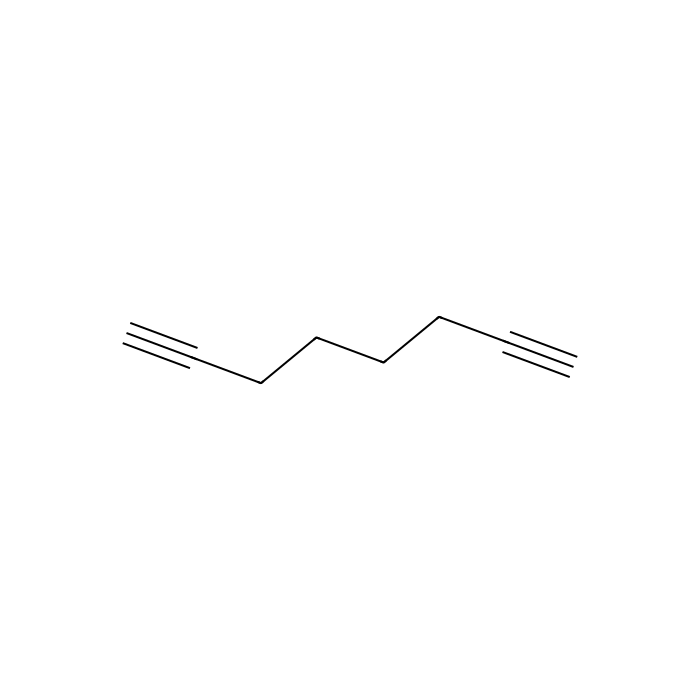
 E2310716