for sensitive chromatographic and analytical workflows requiring minimal baseline interference.
🌡
Storage & shipping
Store at -20°C Ships Ice chest + Ice pads Check lot-specific COA for exact specifications.
📋
Quality documents
SDS, COA, datasheet, and spec sheet available for download. Lot-specific COA accessible via lot number lookup.
📚
Literature proof
Cited in 6 peer-reviewed publications across chromatography, organic synthesis, and cross-coupling reactions.
Vue d’ensemble
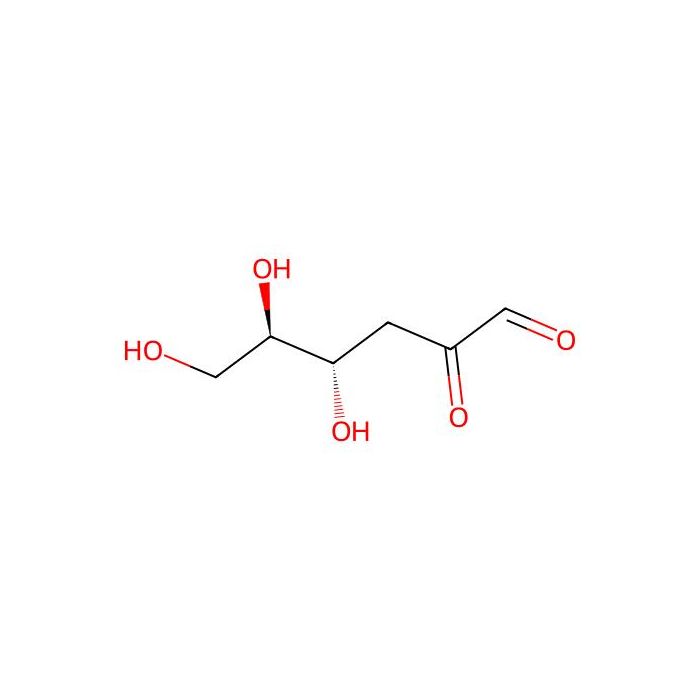
3-Deoxyglucosone (3-Deoxy-D-glucosone) is a reactive intermediate of the Maillard reaction and the polyol pathway. 3-Deoxyglucosone rapidly reacts with protein amino groups to form advanced glycation end products ( AGEs ), such as imidazolone, it is the most specific AGE for 3-DG. 3-Deoxyglucosone synergizes with low glucose to potentiate GLP-1 secretion and is considered as a biomarker for diabetes .
In Vitro
3-Deoxyglucosone (80 ng/ml-1000 ng/ml; 1 hour) markedly increases GLP-1 secretion by 1.23-folds in 300 ng/ml or 1000 ng/ml 3DG-treated group. But at alower concentration (80 ng/ml) has no effects. 3-Deoxyglucosone (300 ng/ml; 1 hour) dramatically increases intracellular Ca 2+ levels by Fluo-3/AM determination (2.5 μM for 30 mins). But 3DG does not affect intracellular cAMP levels in a cAMP Elisa assay. 3-Deoxyglucosone (300 ng/ml; 1 hour) significantly increases the protein expression levels of TAS1R2, TAS1R3, and TRPM5 under both glucose-free and highconditions. MCE has not independently confirmed the accuracy of these methods. They are for reference only. Western Blot AnalysisCell Line: STC-1 cells Concentration: 300 ng/ml Incubation Time: 1 hour Result: Upregulated TAS1R2, TAS1R3, and TRPM5 expression.
In Vivo
3-Deoxyglucosone (intragastric administration; 20 mg/kg; single dose) impairs glucose tolerance with increased AUC, but the plasma Glukagon levels are not significantly different. It developes impaired glucose regulation (IGR) with obviously pancreatic islet cell dysfunction in kunming mice and SD-rats. 3-deoxyglucosone (gastric gavage; 5-50 mg/kg; once daily; 2 weeks) is significantly increased in the upper small intestine (1.4-fold), lower small intestine (1.4-fold), ileum (1.4-fold) and colon (two fold) compared with the basal levels in the corresponding control group. In addition, the protein expressions of TAS1R2, TAS1R3 and TRPM5 in both duodenum and colon are significantly decreased. MCE has not independently confirmed the accuracy of these methods. They are for reference only. Animal Model: SD ratsDosage: 5, 20 and 50 mg/kg Administration: oral administration; once daily; 2 weeks Result: Was capable of accumulating in intestinal tissue and thereby decreased secretion of GLP-1 and insulin.
3-Deoxyglucosone (3-Deoxy-D-glucosone) is a reactive intermediate of the Maillard reaction and the polyol pathway. 3-Deoxyglucosone rapidly reacts with protein amino groups to form advanced glycation end products ( AGEs ), such as imidazolone, it is the m
Conditions de stockage de stockage
Store at -20°C
Expédié en
Ice chest + Ice pads
Ce produit nécessite l'expédition en chaîne froide. Les services terrestres et autres services économiques ne sont pas disponibles.
This compound belongs to the class of organic compounds known as fatty alcohols. These are aliphatic alcohols consisting of a chain of a least six carbon atoms.
External Descriptors
deoxyketohexose - deoxyglucose
1. Djoumbou Feunang Y, Eisner R, Knox C, Chepelev L, Hastings J, Owen G, Fahy E, Steinbeck C, Subramanian S, Bolton E, Greiner R, and Wishart DS. ClassyFire: Automated Chemical Classification With A Comprehensive, Computable Taxonomy. Journal of Cheminformatics, 2016, 8:61.
1.Xue Xia, Tong Zhou, Jingyang Yu, Heping Cui, Foxin Zhang, Khizar Hayat, Xiaoming Zhang, Chi-Tang Ho. (2023) Formation of Fluorescent Maillard Reaction Intermediates of Peptide and Glucose during Thermal Reaction and Its Mechanism. JOURNAL OF AGRICULTURAL AND FOOD CHEMISTRY, [PMID:37232325][10.1021/acs.jafc.3c01899]
2.Xue Xia, Tong Zhou, Han Zhang, Heping Cui, Foxin Zhang, Khizar Hayat, Xiaoming Zhang, Chi-Tang Ho. (2023) Simultaneously Enhanced Formation of Pyrazines and Furans during Thermal Degradation of the Glycyl-l-glutamine Amadori Compound by Selected Exogenous Amino Acids and Appropriate Elevated Temperatures. JOURNAL OF AGRICULTURAL AND FOOD CHEMISTRY, [PMID:36880130][10.1021/acs.jafc.3c00085]
3.Xue Xia, Yun Zhai, Heping Cui, Han Zhang, Khizar Hayat, Xiaoming Zhang, Chi-Tang Ho. (2022) Glycine, Diglycine, and Triglycine Exhibit Different Reactivities in the Formation and Degradation of Amadori Compounds. JOURNAL OF AGRICULTURAL AND FOOD CHEMISTRY, [PMID:36378039][10.1021/acs.jafc.2c06639]
4.Xue Xia, Yun Zhai, Heping Cui, Han Zhang, Khizar Hayat, Xiaoming Zhang, Chi-Tang Ho. (2022) Structural diversity and concentration dependence of pyrazine formation: Exogenous amino substrates and reaction parameters during thermal processing of l-alanyl-l-glutamine Amadori compound. FOOD CHEMISTRY, [PMID:35594769][10.1016/j.foodchem.2022.133144]
5.Wen-mei Chen, Yang Wang, Xu-mei Wang, Yan-hong Shao, Zong-cai Tu, Jun Liu. (2024) Effect of superheated steam on Maillard reaction products, digestibility, and antioxidant activity in β-Lactoglobulin-glucose system. INTERNATIONAL JOURNAL OF BIOLOGICAL MACROMOLECULES, [PMID:39647727][10.1016/j.ijbiomac.2024.138514]
6.Chen-Yang Zhang, Yu-Rong Guo, Tian-Yu Hou, Qian-Ru Ning, Wan-Yu Han, Xing-Yun Zhao, Feng Cui, He Li. (2024) Formation of advanced glycation end products in glucose–amino acid models of Maillard reaction under dry- and wet-heating conditions. JOURNAL OF THE SCIENCE OF FOOD AND AGRICULTURE, [PMID:39501682][10.1002/jsfa.14004]
Calculateurs de solution
Molarity Calculator
Determine the necessary mass, volume, or concentration for preparing a solution.
Dilution Calculator
Determine the dilution needed to prepare a stock solution.
We use cookies to ensure the website functions properly and, where permitted, to improve your experience. You can manage your preferences at any time in Settings. Learn more in our Cookie Policy.
Shall we send you a message when we have discounts available?
Remind me later
Thank you! Please check your email inbox to confirm.
Products are supplied to verified businesses, institutions, and qualified professionals for research and development use only. Not for use in humans, animals, diagnosis, or therapy.