
Determine the necessary mass, volume, or concentration for preparing a solution.
| Activity Type | Activity Value -log(M) | Mechanism of Action | Activity Reference | Publications (PubMed IDs) |
|---|
for sensitive chromatographic and analytical workflows requiring minimal baseline interference.
Protected from light,Store at -80°C Ships Dry ice packs + Cold packs Check lot-specific COA for exact specifications.
SDS, COA, datasheet, and spec sheet available for download. Lot-specific COA accessible via lot number lookup.
Cited in 0 peer-reviewed publications across chromatography, organic synthesis, and cross-coupling reactions.
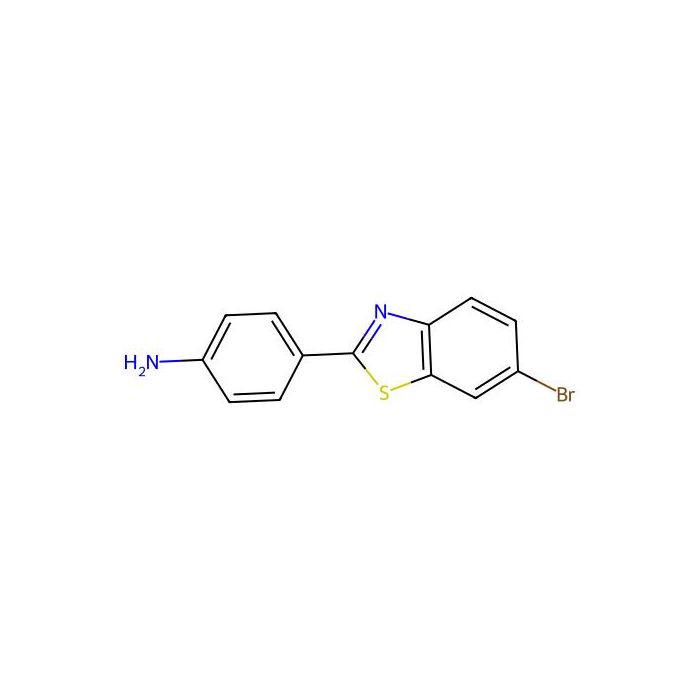
4-(6-Bromo-2-benzothiazolyl)benzenamine is a β-amyloid PET (positron emission tomography) tracer that can be used in the diagnosis of neurological diseases, such as Alzheimer's and Down's syndrome.
In Vitro
4-(6-Bromo-2-benzothiazolyl)benzenamine (compound 6l) plus ultraviolet A (UVA) can induce caspase-3 activity, poly(ADP-ribose)polymerase cleavage, M30 positive CytoDeath staining, and subsequent apoptotic cell death. Treatment of A375 cells with 4-(6-Bromo-2-benzothiazolyl)benzenamine plus UVA results in a decrease in mitochondrial membrane potential (ΔΨ mt ), oxidative phosphorylation system (OXPHOS) subunits, and adenosine triphosphate (ATP) but an increase in mitochondrial DNA 4977-bp deletion via reactive oxygen species (ROS) generation. Transmission electron microscopy (TEM) observations also show major ultrastructural alterations of mitochondria. MCE has not independently confirmed the accuracy of these methods. They are for reference only.
In Vivo
4-(6-Bromo-2-benzothiazolyl)benzenamine plus UVA is shown to reduce murine melanoma size in a mouse model. 4-(6-Bromo-2-benzothiazolyl)benzenamine-PDT may serve as a potential ancillary modality for the treatment of melanoma. MCE has not independently confirmed the accuracy of these methods. They are for reference only.
Cell Assay
For fluorescence Measurement of Uptake of 4-(6-Bromo-2-benzothiazolyl)benzenamine, cultured A375 cells are seeded on glass coverslips with a density of 2×10 4 cells/well in 24-well plate for 24 h until cell attachment. Then the cells are exposed to 4-(6-Bromo-2-benzothiazolyl)benzenamine at 5 μM for indicated times in the dark. The cells are washed twice with PBS and are then fixed with 4% paraformaldehyde at 4°C for 30 min. The qualitative expression of cell fluorescence is determined using a Leica inverted microscope. MCE has not independently confirmed the accuracy of these methods. They are for reference only.
Animal administration
Mice A total of 5×10 6 B16 cells are inoculated into female ICR mice (about 19-21 g, 7 weeks). The subcutaneous inoculation of tumor cells resulted in tumor generation at the injection site. When tumors reached about 4×4 mm 2 in diameter, mice are separated into groups. Each group had four mice in each experiment; 4 mg/kg of 4-(6-Bromo-2-benzothiazolyl)benzenamine is injected into the tumor site, and then tumor is exposed to different doses of UVA on the day after injection. Tumor volume is measured by calipers every 5 days after agent injection, and tumor volume is calculated aladdin has not independently confirmed the accuracy of these methods. They are for reference only.
Form:Solid
IC50& Target:β-amyloid
| Canonical Smiles | C1=CC(=CC=C1C2=NC3=C(S2)C=C(C=C3)Br)N |
|---|---|
| IUPAC Name | 4-(6-bromo-1,3-benzothiazol-2-yl)aniline |
| InChIKey | WZRRXNJALRCBNH-UHFFFAOYSA-N |
| INCHI | 1S/C13H9BrN2S/c14-9-3-6-11-12(7-9)17-13(16-11)8-1-4-10(15)5-2-8/h1-7H,15H2 |
| Isomeric SMILES | C1=CC(=CC=C1C2=NC3=C(S2)C=C(C=C3)Br)N |
| PubChem CID | 10335228 |
| Molecular Weight | 305.19 |
Comprehensive hazard, handling, storage, and regulatory compliance document.
Download SDS →Lot-specific quality data. Enter your lot number to retrieve the exact COA.
Look up COA →Full quality attributes and acceptance criteria for this grade.
View spec sheet →Taxonomy Tree
| Kingdom | Organic compounds |
|---|---|
| Superclass | Organoheterocyclic compounds |
| Class | Benzothiazoles |
| Subclass | Not available |
| Intermediate Tree Nodes | Not available |
| Direct Parent | Benzothiazoles |
| Alternative Parents | Aniline and substituted anilines Aryl bromides Thiazoles Heteroaromatic compounds Azacyclic compounds Primary amines Organobromides Hydrocarbon derivatives |
| Molecular Framework | Aromatic heteropolycyclic compounds |
| Substituents | 1,3-benzothiazole - Aniline or substituted anilines - Aryl bromide - Aryl halide - Monocyclic benzene moiety - Benzenoid - Azole - Heteroaromatic compound - Thiazole - Azacycle - Organobromide - Organohalogen compound - Amine - Hydrocarbon derivative - Organonitrogen compound - Primary amine - Organic nitrogen compound - Aromatic heteropolycyclic compound |
| Description | This compound belongs to the class of organic compounds known as benzothiazoles. These are organic compounds containing a benzene fused to a thiazole ring (a five-membered ring with four carbon atoms, one nitrogen atom and one sulfur atom). |
| External Descriptors | Not available |
| Activity Type | Activity Value -log(M) | Mechanism of Action | Activity Reference | Publications (PubMed IDs) |
|---|
| Activity Type | Relation | Activity value | Units | Action Type | Journal | PubMed Id | doi | Assay Aladdin ID |
|---|
| Molecular Weight | 305.190 g/mol |
|---|---|
| XLogP3 | 4.300 |
| Hydrogen Bond Donor Count | 1 |
| Hydrogen Bond Acceptor Count | 3 |
| Rotatable Bond Count | 1 |
| Exact Mass | 303.967 Da |
| Monoisotopic Mass | 303.967 Da |
| Topological Polar Surface Area | 67.200 Ų |
| Heavy Atom Count | 17 |
| Formal Charge | 0 |
| Complexity | 268.000 |
| Isotope Atom Count | 0 |
| Defined Atom Stereocenter Count | 0 |
| Undefined Atom Stereocenter Count | 0 |
| Defined Bond Stereocenter Count | 0 |
| Undefined Bond Stereocenter Count | 0 |
| The total count of all stereochemical bonds | 0 |
| Covalently-Bonded Unit Count | 1 |