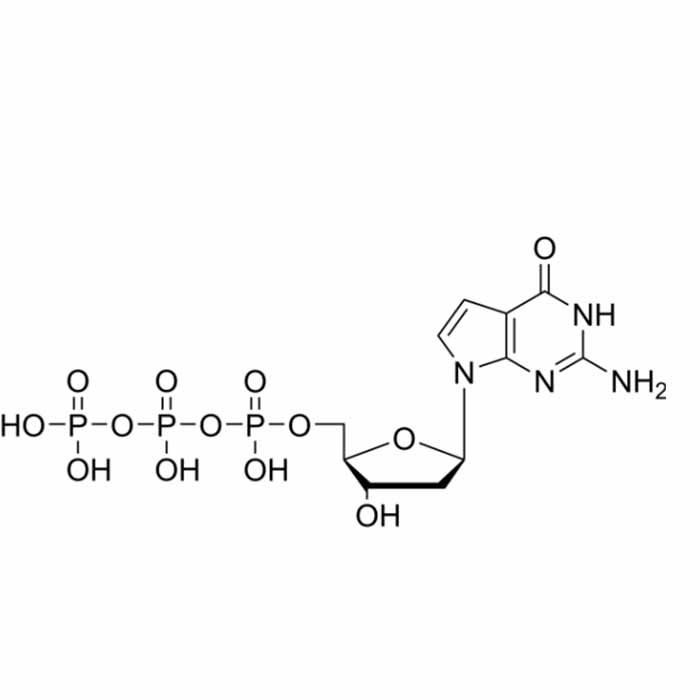
Determine the necessary mass, volume, or concentration for preparing a solution.
Animal Free, DNase, RNase, Protease free, BioReagent, DNase, RNase free, PCR Reagent, Suitable for molecular biology, sterile, ≥99%, 10mM Animal Free,BioReagent,DNase, RNase free,DNase, RNase, Protease free,PCR Reagent,Sterile,Suitable for molecular biology for sensitive chromatographic and analytical workflows requiring minimal baseline interference.
Store at -20°C,Avoid repeated freezing and thawing Ships Ice chest + Ice pads Check lot-specific COA for exact specifications.
SDS, COA, datasheet, and spec sheet available for download. Lot-specific COA accessible via lot number lookup.
Cited in 0 peer-reviewed publications across chromatography, organic synthesis, and cross-coupling reactions.
Physical appearance: Liquid
Storage buffer solution: Ultrapure water
Product Introduction:
7-Deaza-dGTP (10mM) is a single component solution prepared with 7-Deaza-dGTP with a purity of ≥ 99%. It can effectively improve the efficiency of PCR amplification of high GC content sequences and enhance the amplification and sequencing of GC rich DNA sequences.
PCR is the most commonly used technique in many laboratories for diagnostic or molecular biology purposes, which can easily analyze large amounts of DNA sequences. However, due to the formation of secondary structures, some GC rich sequences are difficult to amplify. 7-Deaza-dGTP, also known as 7-Deaza-2 '- deoxyguanosine-5' - triphosphate, 7-deaza-2 '- deoxyguanosine-5' - triphosphate, - N7-dGTP、 7-Denitrification dGTP, etc., molecular formula C11H17N4O13P3 (Free acid), molecular weight 506.19 (Free acid), CAS Number 101515-08-6. 7-Deaza-dGTP is an artificially synthesized dGTP analog that can serve as a substrate for most DNA polymerases, including Taq DNA polymerase. Compared with dGTP, 7-Deaza-dGTP has higher chemical stability, and its incorporation into DNA can affect DNA fluorescence staining and electrophoretic mobility; Compared with dITP, 7-Deaza-dGTP improves the readability of long sequence regions. 7-Deaza-dGTP can replace or partially replace dGTP in amplifying GC rich DNA sequences, effectively reducing PCR reaction error rates, increasing PCR product yields, making DNA sequencing simpler and more efficient. It is widely used in biological experiments such as PCR amplification, sequencing, and gene cloning of GC rich DNA sequences, and plays an important role in disease diagnosis
matters needing attention:
It can dissolve at room temperature and should be stored in an ice box or on an ice bath after dissolution. After use, it should be immediately stored at -20 º C. When the PCR product contains 7-Deaza-dGTP, the reduced stacking of adjacent bases in the product makes it difficult to stain with dyes such as ethidium bromide. This product is only for scientific research by professionals and should not be used for clinical diagnosis or treatment, food or medicine, or stored in ordinary residential areas. For your safety and health, please wear lab coats and disposable gloves when operating.
| PH | 7.0-7.5 |
|---|---|
| Canonical Smiles | C1C(C(OC1N2C=CC3=C2N=C(NC3=O)N)COP(=O)(O)OP(=O)(O)OP(=O)(O)O)O |
| IUPAC Name | [[(2R,3S,5R)-5-(2-amino-4-oxo-3H-pyrrolo[2,3-d]pyrimidin-7-yl)-3-hydroxyoxolan-2-yl]methoxy-hydroxyphosphoryl] phosphono hydrogen phosphate |
| InChIKey | DLLXAZJTLIUPAI-XLPZGREQSA-N |
| INCHI | 1S/C11H17N4O13P3/c12-11-13-9-5(10(17)14-11)1-2-15(9)8-3-6(16)7(26-8)4-25-30(21,22)28-31(23,24)27-29(18,19)20/h1-2,6-8,16H,3-4H2,(H,21,22)(H,23,24)(H2,18,19,20)(H3,12,13,14,17)/t6-,7+,8+/m0/s1 |
| Isomeric SMILES | C1[C@@H]([C@H](O[C@H]1N2C=CC3=C2N=C(NC3=O)N)COP(=O)(O)OP(=O)(O)OP(=O)(O)O)O |
| Molecular Weight | 506.19 |
Comprehensive hazard, handling, storage, and regulatory compliance document.
Download SDS →Lot-specific quality data. Enter your lot number to retrieve the exact COA.
Look up COA →Full quality attributes and acceptance criteria for this grade.
View spec sheet →Taxonomy Tree
| Kingdom | Organic compounds |
|---|---|
| Superclass | Organoheterocyclic compounds |
| Class | Pyrrolopyrimidines |
| Subclass | Pyrrolo[2,3-d]pyrimidines |
| Intermediate Tree Nodes | Not available |
| Direct Parent | Pyrrolo[2,3-d]pyrimidines |
| Alternative Parents | Pyrimidones Monoalkyl phosphates Aminopyrimidines and derivatives Substituted pyrroles Vinylogous amides Tetrahydrofurans Heteroaromatic compounds Secondary alcohols Oxacyclic compounds Azacyclic compounds Primary amines Organopnictogen compounds Organic oxides Hydrocarbon derivatives |
| Molecular Framework | Aromatic heteropolycyclic compounds |
| Substituents | Pyrrolo[2,3-d]pyrimidine - Monoalkyl phosphate - Pyrimidone - Aminopyrimidine - Alkyl phosphate - Substituted pyrrole - Pyrimidine - Phosphoric acid ester - Organic phosphoric acid derivative - Heteroaromatic compound - Vinylogous amide - Tetrahydrofuran - Pyrrole - Secondary alcohol - Oxacycle - Azacycle - Organic nitrogen compound - Organic oxygen compound - Organopnictogen compound - Organic oxide - Hydrocarbon derivative - Primary amine - Organooxygen compound - Organonitrogen compound - Amine - Alcohol - Aromatic heteropolycyclic compound |
| Description | This compound belongs to the class of organic compounds known as pyrrolo[2,3-d]pyrimidines. These are aromatic heteropolycyclic compounds containing a pyrrolo[2,3-d]pyrimidine ring system, which is an pyrrolopyrimidine isomers having the 3 ring nitrogen atoms at the 1-, 5-, and 7-positions. |
| External Descriptors | Not available |
Our grade selection guide covers purity, stabilizer status, and application suitability for all variants in our catalog.
View Animal Free grade guide → View DNase, RNase, Protease free grade guide → View Suitable for molecular biology grade guide → View BioReagent grade guide → View DNase, RNase free grade guide → View PCR Reagent grade guide → View Sterile grade guide →