GRADE & PURITYMoligand™?Moligand™ — Aladdin's line of ligands and bioactive small molecules. Use for receptor, pathway, and binding studies needing defined small-molecule tools.≥98%
Moligand™, ≥98% Moligand™ for sensitive chromatographic and analytical workflows requiring minimal baseline interference.
🌡
Storage & shipping
Store at -20°C Ships Ice chest + Ice pads Check lot-specific COA for exact specifications.
📋
Quality documents
SDS, COA, datasheet, and spec sheet available for download. Lot-specific COA accessible via lot number lookup.
📚
Literature proof
Cited in 0 peer-reviewed publications across chromatography, organic synthesis, and cross-coupling reactions.
Vue d’ensemble
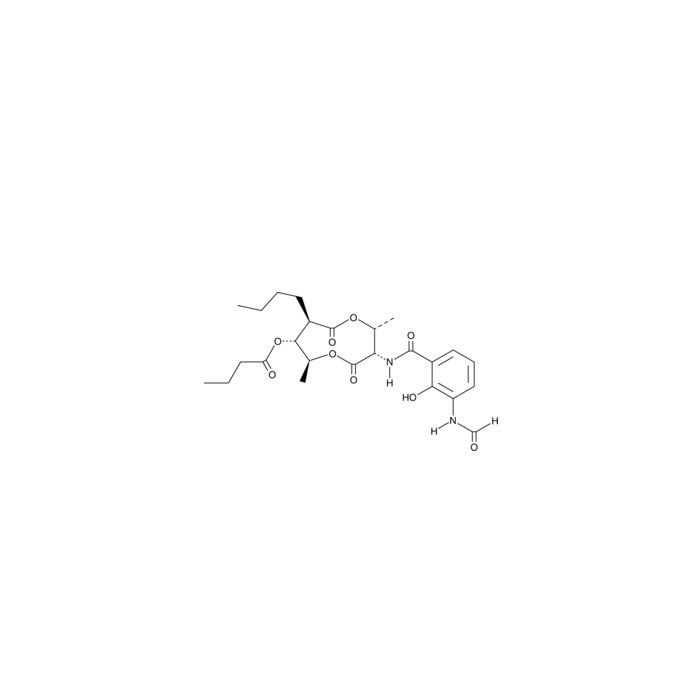
Antimycin A4 is one of the derivatives in the antimycin family, a group of macrolides produced by the bacterium Streptomyces. This compound is notable for its role as a potent inhibitor of the mitochondrial electron transport chain, specifically targeting Complex III (cytochrome bc1 complex). Its mechanism of action involves binding to the Q_i site of Complex III, which effectively blocks the transfer of electrons from ubiquinol to cytochrome c, thereby halting the production of ATP and inducing a rapid increase in the production of reactive oxygen species (ROS) within the cell. This specific inhibition plays a crucial role in research focused on cellular respiration and energy metabolism, making Antimycin A4 a valuable tool for scientists studying mitochondrial dysfunctions and the regulation of oxidative stress. In addition to its use in basic biochemical studies, Antimycin A4 has been employed in ecological studies to assess the impact of mitochondrial inhibitors on aquatic organisms, thereby contributing to environmental assessments of water systems. Its ability to induce ROS production has also made it a candidate for studying the cellular responses to oxidative stress, including the activation of antioxidant defenses and signaling pathways related to cell survival and apoptosis. Through these varied applications, Antimycin A4 has helped advance our understanding of both environmental biology and fundamental cellular processes.
This compound belongs to the class of organic compounds known as acylaminobenzoic acid and derivatives. These are derivatives of amino benzoic acid derivatives where the amine group is N-acylated.
External Descriptors
Not available
1. Djoumbou Feunang Y, Eisner R, Knox C, Chepelev L, Hastings J, Owen G, Fahy E, Steinbeck C, Subramanian S, Bolton E, Greiner R, and Wishart DS. ClassyFire: Automated Chemical Classification With A Comprehensive, Computable Taxonomy. Journal of Cheminformatics, 2016, 8:61.
We use cookies to ensure the website functions properly and, where permitted, to improve your experience. You can manage your preferences at any time in Settings. Learn more in our Cookie Policy.
Shall we send you a message when we have discounts available?
Remind me later
Thank you! Please check your email inbox to confirm.
Products are supplied to verified businesses, institutions, and qualified professionals for research and development use only. Not for use in humans, animals, diagnosis, or therapy.

 C2610279