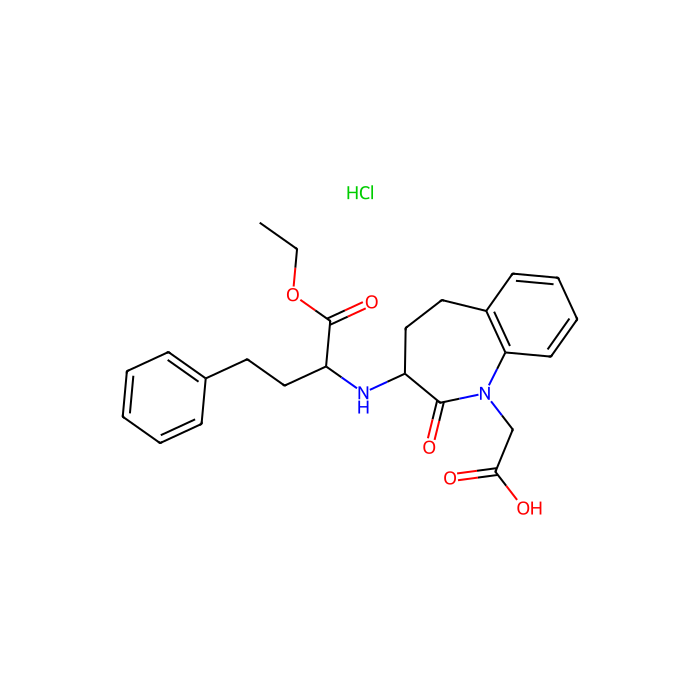
10mM in DMSO for sensitive chromatographic and analytical workflows requiring minimal baseline interference.
🌡
Storage & shipping
Store at -80°C Ships Dry ice packs + Cold packs Check lot-specific COA for exact specifications.
📋
Quality documents
SDS, COA, datasheet, and spec sheet available for download. Lot-specific COA accessible via lot number lookup.
📚
Literature proof
Cited in 0 peer-reviewed publications across chromatography, organic synthesis, and cross-coupling reactions.
Overview
Information
Benazepril HCl (CGS 14824A) is a novelangiotensin I converting enzymeinhibitor, used primarily in treatment of hypertension. In vitro
In vivo
Benazepril hydrochloride (3 or 10 mg/kg/d, p.o. for 14 days) dose-dependently inhibits the increase in the blood pressure caused by continuous norepinephrine (NE) infusion in spontaneously hypertensive rats (SHR) and suppresses in seizures induced by a monoamine oxidase inhibitor, tranylcypromine in NE infused SHR. Benazepril hydrochloride (30 mg/kg p.o.) decreases the triglyceride and total cholesterol levels in normotensive rats. Benazepril hydrochloride (3 mg/kg s.c.) causes a significant decrease in aortic atherosclerosis without reducing hypercholesterolemia in cholesterol-fed rabbits. Benazepril hydrochloride (100 mg/kg p.o.) shows no effect on the urine volume and urinary excretion of electrolytes but decreases PSP excretion in normotensive rats. Benazepril hydrochloride (10 mg/kg p.o.) inhibits the increase in the excretion of urinary protein in DOCA/salt spontaneously hypertensive rats. Benazepril Hydrochloride administration corrects systemic hypertension and significantly reduces angiotensin II and aldosterone in cats with experimentally induced or spontaneously occurring chronic renal failure. Benazepril hydrochloride administration reduces serum creatinine and urinary protein concentration in cat with experimentally induced or spontaneously occurring chronic renal failure. Benazepril hydrochloride significantly decreases blood pressure, angiotensin II and aldosterone and, increases upon discontinuation of administration to the pre-administration levels in a canine remnant kidney model of chronic renal failure. Cell Data
1.Zheng Di-Wei, Pan Pei, Chen Ke-Wei, Fan Jin-Xuan, Li Chu-Xin, Cheng Han, Zhang Xian-Zheng. (2020) An orally delivered microbial cocktail for the removal of nitrogenous metabolic waste in animal models of kidney failure. Nature Biomedical Engineering, 4 (9):(853-862). [PMID:32632226][10.1038/s41551-020-0582-1]
2.Wang Yiran, Shi Jihua, Dai Dapeng, Cai Jianping, Wang Shuanghu, Hong Yun, Zhou Shan, Zhao Fangling, Zhou Quan, Geng Peiwu, Zhou Yunfang, Xu Xue, Luo Qingfeng. (2022) Evaluation of commonly used cardiovascular drugs in inhibiting vonoprazan metabolism in vitro and in vivo. Frontiers in Pharmacology, [PMID:36052128][10.3389/fphar.2022.909168]
3.Tan Lihua, Tu Yanbei, Wang Kai, Han Bing, Peng Hongquan, He Chengwei. (2020) Exploring protective effect of Glycine tabacina aqueous extract against nephrotic syndrome by network pharmacology and experimental verification. Chinese Medicine, 15 (1):(1-17). [PMID:32765640][10.1186/s13020-020-00361-7]
Solution Calculators
Molarity Calculator
Determine the necessary mass, volume, or concentration for preparing a solution.
Dilution Calculator
Determine the dilution needed to prepare a stock solution.
We use cookies to ensure the website functions properly and, where permitted, to improve your experience. You can manage your preferences at any time in Settings. Learn more in our Cookie Policy.
Shall we send you a message when we have discounts available?
Remind me later
Thank you! Please check your email inbox to confirm.
Products are supplied to verified businesses, institutions, and qualified professionals for research and development use only. Not for use in humans, animals, diagnosis, or therapy.