
From Indole to Azaindoles: A One-Nitrogen “Control Knob” for Tunable Properties and Scaffold Selection
From Indole to Azaindoles: A One-Nitrogen “Control Knob” for Tunable Properties and Scaffold Selection
1.A practical problem: indole often brings potency, but physicochemical properties are hard to tune and hard to stabilize
In drug discovery and functional-molecule R&D, indole is a high-frequency scaffold: it is planar, has a rich π system, readily participates in hydrophobic/π–π interactions, and it also provides an N–H hydrogen-bond donor—so it often “adds binding affinity.” But as projects progress, a very practical set of bottlenecks becomes common:
1. Solubility and salt formation are difficult, leading to unstable formulation behavior and variable in vivo exposure;
2. Selectivity is hard to widen (binding to related targets or off-targets can look too similar);
3. Metabolic stability and the property window drift (lipophilicity tends to be high, with too few effective “tuning knobs”).
One approach is to keep the overall scaffold concept while adding one controllable polarity and interaction site—this is a key reason azaindoles are frequently used as heterocycle building blocks. More broadly, nitrogen-containing heterocycles are extremely prevalent in marketed drugs: statistical analyses have reported that around ~60% of small-molecule drugs approved by the U.S. FDA contain a nitrogen heterocycle scaffold (the exact percentage varies with dataset definitions).
2.Definitions and core concepts: what are “heterocycle building blocks—azaindoles”?
2.1 What “heterocycle building block” means here
Here, a heterocycle building block refers to a heteroaromatic scaffold that can serve as a synthetic starting point / modular fragment. It typically offers:
1. Clearly addressable functionalization sites (to enable substitution scans or introduction of linkers);
2. Predictable physicochemical tuning space (e.g., basicity, polarity, hydrogen-bonding patterns, dipole moment, etc.), allowing rapid construction of a target’s scaffold core, followed by fine-tuning of properties and activity through substituents and connection patterns.
2.2 What class of heterocycles azaindoles belong to
Azaindoles are fused heteroarenes. A heteroarene (hetarene) can be understood as an aromatic ring system in which one or more carbon atoms (or carbon fragments) are replaced by heteroatoms such as N, O, or S, while aromaticity is retained.
2.3 The core definition of azaindoles
An azaindole can be viewed as a nitrogen analogue of indole:
1. Specifically, it replaces one sp²-CH (=CH–) in the benzene portion (positions 4–7) of indole with an sp²-N (pyridine-type N), giving four positional isomers: 4-, 5-, 6-, and 7-azaindole.
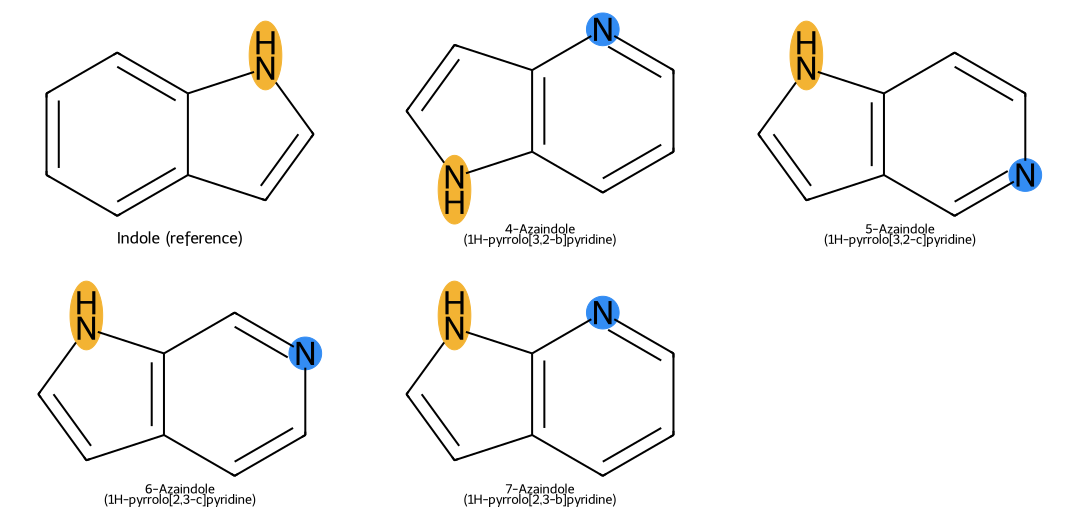
2. In terms of structure and interactions, it contains both:
a) a pyrrolic N–H (typically a hydrogen-bond donor);
b) a pyridinic N (a typical hydrogen-bond acceptor and the primary protonation site).
3. Put intuitively: an azaindole is a fused “pyrrole ring (relatively electron-rich, bearing N–H) + pyridine ring (relatively electron-poor, bearing a pyridinic N)” system—i.e., a pyrrolopyridine scaffold. This fusion of two rings with opposing electronic character significantly reshapes electron distribution, hydrogen-bonding patterns, and downstream functionalization/salt-formation behavior. As a result, azaindoles are often used in medicinal chemistry and materials research as a controllable “heterocycle scaffold tuning knob.”
3.Structural features: why “one extra nitrogen” makes it more tunable and more controllable
3.1 One scaffold provides both HBD + HBA: easier to create a “directional” binding pattern
1. Pyrrolic N–H: a typical hydrogen-bond donor (HBD).
2. Pyridinic N: a typical hydrogen-bond acceptor (HBA), and it can be protonated.
This coexistence of HBD and HBA on the same scaffold means azaindoles are often used in drug design as directional hydrogen-bonding modules that can replace indole-like motifs or even purine-like interaction patterns. In settings such as kinase ATP-binding sites, the additional nitrogen expands the “fit space” to match the local H-bond donor/acceptor network.
3.2 Why they salt/protonate more readily: an added pyridinic N raises the basicity window (with strong isomer dependence)
Indole is essentially not a mildly protonatable base in aqueous media. By contrast, azaindoles include an additional pyridinic N, so their pKa(BH⁺) for protonation (on the pyridinic N) is substantially higher.
Data source note: the pKa values below are taken from reference [1].
[1] Mérour, J.-Y.; Joseph, B. Azaindoles and Their Derivatives. In Science of Synthesis Knowledge Updates 2016/3; Joule, J. A., Ed.; Georg Thieme Verlag KG: Stuttgart, 2017. DOI: 10.1055/sos-SD-110-00717.
The table lists aqueous pKa(BH⁺) values for the unsubstituted parent cores (protonation at the pyridinic N). Absolute values depend on measurement conditions, solvent/ionic strength, and substituents; the main purpose here is to capture relative trends across isomers.
Unsubstituted parent core | pKaH (BH⁺) in water | Implications for charge state / salt formation / solubility tuning |
Indole | −2 to −3 (extremely weak base) | Extremely weak base (pKaH on the order of −2 to −3; a commonly cited value is ~−2.4), so stable salt formation via mild protonation is usually difficult. Under strong acid, C3 protonation / formation of 3H-indolium species is more commonly encountered. |
4-Azaindole (pyrrolo[3,2-b]pyridine) | 6.94 | Moderate basicity: salts form relatively readily; pH changes can produce substantial shifts in the charged fraction. |
5-Azaindole (pyrrolo[3,2-c]pyridine) | 8.26 | Stronger basicity: easier protonation/salt formation; wider room to tune solubility via salt forms. |
6-Azaindole (pyrrolo[2,3-c]pyridine) | 7.95 | Close to the 5-isomer: likewise falls in a more “saltable” window. |
7-Azaindole (pyrrolo[2,3-b]pyridine) | 4.59 | Relatively weaker: more of a “mildly chargeable window”—still protonatable, but less prone than 5/6 to remain strongly charged across conditions. |
3.3 What “more controllable” really means: not “inherently more soluble/stable,” but “a clearer tuning pathway”
Compared with indole, the controllability of azaindoles mainly comes from three adjustable parameter families:
1. Introduction of a protonation site → enables tuning of charge state and solubility via pH, salt form, and counter-ions (one of the most used and most reproducible tuning routes).
2. More explicit HBD/HBA patterning → makes it easier to achieve directional binding and conformational constraints (whether “dual hydrogen bonding” forms depends on receptor geometry and substituents).
3. Shifted electronic character (“the pyridine ring is more electron-poor”) → leads to differences in reactivity, metabolic sites, and selectivity windows; the exact outcome must be validated by controlled comparisons across isomer + substituent set + specific system.
4.Typical application example: why 7-azaindole is so common in ATP-competitive kinase inhibitors
4.1 A “hard constraint” in kinase inhibition: hinge-region hydrogen bonds must be stable and precise
1. Many small-molecule kinase inhibitors are ATP-competitive. A common strategy is to use a hinge binder within the ATP pocket to form a key hydrogen-bond network with the hinge backbone, thereby locking the binding conformation and improving binding directionality and reproducibility.
2. Among these hinge binders, 7-azaindole (7-azaindole, 1H-pyrrolo[2,3-b]pyridine) is a high-frequency, classic fragment: it has been repeatedly adopted across many kinase systems and is often used as a more clearly defined starting point for hinge-region H-bond pairing.
3. Its “pyridinic N (acceptor) + pyrrolic N–H (donor)” combination can often present a typical two-point (dual) hydrogen-bond binding mode at the hinge region, strengthening binding directionality. However, whether a stable “dual H-bond” is actually achieved—and which H-bond is more dominant—still depends on hinge geometry and the molecule’s overall conformation. In different systems, both normal and flipped orientations may occur (the donor/acceptor correspondence to hinge residues is swapped), providing more flexible tuning space for SAR expansion.
4.2 Pain-point mapping: what can azaindoles solve, and what is the most effective next tuning step?
Common pain points in kinase projects | “Scaffold capability” brought by azaindoles (especially 7-azaindole) | Typical next tuning directions |
Hinge anchoring is not stable enough: potency plateaus, poor reproducibility | The core scaffold inherently provides a “one donor + one acceptor” hinge H-bond set, enabling a strong hinge binder; normal/flipped orientations may both exist, which helps SAR expansion | Tune pocket matching (shape/hydrophobics/polarity) via substitutions around the core; when needed, explicitly compare substitution strategies for normal vs flipped orientations |
Indole delivers potency, but properties are hard to balance: solubility, salt forms, exposure | Adding a pyridinic N makes overall polarity and the pKaH window more tunable; many projects treat this as a common entry point when moving from “indole” to a “more tunable N-containing fused ring” | Switch among 4/5/6/7 isomers to coarsely tune basicity; then use substituents to fine-tune pKa/solubility/permeability (note: not “inherently more soluble,” but more tunable) |
Selectivity is hard to widen / too many off-targets: kinases within the same family look too similar | 7-azaindole provides a stable hinge anchor, allowing you to focus differentiation effort on regions beyond the hinge (hydrophobic pockets, solvent channel, adjacent subpockets) | Use substituents to “read out” pocket differences across kinases: steric shaping, electronic effects to subtly tune H-bond strength, and extensions into adjacent subpockets to gain selectivity |
Small reminder: “Common/high-frequency” does not mean “optimal for all kinases.” Whether 7-azaindole is advantageous still depends on the specific hinge-residue geometry and the molecule’s overall conformation.
5.Choosing azaindoles by problem type: three common needs × recommended starting points
Problem to solve | Recommended starting point | Core rationale | Necessary reminder |
Need a “dual H-bond, highly precise geometry” hinge anchor (common for ATP-competitive kinases) | 7-azaindole | Inherently provides a “one donor + one acceptor” hinge H-bond set; a classic hinge binder | Normal/flipped orientations may both occur; substitution strategy must follow the orientation |
Solubility/salt form/charge state are hard to balance (properties won’t move) | 5- / 6-azaindole | Higher basicity window; easier to shift properties via protonation/salt formation | Stronger basicity ≠ necessarily better exposure; validate with isomer controls |
Want to keep the indole-like 3D footprint but add one extra “acceptor site” to tune H-bonding/electronics | Switch among 4/5/6/7 isomers | Minimal scaffold change: one N can rearrange acceptor position and electron distribution | Coarse-tune with isomer choice first, then fine-tune with substituents |
6.Product navigation table | Azaindole-related chemicals: choose the right table by research task / experimental need (Tables A–C)
Research task / experimental need (what problem you are solving) | Which table to check first | Table selection logic | Typical entry points you’ll use |
Need to decide which N-position isomer to use (4/5/6/7-azaindole) for “indole → azaindole” replacement or isomer comparison | Table A | Table A focuses on the four parent cores and saturated parent cores—ideal early in a project to lock in the “baseplate” of H-bond topology / basicity window / electronic effects, then move into site derivatization | 4-azaindole, 5-azaindole, 6-azaindole, 7-azaindole; 2,3-dihydro-7-azaindole |
Scaffold is chosen, but reactions keep getting disrupted by the pyrrolic N (side reactions/coordination/unstable coupling); want more controllable derivatization and smoother library synthesis | Table B | Table B is about protection strategies and combinable entry points: masking the pyrrolic N first (e.g., N-Boc) often significantly improves coupling/functionalization controllability and reproducibility | N-Boc-7-azaindole; 1-Boc-1H-pyrrolo[3,2-c]pyridine; 1H-pyrrolo[2,3-c]pyridine-1-carboxylic acid tert-butyl ester |
Cross-coupling is the main route (Suzuki / Buchwald / need halogen “reaction handles” for fast library build), and you want site scanning (positions 3/4/5/6) | Table C | Table C concentrates on site-functionalized entry points. Halides (Br/I/Cl) and BPin (pinacol boronate) are the most direct coupling starts—well-suited for parallel synthesis and rapid expansion of substitution patterns | 3-bromo-7-azaindole, 4-bromo-7-azaindole, 5-bromo-7-azaindole, 3-iodo-7-azaindole, 4-chloro-7-azaindole; 7-azaindole-3/4/5-BPin |
Prefer a more Suzuki-friendly route (milder, more functional-group tolerant), or want “boron source + halide” as two interchangeable options | Table C (and Table B if needed) | Table C’s BPin is a common Suzuki boron source; if coupling is unstable or side reactions are frequent, combining with Table B’s Boc-protected forms can improve controllability and yield stability | 7-azaindole-3/4/5-pinacol boronate; 1-(tert-butoxycarbonyl)-7-azaindole-3-BPin |
Need rapid introduction of amine side chains / polar chains (for salt forms, solubility, exposure, selectivity), leaning toward late-stage functionalization rather than large early couplings | Table C (and Table B if needed) | Table C’s “aldehyde/carboxylic acid/amine/nitrile” entries are cost-effective functional-group handles: aldehydes enable fast reductive amination; carboxylic acids enable amide formation to install polar side chains; amines support urea/sulfonamide linkages | 7-azaindole-3-carbaldehyde; 7-azaindole-3/2/4-carboxylic acid; 1H-pyrrolo[2,3-b]pyridine-5-amine |
Want to increase 3D character / reduce planarity while keeping recognition elements (improve metabolism, solubility, or reduce π-stacking risk) | Table A | Table A includes saturated cores (azaindolines)—a common “scaffold-level” property correction approach; useful as a matched comparison to the aromatic parent | 2,3-dihydro-7-azaindole |
Need fragment-level controls for electronic effects / H-bond acceptors, or need fluorinated pyridine fragments as comparable pieces in synthesis routes | Table C | Table C includes related control fragments (not necessarily azaindoles), useful for electronic/acceptor-position comparisons or as upstream precursor fragments | 2-hydroxy-5-(trifluoromethyl)pyridine |
Suggested use order: start with Table A to lock the scaffold → then Table C to choose site entry points (halides/BPin/functional groups) → if reactions are unstable or you are building libraries in parallel, add Table B for Boc protection and combinable entry points.
Table A | Parent Cores and N-Position Isomers (Including Saturated Cores) | For Scaffold Screening and Isomer Comparisons
Category | CAS No. | Aladdin Cat. No. | Name | Spec / Purity | Key Features & Applications |
Parent core | 4-azaindole (unprotected) | 272-49-1 | 4-Azaindole | ≥97% | Parent core of the 4-N isomer; used for N-position isomer switching comparisons (H-bond geometry/basicity/electronic effects can differ markedly), commonly applied in fragment/lead optimization for targets such as kinases. | |
Parent core | 5-azaindole (unprotected) | 271-34-1 | 1H-Pyrrolo[3,2-c]pyridine | ≥98% | Parent core of 5-azaindole; frequently used in heteroaromatic scaffold screening and N-position isomer switching studies (notably affects H-bond topology, basicity, and electronics), supporting kinase/receptor binding programs and property tuning. | |
Parent core | 6-azaindole (unprotected) | 271-29-4 | 6-Azaindole | ≥98% (HPLC) | A representative azaindole parent core (6-N isomer); often used in medicinal chemistry as an “indole → azaindole” replacement to add an H-bond acceptor and tune pKa/solubility windows; also widely used for scaffold screening and SAR controls in targets such as kinases. | |
Parent core | 7-azaindole (unprotected) | 271-63-6 | 7-Azaindole | ≥98% | A classic azaindole parent core; due to the “pyrrolic NH (donor) + pyridinic N (acceptor)” pairing, it is widely used as an H-bond recognition scaffold for targets such as kinases (common in hinge-binding contexts), and for indole replacement to improve properties and selectivity. | |
Saturated core | Azaindoline (increased 3D character) | 10592-27-5 | 2,3-Dihydro-7-azaindole | ≥97% | More saturated/3D than aromatic 7-azaindole; often used to reduce planarity while retaining recognition elements, improving metabolic and solubility behavior as an alternative property-correction scaffold. |
Table B | N-Protected Forms and “Protection + Functional Handle” Combination Entry Points | To Improve Coupling/Derivatization Controllability
Category | CAS No. | Aladdin Cat. No. | Name | Spec / Purity | Key Features & Applications |
N-protected form | Boc-protected parent core | 148760-75-2 | 1-Boc-1H-pyrrolo[3,2-c]pyridine | ≥98% | N-Boc protected form of 5-azaindole (pyrrolo[3,2-c]pyridine); used to mask the pyrrolic N during cross-coupling/metalation/electrophilic substitution to improve selectivity, reduce side reactions, and enable series-oriented derivatization. | |
N-protected form | Boc-protected parent core | 370880-82-3 | tert-Butyl 1H-pyrrolo[2,3-c]pyridine-1-carboxylate | ≥98% | N-Boc protected form of 6-azaindole (pyrrolo[2,3-c]pyridine); commonly used as a more operationally robust 6-azaindole starting point for subsequent coupling/site-selective functionalization and SAR optimization. | |
N-protected form | Boc-protected parent core | 138343-77-8 | N-Boc-7-azaindole | ≥95% | One of the most commonly used protected forms of 7-azaindole; significantly improves controllability in coupling/metalation, and is a frequent starting point for building multi-substituted 7-azaindole series and SAR studies. | |
N-protection + boronate entry | Boc + BPin | 942070-47-5 | tert-Butyl 3-(4,4,5,5-tetramethyl-1,3,2-dioxaborolan-2-yl)-1H-pyrrolo[2,3-b]pyridine-1-carboxylate | ≥97% | A combined entry point of “Boc protection + Suzuki boron source”: masking the pyrrolic N improves coupling controllability; well-suited for parallel synthesis and rapid expansion of side chains/aryl fragments. | |
N-protection + halogen handle | Boc + I | 192189-18-7 | 1-Boc-3-iodo-7-azaindole | ≥95% | A combined entry point of “Boc protection + highly reactive iodo handle”: suitable for efficient coupling and challenging-position derivatization; commonly used for parallel synthesis, rapid expansion, and late-stage modification. | |
N-protection + aldehyde handle | Boc + CHO | 144657-66-9 | tert-Butyl 3-formyl-1H-pyrrolo[2,3-b]pyridine-1-carboxylate | ≥97% | A bifunctional entry point of “Boc protection + 3-formyl”: provides a reductive amination/condensation handle while protecting the pyrrolic N—useful for rapid installation of amine-containing side chains with better control over side reactions. |
Table C | Site-Functionalized Entry Points (Halides / Boronates / Acids / Aldehydes / Nitriles / Amines) and Related Controls | For Rapid Library Building and Property Tuning
Category | CAS No. | Aladdin Cat. No. | Name | Spec / Purity | Key Features & Applications |
Halogen entry | Br (coupling / site-specific functionalization) | 23688-47-3 | 3-Bromo-4-azaindole | ≥98% | A 3-bromo “reaction handle” on 4-azaindole; a typical cross-coupling entry (Suzuki, Buchwald, functionalization after metalation, etc.) to rapidly build substitution series and SAR. | |
Functional-handle entry | Aldehyde (condensation / reductive amination) | 276862-85-2 | 4-Azaindole-3-carbaldehyde | ≥97% | Aldehydes are efficient handles for rapid side-chain installation (reductive amination, condensations, etc.); used to build amine-bearing side chains/linkers and accelerate SAR and property scanning. | |
Halogen entry | Br (coupling / site-specific functionalization) | 23612-36-4 | 3-Bromo-1H-pyrrolo[3,2-c]pyridine | ≥97% | The 3-bromo entry point of 5-azaindole; commonly used in Suzuki/Buchwald cross-couplings to establish substitution patterns for SAR and property-window screening. | |
Halogen entry | Br (coupling / site-specific functionalization) | 67058-76-8 | 3-Bromo-1H-pyrrolo[2,3-c]pyridine | ≥97% | The 3-bromo entry point of 6-azaindole (pyrrolo[2,3-c]pyridine); used to rapidly introduce aryl/heteroaryl groups, build 6-azaindole series, and perform isomer comparisons versus 7-azaindole. | |
Halogen entry | Br (coupling / site-specific functionalization) | 74420-15-8 | 3-Bromo-7-azaindole | ≥98% | One of the most widely used halogenated starting points for 7-azaindole; enables rapid installation of aryl/alkenyl/amine-type substituents and is common in fast library building and optimization around kinase hinge-binding fragments. | |
Halogen entry | I (high-activity coupling handle) | 23616-57-1 | 3-Iodo-7-azaindole | ≥97% | Iodides generally couple more readily (a more “reactive” handle); suitable for difficult coupling systems or when milder conditions are preferred for rapid derivatization and parallel library construction. | |
Halogen entry | Br (coupling / site-specific functionalization) | 348640-06-2 | 4-Bromo-7-azaindole | ≥96% | A 4-bromo entry point of 7-azaindole; used for cross-coupling/derivatization at the 4-position to build alternative substitution maps for binding-geometry and property optimization. | |
Halogen entry | Cl (SNAr / coupling / site-specific functionalization) | 55052-28-3 | 4-Chloro-7-azaindole | ≥98% | A chloro entry point of 7-azaindole; can be used for coupling or (under specific conditions) nucleophilic substitution depending on position/substituents—useful for site-controlled expansion and comparisons. | |
Halogen entry | Br (coupling / site-specific functionalization) | 183208-35-7 | 5-Bromo-7-azaindole | ≥97% | A 5-bromo entry point of 7-azaindole; convenient for 5-position aryl/heteroaryl installation or amination, supporting pocket matching and selectivity optimization. | |
Halogen entry | I (high-activity coupling handle) | 898746-50-4 | 5-Iodo-1H-pyrrolo[2,3-b]pyridine | ≥97% | An iodinated entry point on the 7-azaindole scaffold (5-position); used for high-efficiency coupling expansion, often preferred for rapid library build-out and as a “rescue” option in challenging systems. | |
Halogen entry | Cl (site-specific functionalization / control) | 55052-27-2 | 6-Chloro-1H-pyrrolo[2,3-b]pyridine | ≥97% | A chloro entry point on the 7-azaindole scaffold (6-position); used for site-selective derivatization and electronic/steric controls, and can also serve as a starting point for downstream functional group interconversion. | |
Boronate entry | BPin (Suzuki coupling) | 942919-26-8 | 7-Azaindole-4-boronic acid pinacol ester | ≥98% | A commonly used Suzuki boron source; uses the 4-position as the coupling interface for rapid introduction of aryl/heteroaryl groups, supporting SAR optimization and fine tuning of electronics/hydrophobicity. | |
Boronate entry | BPin (Suzuki coupling) | 945256-29-1 | 7-Azaindole-3-boronic acid pinacol ester | ≥97% | One of the high-frequency Suzuki boron sources (3-position handle); enables rapid aryl/heteroaryl installation and supports SAR expansion and electronic/lipophilicity tuning. | |
Boronate entry | BPin (Suzuki coupling) | 754214-56-7 | 7-Azaindole-5-boronic acid pinacol ester | ≥97% | A 5-position Suzuki boron source: suitable for installing aryl/heteroaryl groups at C5 to match hydrophobic pockets or adjust electron distribution; commonly used for parallel derivatization and rapid screening. | |
Functional-handle entry | Carboxylic acid (amidation / salt-form tuning) | 136818-50-3 | 1H-Pyrrolo[2,3-b]pyridine-2-carboxylic acid | ≥97% | A carboxylic-acid handle on the 7-azaindole scaffold; often used to install polar side chains via amidation and to tune salt forms/solubility; can also serve as a “polarity anchor” to improve exposure and selectivity. | |
Functional-handle entry | Carboxylic acid (amidation / salt-form tuning) | 479553-01-0 | 1H-Pyrrolo[2,3-b]pyridine-4-carboxylic acid | ≥97% | A carboxylic-acid entry point (4-position) on the 7-azaindole scaffold; used to build amide/urea/ester derivatives, increasing tunability and enabling rapid SAR iteration. | |
Functional-handle entry | Carboxylic acid (amidation / salt-form tuning) | 156270-06-3 | 7-Azaindole-3-carboxylic acid | ≥95% | A high-frequency “polarity anchor” at the 3-position: enables side-chain installation via amidation, improves solubility/exposure/selectivity, and supports more stable, controllable series-based derivatization. | |
Functional-handle entry | Aldehyde (condensation / reductive amination) | 4649-09-6 | 7-Azaindole-3-carbaldehyde | ≥97% | A 3-formyl handle on 7-azaindole: a rapid side-chain installation interface, commonly used to build amine side chains (reductive amination) or to integrate conjugated/heterocyclic linkers for binding and property optimization. | |
Functional-handle entry | Amine (urea / sulfonamide / amide formation) | 100960-07-4 | 1H-Pyrrolo[2,3-b]pyridine-5-amine | ≥97% | An amine handle for building common medicinal chemistry linkages (ureas, sulfonamides, amides); used to complement H-bond networks, tune basicity/polarity, and rapidly scan side chains. | |
Functional-handle entry | Nitrile (electronic tuning / further transformations) | 517918-95-5 | 5-Cyano-7-azaindole | ≥97% | Nitrile is a strong electron-withdrawing group, useful for tuning electronics and hydrophobic/polar balance; it can also be transformed into amides, carboxylic acids, tetrazoles, etc., expanding chemical space. | |
Functional-handle entry | Nitrile (electronic tuning / further transformations) | 344327-11-3 | 7-Azaindole-4-acetonitrile | ≥97% | A 4-position nitrile entry: used for subtle tuning of electronic effects and polarity; also serves as a precursor for functional group interconversions (e.g., hydrolysis/addition/cyclization) to expand structural space. | |
Functional-handle entry | Nitrile (electronic tuning / further transformations) | 4414-89-5 | 7-Azaindole-3-acetonitrile | ≥95% | A 3-position nitrile entry: used to strengthen electron-withdrawing character and reduce reactivity / tune binding; can be further converted to acids/amides/tetrazoles, providing an expansion point for chemical space. | |
Related precursor/control | Substituted pyridine fragment (non-azaindole) | 33252-63-0 | 2-Hydroxy-5-(trifluoromethyl)pyridine | ≥97% | A CF₃-substituted pyridine fragment: commonly used as a fluorinated heteroarene building block and as an electronic/H-bond acceptor (pyridinic N) control; also serves as a general precursor/fragment source when constructing fluorinated heteroaromatic systems (including azaindole series). |
Note: The above are representative Aladdin products. For additional specifications, please refer to the product list at the end of the document, or search the Aladdin website using the product name / CAS / catalog number.
For more related articles, please see below:
D-DTTA Salts of Azaindole Chiral Amines: New Options for Chemical Splitting
The process path of EBL-3183: from indole to preclinical inhibitor
Efficient synthesis of Fluorinated Azaindoles