
Determine the necessary mass, volume, or concentration for preparing a solution.
| Activity Type | Activity Value -log(M) | Mechanism of Action | Activity Reference | Publications (PubMed IDs) |
|---|
10mM in DMSO for sensitive chromatographic and analytical workflows requiring minimal baseline interference.
Store at -80°C Ships Dry ice packs + Cold packs Check lot-specific COA for exact specifications.
SDS, COA, datasheet, and spec sheet available for download. Lot-specific COA accessible via lot number lookup.
Cited in 0 peer-reviewed publications across chromatography, organic synthesis, and cross-coupling reactions.
Information
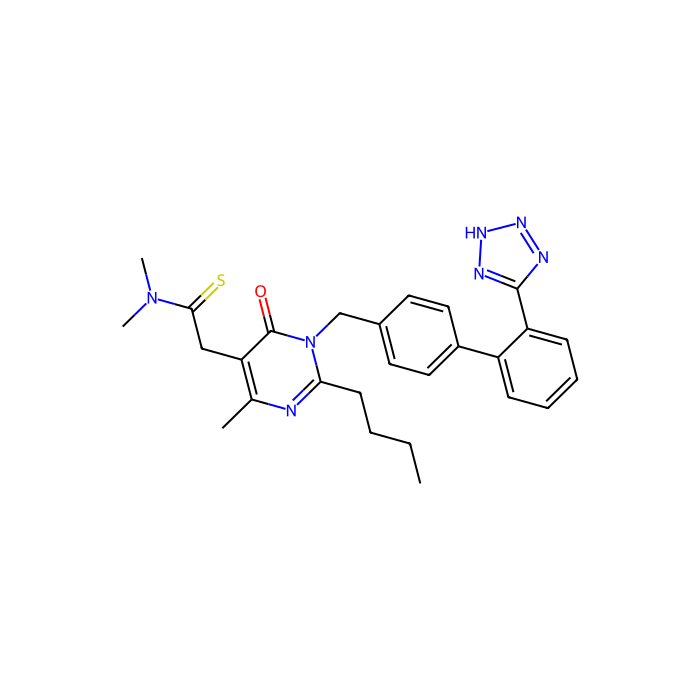
Fimasartan Fimasartan (Kanarb) is a non-peptide angiotensin II receptor antagonist (ARB) with noncompetitive, insurmountable binding with the AT1 receptor. It is used for the treatment of hypertension and heart failure.
Targets
AT1 receptor
In vitro
Fimasartan is a selective AT1 receptor antagonist. The concentration that inhibits the binding of [125I]Ang II to the AT1 receptor from rat adrenal cortex by 50% (IC50) is 0.13 nM. Fimasartan shows superior inhibitory activity in the contraction of isolated rabbit thoracic aorta compared to other ARBs such as losartan and candesartan. Fimasartan potently attenuates myocardial apoptotic death in reperfused rat heart and H9c2 cells. Fimasartan could attenuate mitochondrial damage which is associated with minimizing the reduction in Bcl-2 and connected with the reduction in p53 and activation of Akt and GSK-3β, and inhibiting mitochondrial Ca2+ overload by suppressing the ICa,L and MCU.
In vivo
In various animal models including renal hypertensive rats, spontaneously hypertensive rats and Beagle dogs, fimasartan effectively reduces blood pressure in a dose-dependent manner following single or repeated oral and intravenous administration. Fimasartan does not affect general behavior, respiratory rate or tidal volume in experimental animals, and shows no adverse findings in the human ether-a-go-go-related gene (hERG) test or monkey telemetry study. A number of general toxicity, carcinogenic toxicity, genetic toxicity, and developmental toxicity studies given either orally or intravenously in various species including mice, rats, monkeys and dogs are conducted and these preclinical results demonstrate the safety and tolerability of fimasartan for long-term clinical use and offer sufficient safety margins to support the expected human therapeutic dose. Fimasartan is rapidly absorbed following oral administration with the time to peak plasma concentration (Tmax) ranging 0.5-3 h and the terminal half-life (t1/2) being 5-16 h at doses of 20 to 480 mg in healthy subjects. Similar results are obtained in patients with hypertension, i.e., Tmax ranges 0.5-1.3 h and t1/2 is 7-10 h following fimasartan administration at doses 20-180 mg in the subsequent phase II study. The urinary excretion of fimasartan is low, with the overall urinary excretion of unchanged drug over the first 24 h after dosing being less than 3% of the administered dose. Fimasartan undergoes nonrenal elimination with minimal metabolism. Fimasartan treatment before myocardial ischemia significantly attenuates reperfusion injury and apoptotic changes, possibly by suppressing mitochondrial damage during reperfusion. In various preclinical studies, including aortic balloon injury, myocardial infarct ischemia/reperfusion, doxorubicin cardiotoxicity, and ischemic stroke models, fimasartan shows anti-inflammatory and organ-protecting effects.
Cell Research(from reference)
Cell lines:H9c2 cells
Concentrations:50 μM
Incubation Time:24 h
| ALogP | 3.5 |
|---|
| Canonical Smiles | CCCCC1=NC(=C(C(=O)N1CC2=CC=C(C=C2)C3=CC=CC=C3C4=NNN=N4)CC(=S)N(C)C)C |
|---|---|
| IUPAC Name | 2-[2-butyl-4-methyl-6-oxo-1-[[4-[2-(2H-tetrazol-5-yl)phenyl]phenyl]methyl]pyrimidin-5-yl]-N,N-dimethylethanethioamide |
| InChIKey | AMEROGPZOLAFBN-UHFFFAOYSA-N |
| INCHI | 1S/C27H31N7OS/c1-5-6-11-24-28-18(2)23(16-25(36)33(3)4)27(35)34(24)17-19-12-14-20(15-13-19)21-9-7-8-10-22(21)26-29-31-32-30-26/h7-10,12-15H,5-6,11,16-17H2,1-4H3,(H,29,30,31,32) |
| Isomeric SMILES | CCCCC1=NC(=C(C(=O)N1CC2=CC=C(C=C2)C3=CC=CC=C3C4=NNN=N4)CC(=S)N(C)C)C |
| Molecular Weight | 501.65 |
| Reaxy-Rn | 26118944 |
| Reaxys-RN_link_address | https://www.reaxys.com/reaxys/secured/hopinto.do?context=S&query=IDE.XRN=26118944&ln= |
Comprehensive hazard, handling, storage, and regulatory compliance document.
Download SDS →Lot-specific quality data. Enter your lot number to retrieve the exact COA.
Look up COA →Full quality attributes and acceptance criteria for this grade.
View spec sheet →Taxonomy Tree
| Kingdom | Organic compounds |
|---|---|
| Superclass | Benzenoids |
| Class | Benzene and substituted derivatives |
| Subclass | Biphenyls and derivatives |
| Intermediate Tree Nodes | Not available |
| Direct Parent | Biphenyls and derivatives |
| Alternative Parents | Phenyltetrazoles and derivatives Pyrimidones Hydropyrimidines Thioamides Heteroaromatic compounds Lactams Thiocarboxylic acid amides Azacyclic compounds Thiocarbonyl compounds Organopnictogen compounds Organooxygen compounds Organonitrogen compounds Organic oxides Hydrocarbon derivatives |
| Molecular Framework | Aromatic heteromonocyclic compounds |
| Substituents | Biphenyl - Phenyltetrazole - Pyrimidone - Hydropyrimidine - Pyrimidine - Azole - Heteroaromatic compound - Tetrazole - Thioamide - Lactam - Azacycle - Organoheterocyclic compound - Thiocarboxylic acid amide - Hydrocarbon derivative - Organosulfur compound - Organooxygen compound - Organonitrogen compound - Organic oxide - Organopnictogen compound - Organic nitrogen compound - Organic oxygen compound - Thiocarbonyl group - Aromatic heteromonocyclic compound |
| Description | This compound belongs to the class of organic compounds known as biphenyls and derivatives. These are organic compounds containing to benzene rings linked together by a C-C bond. |
| External Descriptors | Not available |
| Activity Type | Activity Value -log(M) | Mechanism of Action | Activity Reference | Publications (PubMed IDs) |
|---|
| Activity Type | Relation | Activity value | Units | Action Type | Journal | PubMed Id | doi | Assay Aladdin ID |
|---|
| Activity Type | Relation | Activity value | Units | Action Type | Journal | PubMed Id | doi | Assay Aladdin ID |
|---|
| Activity Type | Relation | Activity value | Units | Action Type | Journal | PubMed Id | doi | Assay Aladdin ID |
|---|
| Activity Type | Relation | Activity value | Units | Action Type | Journal | PubMed Id | doi | Assay Aladdin ID |
|---|
| Activity Type | Relation | Activity value | Units | Action Type | Journal | PubMed Id | doi | Assay Aladdin ID |
|---|
| Activity Type | Relation | Activity value | Units | Action Type | Journal | PubMed Id | doi | Assay Aladdin ID |
|---|
| Activity Type | Relation | Activity value | Units | Action Type | Journal | PubMed Id | doi | Assay Aladdin ID |
|---|
| Molecular Weight | 501.600 g/mol |
|---|---|
| XLogP3 | 3.500 |
| Hydrogen Bond Donor Count | 1 |
| Hydrogen Bond Acceptor Count | 6 |
| Rotatable Bond Count | 9 |
| Exact Mass | 501.231 Da |
| Monoisotopic Mass | 501.231 Da |
| Topological Polar Surface Area | 122.000 Ų |
| Heavy Atom Count | 36 |
| Formal Charge | 0 |
| Complexity | 849.000 |
| Isotope Atom Count | 0 |
| Defined Atom Stereocenter Count | 0 |
| Undefined Atom Stereocenter Count | 0 |
| Defined Bond Stereocenter Count | 0 |
| Undefined Bond Stereocenter Count | 0 |
| The total count of all stereochemical bonds | 0 |
| Covalently-Bonded Unit Count | 1 |