
Determine the necessary mass, volume, or concentration for preparing a solution.
| Activity Type | Activity Value -log(M) | Mechanism of Action | Activity Reference | Publications (PubMed IDs) |
|---|
Moligand™, ≥99% Moligand™ for sensitive chromatographic and analytical workflows requiring minimal baseline interference.
Store at -20°C Ships Ice chest + Ice pads Check lot-specific COA for exact specifications.
SDS, COA, datasheet, and spec sheet available for download. Lot-specific COA accessible via lot number lookup.
Cited in 0 peer-reviewed publications across chromatography, organic synthesis, and cross-coupling reactions.
Information
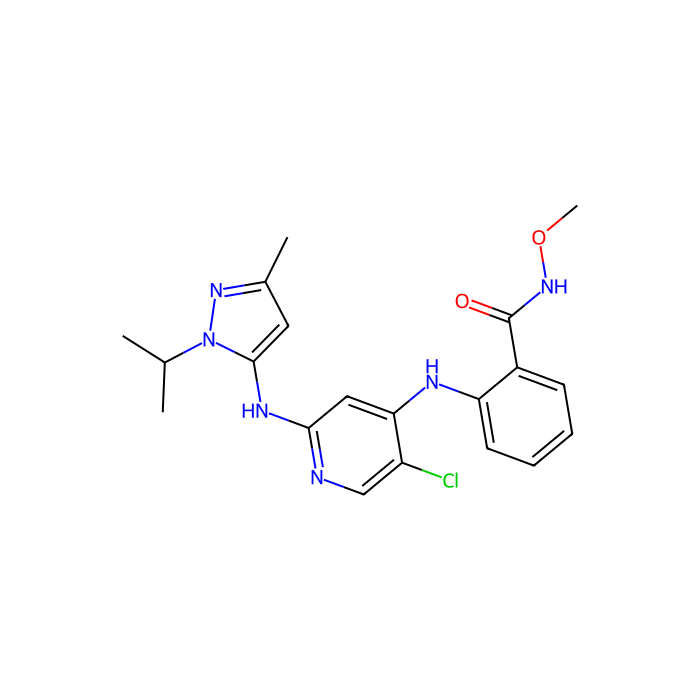
GSK2256098 GSK2256098 is a potent, selective, reversible, and ATP competitive FAK kinase inhibitor with apparent Ki of 0.4 nM. GSK2256098 inhibits cancer cell growth and induces apoptosis .
Targets
FAK 0.4 nM(Ki)
In vitro
GSK2256098 has been developed to inhibit FAK activity through targeting the phosphorylation site of FAK, tyrosine (Y) 397. After a 30-min incubation, GSK2256098 inhibits FAK activity or Y397 phosphorylation in cancer cell lines, OVCAR8 (ovary), U87MG (brain), and A549 (lung), at IC50 values of 15, 8.5 and 12 nM, respectively. In addition, the data suggests that cellular inhibition of FAK by GSK2256098 can occur as early as 30 min in cultured cells and lasts up to 12 hours in mouse tumor xenografts. GSK2256098 inhibition of FAK kinase activity can decrease Akt and ERK activity. PI3K/Akt and ERK signaling contributes to cell survival, implying a pharmacological value of GSK2256098 in attenuation of abnormal survival pathways in specific types of PDAC cells. GSK2256098 can promote apoptosis in L3.6P1 cells through caspase-9/PARP-related pathways. It attenuates abnormal growth and aberrant motility of PDAC cells in a FAK specific manner. GSK2256098 also inhibits growth, migration, and invasion and induces apoptosis in a subset of GBM cell lines.
In vivo
Pharmacokinetic (PK) studies in mice and rats with an intact blood brain barrier indicate that the penetration of GSK2256098 into the CNS is poor. However, it achieves concentrations in tumor of patients with GBM(glioblastoma) exceeding those associated with preclinical activity. GSK2256098 has an acceptable safety profile, has evidence of target engagement at doses at or below the MTD (maximum tolerated dose), and has clinical activity in patients with mesothelioma, particularly those with merlin loss. In the Ishikawa orthoptopic murine model, treatment with GSK2256098 results in lower tumor weights and fewer metastases than mice inoculated with Hec1A cells. Tumors treated with GSK2256098 have lower microvessel density (CD31), less cellular proliferation (Ki67), and higher apoptosis (TUNEL) rates in the Ishikawa model when compared to the Hec1a model. GSK2256098 may be therapeutically beneficial to patients with PTEN-mutant uterine cancer, and PTEN represents a potential predictive biomarker.
Cell Research(from reference)
Cell lines:PDAC(pancreatic ductal adenocarcinoma) cells
Concentrations:0.1–10\xa0μM
Incubation Time:48 or 72 h
| ALogP | 4.5 |
|---|
| Pubchem Sid | 504770685 |
|---|---|
| Pubchem Sid Url | https://pubchem.ncbi.nlm.nih.gov/substance/504770685 |
| Canonical Smiles | CC1=NN(C(=C1)NC2=NC=C(C(=C2)NC3=CC=CC=C3C(=O)NOC)Cl)C(C)C |
| IUPAC Name | 2-[[5-chloro-2-[(5-methyl-2-propan-2-ylpyrazol-3-yl)amino]pyridin-4-yl]amino]-N-methoxybenzamide |
| InChIKey | BVAHPPKGOOJSPU-UHFFFAOYSA-N |
| INCHI | 1S/C20H23ClN6O2/c1-12(2)27-19(9-13(3)25-27)24-18-10-17(15(21)11-22-18)23-16-8-6-5-7-14(16)20(28)26-29-4/h5-12H,1-4H3,(H,26,28)(H2,22,23,24) |
| Isomeric SMILES | CC1=NN(C(=C1)NC2=NC=C(C(=C2)NC3=CC=CC=C3C(=O)NOC)Cl)C(C)C |
| Alternate CAS | 1224887-10-8 |
| MeSH Entry Terms | GSK2256098 |
| Molecular Weight | 414.89 |
| Reaxy-Rn | 20178710 |
| Reaxys-RN_link_address | https://www.reaxys.com/reaxys/secured/hopinto.do?context=S&query=IDE.XRN=20178710&ln= |
Comprehensive hazard, handling, storage, and regulatory compliance document.
Download SDS →Lot-specific quality data. Enter your lot number to retrieve the exact COA.
Look up COA →Full quality attributes and acceptance criteria for this grade.
View spec sheet →Taxonomy Tree
| Kingdom | Organic compounds |
|---|---|
| Superclass | Benzenoids |
| Class | Benzene and substituted derivatives |
| Subclass | Benzoic acids and derivatives |
| Intermediate Tree Nodes | Not available |
| Direct Parent | Aminobenzoic acids and derivatives |
| Alternative Parents | Benzoyl derivatives Aniline and substituted anilines Aminopyridines and derivatives Imidolactams Aryl chlorides Vinylogous amides Pyrazoles Heteroaromatic compounds Amino acids and derivatives Secondary amines Azacyclic compounds Organopnictogen compounds Organooxygen compounds Organochlorides Organic oxides Hydrocarbon derivatives |
| Molecular Framework | Aromatic heteromonocyclic compounds |
| Substituents | Aminobenzoic acid or derivatives - Aniline or substituted anilines - Benzoyl - Aminopyridine - Imidolactam - Pyridine - Aryl halide - Aryl chloride - Heteroaromatic compound - Vinylogous amide - Pyrazole - Azole - Amino acid or derivatives - Azacycle - Organoheterocyclic compound - Secondary amine - Carboxylic acid derivative - Organic nitrogen compound - Organic oxygen compound - Organopnictogen compound - Organic oxide - Hydrocarbon derivative - Organooxygen compound - Organonitrogen compound - Organochloride - Organohalogen compound - Amine - Aromatic heteromonocyclic compound |
| Description | This compound belongs to the class of organic compounds known as aminobenzoic acids and derivatives. These are benzoic acids (or derivative thereof) containing an amine group attached to the benzene moiety. |
| External Descriptors | Not available |
| Activity Type | Activity Value -log(M) | Mechanism of Action | Activity Reference | Publications (PubMed IDs) |
|---|
| Activity Type | Relation | Activity value | Units | Action Type | Journal | PubMed Id | doi | Assay Aladdin ID |
|---|
| Activity Type | Relation | Activity value | Units | Action Type | Journal | PubMed Id | doi | Assay Aladdin ID |
|---|
| Activity Type | Relation | Activity value | Units | Action Type | Journal | PubMed Id | doi | Assay Aladdin ID |
|---|
| Activity Type | Relation | Activity value | Units | Action Type | Journal | PubMed Id | doi | Assay Aladdin ID |
|---|
| Activity Type | Relation | Activity value | Units | Action Type | Journal | PubMed Id | doi | Assay Aladdin ID |
|---|
| Activity Type | Relation | Activity value | Units | Action Type | Journal | PubMed Id | doi | Assay Aladdin ID |
|---|
Find and download the COA for your product by matching the lot number on the packaging.
| Lot Number | Certificate Type | Date | Item |
|---|---|---|---|
 G2215621 G2215621 | Certificate of Analysis | Apr 07, 2025 | G414038 |
| Solubility | Solubility (25°C) In vitro DMSO: 82 mg/mL (197.64 mM); Ethanol: 82 mg/mL (197.64 mM); Water: Insoluble; |
|---|---|
| Molecular Weight | 414.900 g/mol |
| XLogP3 | 4.500 |
| Hydrogen Bond Donor Count | 3 |
| Hydrogen Bond Acceptor Count | 6 |
| Rotatable Bond Count | 7 |
| Exact Mass | 414.157 Da |
| Monoisotopic Mass | 414.157 Da |
| Topological Polar Surface Area | 93.100 Ų |
| Heavy Atom Count | 29 |
| Formal Charge | 0 |
| Complexity | 539.000 |
| Isotope Atom Count | 0 |
| Defined Atom Stereocenter Count | 0 |
| Undefined Atom Stereocenter Count | 0 |
| Defined Bond Stereocenter Count | 0 |
| Undefined Bond Stereocenter Count | 0 |
| The total count of all stereochemical bonds | 0 |
| Covalently-Bonded Unit Count | 1 |
Our grade selection guide covers purity, stabilizer status, and application suitability for all variants in our catalog.
View Moligand™ grade guide →