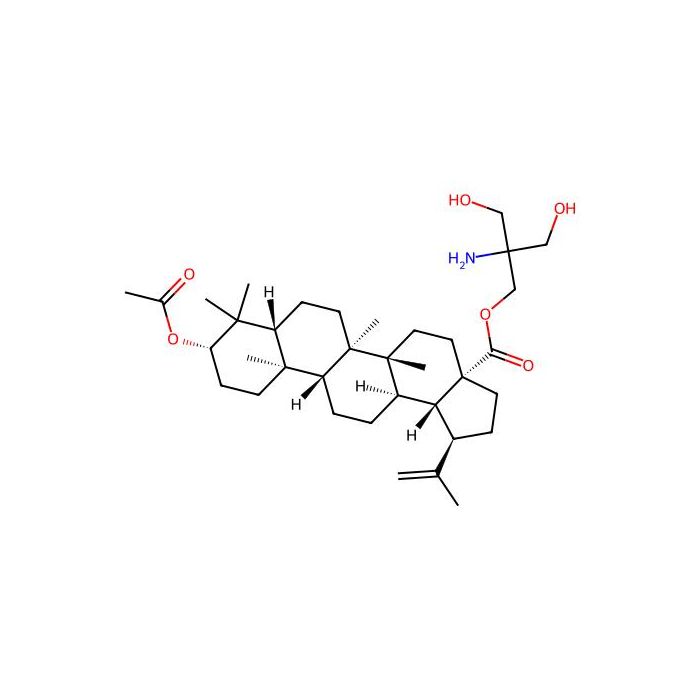
NVX-207, a Betulinic acid-derived anti-cancer compound, shows anti-tumor activity (mean IC 50 =3.5 μM) against various human and canine cell lines. NVX-207-induced apoptosis is associated with activation of the intrinsic apoptotic pathway via cleavage of caspases -9, -3, -7 and of PARP.
In Vitro
NVX-207 induces cell death via apoptosis. NVX-207 has a high cytotoxicity with IC 50 values ranging from 7.6-8.5 µM, in the three analyzed malignant glioma cell lines. NVX-207 leads to PARP cleavage and to a decrease in Survivin expression levels under normoxic and hypoxic conditions. NVX-207 (20 µM) causes a significantly high rate of necrosis of glioma cell lines. MCE has not independently confirmed the accuracy of these methods. They are for reference only.
In Vivo
Intravenous application of NVX-207 in mice is well tolerated . MCE has not independently confirmed the accuracy of these methods. They are for reference only.
Cell Assay
Cytotoxic activities are evaluated using the Sulforhodamine-B (SRB) assay. Exponentially growing cells are seeded into 96-well plates at cell densities to prevent confluence for 96 h. After 24 h, the cells are treated using a dilution series of the compounds for 72 h under normoxic or hypoxic conditions. After treatment, the adherent cells are fixed using 10% TCA at 4°C for 1 h; the cells are washed with ice-cold water and are dyed using 100 µL of 4.4% SRB solution for 10 min. After staining, the plates are washed with 1% acetic acid and air-dried overnight. Three hundred microliters of 20 mM Tris base solution is added, and the absorbance is measured at 540 nm using a 96-well plate reader. The IC 50 values indicate the concentrations of the compound that cause 50% cell inhibition. The data are obtained in three independent experiments. MCE has not independently confirmed the accuracy of these methods. They are for reference only.
Form:Solid
Spécifications
Spécifications et pureté
≥98%
Mécanismes biochimiques et physiologiques
NVX-207, a Betulinic acid-derived anti-cancer compound, shows anti-tumor activity (mean IC 50 =3.5 μM) against various human and canine cell lines. NVX-207-induced apoptosis is associated with activation of the intrinsic apoptotic pathway via cleavage of
Conditions de stockage de stockage
Store at -20°C
Expédié en
Ice chest + Ice pads
Ce produit nécessite l'expédition en chaîne froide. Les services terrestres et autres services économiques ne sont pas disponibles.
This compound belongs to the class of organic compounds known as triterpenoids. These are terpene molecules containing six isoprene units.
External Descriptors
Not available
1. Djoumbou Feunang Y, Eisner R, Knox C, Chepelev L, Hastings J, Owen G, Fahy E, Steinbeck C, Subramanian S, Bolton E, Greiner R, and Wishart DS. ClassyFire: Automated Chemical Classification With A Comprehensive, Computable Taxonomy. Journal of Cheminformatics, 2016, 8:61.
Certificats (CoA, COO, BSE/TSE et tableau d'analyse)
C of A & Other Certificates(BSE/TSE, COO):
Analytical Chart:
Propriétés chimiques et physiques
Solubilité
DMSO : 125 mg/mL (207.69 mM; Need ultrasonic)
Poids moléculaire
601.9
XLogP3
6.700
Hydrogen Bond Donor Count
3
Hydrogen Bond Acceptor Count
7
Rotatable Bond Count
9
Exact Mass
601.434 Da
Monoisotopic Mass
601.434 Da
Topological Polar Surface Area
119.000 Ų
Heavy Atom Count
43
Formal Charge
0
Complexity
1130.000
Isotope Atom Count
0
Defined Atom Stereocenter Count
10
Undefined Atom Stereocenter Count
0
Defined Bond Stereocenter Count
0
Undefined Bond Stereocenter Count
0
The total count of all stereochemical bonds
0
Covalently-Bonded Unit Count
1
Calculateurs de solution
Molarity Calculator
Determine the necessary mass, volume, or concentration for preparing a solution.
Dilution Calculator
Determine the dilution needed to prepare a stock solution.
Reconstitution Calculator
Avis
Avis des clients
Application Protocols
No item-specific, validated application protocols are supplied for this listing. The following are general, literature-informed guidelines for hydrophobic small molecules in cell-based research:
DMSO stock preparation: Weigh compound quickly, minimize ambient exposure. Prepare a 10–50 mM stock in anhydrous DMSO. Vortex and, if needed, sonicate briefly. Filter through 0.2 µm PTFE if particulate persists.
Working solutions: Dilute stock into pre-warmed media to the desired concentration, keeping final DMSO ≤0.1–0.5% v/v (as tolerated by your system). Include matched vehicle controls.
Concentration ranges: Exploratory viability or pathway assays often screen 0.1–50 µM; optimize per cell line/assay. Avoid precipitation by visual inspection and, if possible, nephelometry.
Plate handling: Add compound last to minimize adsorption losses; mix gently to ensure homogeneity. For prolonged incubations, consider daily redosing if stability is uncertain.
Storage of working stocks: Short-term (same day) at 2–8°C protected from light; discard if precipitation or discoloration occurs.
These are general recommendations; tailor to your model system and verify compatibility of any solubilizers or excipients with your readouts.
Biological Roles
No item-specific biological data are provided for this listing. The following describes literature/general roles for betulinic acid–derived triterpenoids, a class that includes compounds referred to as NVX-207.
Cellular interactions: Pentacyclic triterpenoids often localize to lipid membranes due to high hydrophobicity, potentially altering membrane order and impacting signaling microdomains.
Pathway modulation: Literature reports for BA derivatives include engagement of mitochondrial outer membrane events and caspase cascade activation in apoptosis studies, as well as modulation of oxidative stress responses. Exact targets can be pleiotropic and cell-line dependent.
Enzyme/target binding: Reports describe interactions with topoisomerases, NF-κB pathway components, and other proteins in cell-based assays, though binding affinities and specificity can vary widely between analogs; confirm for the exact structure.
ADME considerations: Poor aqueous solubility and high plasma protein binding are common; permeability may be high but formulation-limited.
Important caveats:
Mechanistic outcomes are sensitive to vehicle, surfactant, and DMSO levels—always include matched vehicle controls.
Do not infer therapeutic relevance from in vitro findings; this product is for research use only and not for human or veterinary applications.
Buffer Applications
Not typically applicable. NVX-207 is a hydrophobic small molecule and is not used as a buffering agent. For aqueous biological assays, dissolve first in an organic co-solvent (e.g., DMSO) and then dilute into your buffer system (e.g., PBS, HBSS, culture media) keeping the final co-solvent level within assay tolerances. If higher apparent solubility is required, consider cyclodextrin complexes or nonionic surfactants and validate buffer compatibility.
Green Alternatives
As a discrete small molecule, NVX-207 does not have a “greener substitute” in the same sense as commodity solvents. However, greener principles can guide how you handle, purify, and formulate this compound.
Greener handling/formulation choices (general):
Prefer bio-based or low-toxicity solvents for workup/purification when feasible: Ethyl acetate, ethanol, isopropanol, and 2-MeTHF often substitute for dichloromethane, acetonitrile, or toluene in extractions and chromatography (subject to solubility/selectivity testing).
Aqueous enabling systems: Use cyclodextrins or lipid-based vehicles to reduce organic solvent content in in vitro dosing solutions.
Minimize DMSO: Prepare concentrated master stocks and perform serial dilutions to reduce overall DMSO usage and waste.
DCM vs. 2-MeTHF: 2-MeTHF is renewable and has lower toxicity; test resolution in flash chromatography of triterpenoids—often acceptable with adjusted polarity (e.g., 2-MeTHF/EtOAc/hexanes systems).
Acetonitrile vs. ethanol/water: For preparative HPLC, ethanol/water (with formic acid or ammonium acetate) can sometimes replace MeCN; validate pressure/viscosity and detector response.
Waste reduction:
Implement solid-phase extraction (SPE) for sample cleanup to reduce solvent volumes.
Consolidate compatible organic waste streams and use microscale assays to limit consumption.
Pharmaceutical Uses
No item-specific pharmacopeial status, excipient role, or formulation grade is provided for this product.
General, non-clinical context:
Role in formulation research: Hydrophobic triterpenoid derivatives like NVX-207 are often explored in preclinical formulation studies (e.g., lipid-based systems, nanosuspensions, cyclodextrin inclusion complexes) to enhance solubility for in vitro assays.
Analytical standards: May be employed as a reference standard for method development in bioanalytical or quality-control settings related to triterpenoids.
Compliance and limitations:
This product is supplied for research use only and is not intended for human or veterinary use, API manufacture, or clinical applications.
If your workflow requires GMP, pharmacopoeial compliance, or ICH stability data, contact us for availability; otherwise consult the lot-specific CoA for research-grade specifications.
Physical Properties
Item-specific specifications
Appearance: Not specified for this item; refer to CoA/Spec Sheet.
Molecular weight: Not specified for this item; refer to CoA/Spec Sheet.
Molecular formula: Not specified for this item; refer to CoA/Spec Sheet.
Melting point (MP), boiling point (BP), density, refractive index, pKa, logP/logD: Not specified for this item; refer to CoA/Spec Sheet.
Literature/general properties for lupane-type triterpenoid derivatives (contextual, non-spec):
Physical state: Typically crystalline solids or amorphous powders due to extensive aliphatic framework.
Solubility: Very low in water; readily soluble in polar aprotic organic solvents such as DMSO and DMF; moderate solubility in ethanol/isopropanol when warmed; soluble in chlorinated solvents and THF. Aqueous work typically requires co-solvents, cyclodextrins, or surfactants.
Partitioning: High hydrophobicity is typical (literature logP for related betulinic acid derivatives often >5), driving membrane association.
Thermal behavior: High decomposition temperatures with no conventional atmospheric boiling point; many triterpenoids char/decompose before melting under ambient pressure.
Practical handling notes (general):
For analytical preparation, make concentrated DMSO stocks (e.g., 10–50 mM) and dilute into assay media with ≤0.1–0.5% final DMSO, as assay-tolerated.
Gentle warming (25–40°C) and vortex/sonication aid dissolution; avoid prolonged heating that can promote degradation.
Verify exact constants for NVX-207 on the item-specific CoA before quantitative method development.
Quality and Grades
Item-specific grade/purity: Not specified for this item; refer to CoA/Spec Sheet.
General guidance on quality attributes for small-molecule research compounds:
Research grade: Typically intended for discovery biology, assay development, and medicinal chemistry. Purity is often reported by HPLC/UPLC area% with orthogonal ID (NMR/HRMS). Confirm acceptance criteria on the CoA.
Chromatographic purity vs. assay suitability: For bioassays, low UV background and absence of reactive impurities (acids, peroxides, residual metals) are beneficial. If UHPLC purity is specified on the CoA, also confirm peak homogeneity across wavelengths.
Identity confirmation: Verify with 1H/13C NMR and MS; for stereochemically complex triterpenoids, optical rotation or chiroptical methods can be informative.
Residual solvents and water: If Karl Fischer or GC residual solvent data are needed for your application (e.g., solid-state work), request the lot-specific CoA.
Stabilizers: Not specified for this item. If present, they will be listed on the CoA and may affect downstream biology; plan controls accordingly.
Recommendation: Before quantitative pharmacology, obtain the lot CoA and, if critical, perform in-house orthogonal purity checks (e.g., qNMR) and confirm stability under your assay storage/handling conditions.
Reaction and Applications
Manufacturer application text: Not provided for this listing.
Research applications (literature/general for NVX-207-class triterpenoid derivatives):
Chemical biology: Utilized as a probe compound in studies of membrane interactions, apoptosis pathways, and mitochondrial function due to high hydrophobicity and reported activities of betulinic acid derivatives. Use appropriate controls to dissociate target effects from nonspecific membrane perturbation.
Medicinal chemistry: Serves as a benchmark comparator in SAR programs around the lupane scaffold (modifications at C-3 and C-28). Employed in cytotoxicity panels, mechanism-of-action studies, and ADME profiling (all preclinical research only).
Analytical references: Useful as a positive control/reference standard in LC–MS method development for triterpenoid quantification; confirm exact retention and ionization behavior for your instrument.
Best practices:
Prepare fresh DMSO stocks and minimize freeze–thaw to maintain integrity.
Confirm compound identity/purity via LC–MS and 1H NMR prior to mechanistic or quantitative assays.
Include vehicle controls matching the maximal DMSO/solubilizer level and perform surfactant-only controls when using delivery excipients.
Note: The above are general literature-guided applications for this class; consult your internal protocols and verify the exact structure/specifications of this NVX-207 lot on the CoA before critical experiments.
Reaction Conditions
Item-specific reaction condition data are not provided. Below are general literature conditions for transforming lupane-type triterpenoids (contextual guidance only):
Esterification at C-3 hydroxyl: DCC (1.2–1.5 eq), catalytic DMAP (0.05–0.10 eq) in DCM or THF, 0°C to rt, 2–18 h; workup with filtration of dicyclohexylurea and silica plug. Alternatively, EDCI (1.2–1.5 eq)/DMAP in DCM avoids urea byproduct.
Amide/ester formation at C-28 acid: EDCI/HOBt (or HOAt) with DIPEA in DMF or DCM, 0°C to rt, 4–24 h. Acid chloride route: SOCl2 (2–5 eq) with catalytic DMF, reflux 1–3 h, then couple with nucleophile in pyridine or Et3N.
Carbonate/carbamate installation: p-NPC or CDI activation in THF/DCM, rt to 50°C, providing prodrug-like functionality.
Hydrogenation/deprotection: H2 (1–3 bar) over Pd/C in EtOAc/EtOH at rt to 40°C to remove benzyl-type protections when present.
Yields (literature ranges): Often 50–90% for well-behaved acylations; steric hindrance at C-3 can reduce rates—microwave (80–120°C, sealed) or higher catalyst loadings can help.
Analytical control: Monitor by TLC (anisaldehyde stain) and LC–MS (APCI/ESI). Confirm regioselectivity and integrity of stereocenters by 2D NMR.
Always adapt conditions to the exact NVX-207 structure as confirmed by the CoA.
Safety and Handling
Item-specific safety designations
GHS classification: Not specified for this item; refer to SDS.
Signal word / H-statements / pictograms: Not specified for this item; refer to SDS.
General laboratory safety guidance (non-clinical, for research use only):
PPE: Wear lab coat, safety glasses, and appropriate chemically resistant gloves (e.g., nitrile). Handle powders in a fume hood to minimize dust inhalation.
Hazards (general for hydrophobic organics): May cause skin/eye irritation; avoid inhalation of dusts and ingestion. Consider potential for environmental persistence—avoid release to the environment.
First aid (summary; defer to SDS): Inhalation—move to fresh air; Skin—wash with soap/water; Eyes—rinse cautiously with water for several minutes; Ingestion—rinse mouth and seek medical advice. Provide SDS to medical personnel.
Incompatibilities: Strong oxidizers and strong acids/bases can degrade triterpenoid frameworks or ester/amide functionalities. Avoid excessive heat and UV exposure.
Handling: Use weighing boats with antistatic measures for fine powders. Prepare concentrated DMSO stocks to limit repeated solid handling.
Waste: Collect organic solutions and contaminated disposables in halogenated or non-halogenated organic waste streams per local regulations.
Always consult the item-specific SDS for authoritative hazard classification, exposure limits, and emergency procedures.
Solvent Selection
Context: NVX-207 is cataloged as a hydrophobic small molecule (triterpenoid-derivative class by literature). Item-specific solubility data are not provided.
Solvent considerations (literature/general):
Primary stock solvent: DMSO is preferred for high-concentration stocks (e.g., 10–50 mM). DMF is an alternative but less favored in biological assays.
Co-solvent strategies: For aqueous systems, pre-dissolve in DMSO, then dilute into buffered media, keeping final DMSO ≤0.1–0.5% v/v (as assay-tolerated). Ethanol (≤1% v/v) can also function as a co-solvent in some systems.
Non-aqueous work: Soluble in EtOAc, CH2Cl2, THF, toluene; solubility improves with gentle warming. For crystallization, mixtures like EtOAc/hexanes or EtOH/water (with anti-solvent addition) are commonly effective for triterpenoids.
Enabling excipients: Cyclodextrins (e.g., HP-β-CD), PEG 400, or Tween-80 can markedly increase apparent solubility in aqueous formulations for in vitro delivery; validate compatibility with your assay readouts.
Comparison (general):
DMSO: maximal solvency, biologically compatible at low %; may interfere with some enzymes at higher %.
Ethanol: broadly compatible but lower capacity for highly hydrophobic scaffolds.
Aqueous buffers: typically inadequate without co-solvents/surfactants.
Tip: Filter sterilization of DMSO stocks (PTFE, 0.2 µm) can reduce particulates; avoid cellulose ester membranes which may not tolerate neat DMSO.
Storage and Reconstitution
Item-specific conditions (from product data):
Storage: Store at -20°C.
Shipping: Shipped in an ice chest with ice pads to maintain a cold chain.
General guidance for this compound class:
Container: Store in tightly sealed, inert containers (amber glass vials) under dry, inert atmosphere if possible. Include desiccant to minimize moisture uptake.
Light/moisture: Protect from light and humidity; many triterpenoid derivatives are stable as solids but can slowly degrade with prolonged exposure to heat/UV.
Reconstitution: Prepare concentrated stocks in anhydrous DMSO (e.g., 10–50 mM). Vortex and, if needed, sonicate gently. Record exact concentration gravimetrically or by UV only if an extinction coefficient is validated for this structure.
Aliquoting: Dispense single-use aliquots to avoid repeated freeze–thaw cycles. Store aliquots at -20°C or below. Thaw at room temperature, mix, and use promptly.
Stability: Item-specific shelf-life and stability-in-solution are Not specified for this item; refer to CoA/Spec Sheet. As a precaution, limit DMSO stock storage to weeks at -20°C and days at 2–8°C, monitoring for precipitation or discoloration.
Always defer to the lot-specific CoA/SDS for definitive storage and handling instructions.
Structure and Identity
Brief overview: NVX-207 is listed as a small-molecule research compound. Item-specific identifiers are limited in the product data; literature places “NVX-207” among semi-synthetic betulinic acid (lupane-type triterpenoid) derivatives used as research tools.
SKU: N649434
Product name: NVX-207
CAS: 745020-66-0 (product data)
PubChem CID: 9960374 (product data)
InChIKey: 187315 (product data; note: format appears truncated compared to typical 27-character InChIKeys)
SMILES: Not specified for this item; refer to CoA/Spec Sheet.
Molecular formula: Not specified for this item; refer to CoA/Spec Sheet.
Molecular weight: Not specified for this item; refer to CoA/Spec Sheet.
Structural features (literature/general):
NVX-207 is reported in the literature as a pentacyclic triterpenoid scaffold related to betulinic acid, typically featuring a rigid lupane core with multiple fused cyclohexane/cyclopentane rings, a tertiary alcohol around C-3, and a carboxylate/ester functionality near C-28. Specific substituents vary by synthetic route and must be confirmed on the CoA.
Stereochemistry: Lupane triterpenoids possess multiple defined stereocenters across the fused-ring framework; exact configuration is scaffold-intrinsic and should be verified for the exact NVX-207 lot/form.
2D description (literature/general): A compact, polycyclic hydrocarbon backbone bearing a single polar headgroup (carboxylate/ester) and one secondary/tertiary alcohol, with predominantly aliphatic surface and minimal heteroatoms, conferring high hydrophobicity.
Synthetic Utility
While NVX-207 is generally used as a final research compound rather than a building block, the underlying triterpenoid scaffold offers synthetic entry points. The following are literature/general synthetic considerations for lupane-type triterpenoids:
Functional handles: Common derivatization sites are the C-3 hydroxyl (esterification, carbonate/urethanes, carbamates) and C-28 carboxyl (amide/ester formation, activation as acid chlorides or mixed anhydrides). Selective protection can be required to avoid overfunctionalization.
Coupling strategies: EDCI/HOBt or DCC/DMAP for ester/amide formation in DCM/DMF; acid chloride routes (oxalyl chloride, SOCl2) followed by alcohol/amine coupling. Microwaves can accelerate sluggish acylations on sterically congested frameworks.
Late-stage diversification: Click-like handles (azides/alkynes) can be installed via linker strategies from the C-28 position to generate probe conjugates (fluorophores, biotin), aiding target engagement studies.
Purification: Normal-phase silica with gradient hexanes/EtOAc or 2-MeTHF/EtOAc commonly resolves derivatives; final polishing by preparative HPLC (C18, ACN/H2O or EtOH/H2O with 0.1% formic acid) may be necessary.
Note: Verify the exact NVX-207 structure on the CoA to ensure appropriate protecting-group and chemoselectivity planning before undertaking derivative synthesis.
Target Specificity
Not applicable for this product type. NVX-207 is a small molecule, not an antibody or biological reagent with defined antigen/epitope specificity. No item-specific target binding profile is provided in the product data. If you require target engagement information, consult the primary literature for the exact NVX-207 structure and perform in-house profiling (e.g., thermal shift assays, CETSA, chemoproteomics) as appropriate.
Foire aux questions
What is the purity of this product?
This product is supplied at ≥98% purity (chemical assay). Lot-specific values are stated on the Certificate of Analysis.
How should this product be stored?
Store at ?20 °C. Freezer storage is required to maintain the specified shelf life.
How is this product shipped?
This product ships in an insulated container with ice pads. Unpack on arrival and transfer it to the storage condition stated above.
What are the CAS number, molecular formula and molecular weight?
The CAS Number is 745020-66-0, the molecular formula is C36H59NO6, and the molecular weight is 601.86 g/mol. InChIKey KQZVSTAVTJCKDG-DRSBITMPSA-N.
What documentation is provided?
Available product documentation, including Certificates of Analysis (COA), Safety Data Sheets (SDS), and specification sheets, is shown in the product document area. Document availability and access follow the current site policy.
Nous utilisons des cookies pour garantir le bon fonctionnement du site et, lorsque cela est autorisé, pour améliorer votre expérience. Vous pouvez gérer vos préférences à tout moment dans les Paramètres. Pour en savoir plus, consultez notre Politique relative aux cookies.
Souhaitez-vous que nous vous envoyions un message lorsque des réductions seront disponibles?
Me rappeler plus tard
Merci ! Veuillez vérifier votre boîte de réception e-mail pour confirmer.
Products are supplied to verified businesses, institutions, and qualified professionals for research and development use only. Not for use in humans, animals, diagnosis, or therapy.