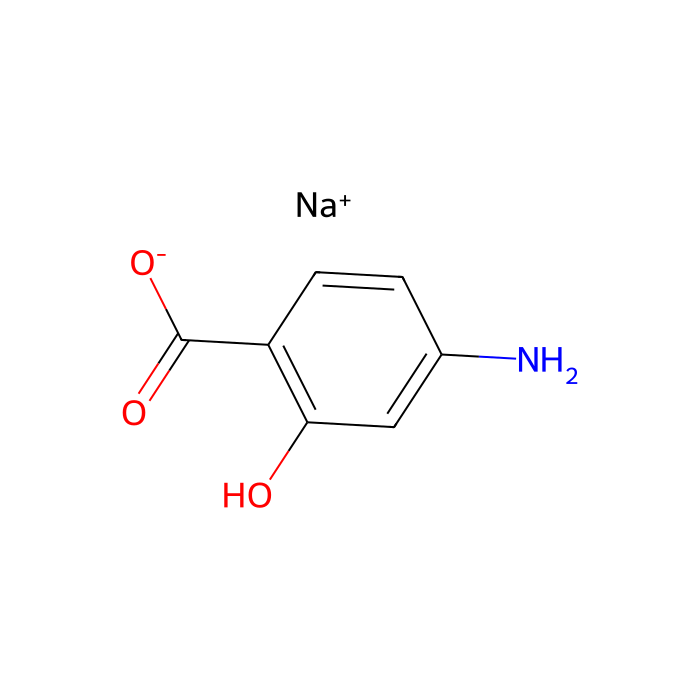
10mM in DMSO for sensitive chromatographic and analytical workflows requiring minimal baseline interference.
🌡
Storage & shipping
Store at -80°C Ships Dry ice packs + Cold packs Check lot-specific COA for exact specifications.
📋
Quality documents
SDS, COA, datasheet, and spec sheet available for download. Lot-specific COA accessible via lot number lookup.
📚
Literature proof
Cited in 0 peer-reviewed publications across chromatography, organic synthesis, and cross-coupling reactions.
Overview
Information
Sodium 4-Aminosalicylate Sodium 4-Aminosalicylate is an antibiotic used to treat tuberculosis via NF-κB inhibition and free radical scavenging. In vitro
4-Aminosalicylate reacts promptly with DPPH, suggesting a potent radical scavenger activity. 4-Aminosalicylate exhibits peroxyl radical scavenging activity generated by the water-soluble 2,2\'-azobis-(2-amidinopropane hydrochloride) azoinitiator of peroxyl radicals, as evidenced by the inhibition of cis-parinaric acid fluorescence decay or oxygen consumption. 4-Aminosalicylate rapidly scavenges peroxyl radicals in the aqueous phase, producing a concentration-dependent inhibition period similar to Trolox or cysteine, suggesting an antioxidant activity of chain-breaking type. [14C]4-Aminosalicylate transforms to a number of metabolites, among which we have characterized salicylate and gentisate, in activated mononuclear cells and activated granulocytes. 4-Aminosalicylate (0.65 mM) diminishes the lethal effect on cultured Chinese hamster ovary cells of adding either superoxide radical or hydrogen peroxide. Aminosalicylate (25 mM) stimulates phospholipase D in a time- and concentration-dependent manner via a pathway involving inositol 1,4,5-trisphosphate generation, calcium fluxes, and Gi/Go in cultured mouse peritoneal macrophages. 4-aminosalicylate (20 mM) increases the levels of inositol 1,4,5-trisphosphate by 260% after treatment of macrophages. 4-aminosalicylate (5 mM) potentiates the activation of PLD by protein kinase C in cultured mouse peritoneal macrophages. 4-aminosalicylate (0.1 mM) decreases the LTB4 synthesis in a dose-related fashion in isolated colonic mucosal cells, thus diminishes the LTB4/PGE2 ratio. 4-aminosalicylate (0.1 mg/mL) is preferentially transported in the basolateral (BL) to apical (AP) direction, and the N-acetyl metabolite appeared only in the AP compartment.
In vivo
4-aminosalicylate (7.5 mg/mL, regional perfusions) results in the appearance of N-acetyl-5-aminosalicylic acid in the intestinal lumen in the anesthetized rat. Cell Data
We use cookies to ensure the website functions properly and, where permitted, to improve your experience. You can manage your preferences at any time in Settings. Learn more in our Cookie Policy.
Shall we send you a message when we have discounts available?
Remind me later
Thank you! Please check your email inbox to confirm.
Products are supplied to verified businesses, institutions, and qualified professionals for research and development use only. Not for use in humans, animals, diagnosis, or therapy.