≥95% for sensitive chromatographic and analytical workflows requiring minimal baseline interference.
🌡
Storage & shipping
Store at -20°C Ships Ice chest + Ice pads Check lot-specific COA for exact specifications.
📋
Quality documents
SDS, COA, datasheet, and spec sheet available for download. Lot-specific COA accessible via lot number lookup.
📚
Literature proof
Cited in 0 peer-reviewed publications across chromatography, organic synthesis, and cross-coupling reactions.
Vue d’ensemble
Stafib-1 is the first selective inhibitor of the STAT5b SH2 domain, with a K i of 44 nM and an IC 50 of 154 nM
In Vitro
Stafib-1 is the first small molecule which inhibits the STAT5b SH2 domain with more than 50-fold selectivity over STAT5a. MCE has not independently confirmed the accuracy of these methods. They are for reference only.
Form:Solid
IC50& Target:STAT5b 154 nM (IC 50 )
Specifications
Spécifications et pureté
≥95%
Mécanismes biochimiques et physiologiques
Stafib-1 is the first selective inhibitor of the STAT5b SH2 domain, with a K i of 44 nM and an IC 50 of 154 nM.
Conditions de stockage de stockage
Store at -20°C
Expédié en
Ice chest + Ice pads
Ce produit nécessite l'expédition en chaîne froide. Les services terrestres et autres services économiques ne sont pas disponibles.
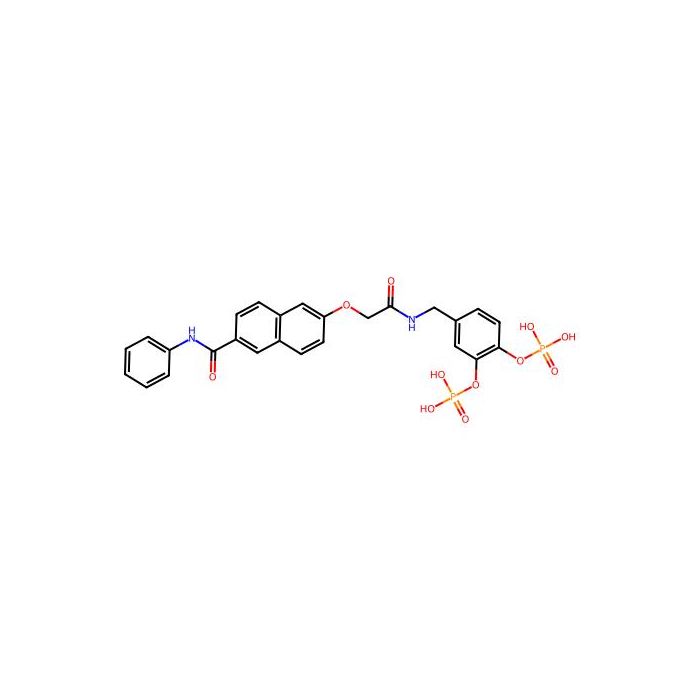
This compound belongs to the class of organic compounds known as naphthalene-2-carboxanilides. These are naphthalene-2-carboxamides, where the carboxamide group is substituted with an aniline.
External Descriptors
Not available
1. Djoumbou Feunang Y, Eisner R, Knox C, Chepelev L, Hastings J, Owen G, Fahy E, Steinbeck C, Subramanian S, Bolton E, Greiner R, and Wishart DS. ClassyFire: Automated Chemical Classification With A Comprehensive, Computable Taxonomy. Journal of Cheminformatics, 2016, 8:61.
Determine the necessary mass, volume, or concentration for preparing a solution.
Dilution Calculator
Determine the dilution needed to prepare a stock solution.
Reconstitution Calculator
Avis
Avis des clients
Application Protocols
No tested application protocols, assay conditions, or recommended dilutions are provided in the Product Data for Stafib-1.
General protocol framework for small-molecule evaluation (not item-specific):
Stock preparation: Prepare 10–50 mM DMSO stock; confirm concentration by UV or qNMR if dosing accuracy is critical.
Biochemical assay example outline: Serially dilute in assay buffer to generate an 8–12 point curve; maintain constant DMSO across wells; include positive/negative controls; monitor for precipitation.
Cell-based assay outline: Establish vehicle controls; start with a broad concentration range (e.g., 0.03–30 µM) as a scout; assess cytotoxicity separately from target readouts.
Stability checks: Incubate in assay buffer at working concentration and monitor by LC–MS over assay time to ensure no significant degradation.
For any specialized applications, consult peer-reviewed literature specific to Stafib-1 (cross-referenced by CAS 1688703-26-5 and CID 122432036) and validate conditions locally.
Biological Roles
Item-specific biological targets, modes of action, or pathway roles for Stafib-1 are not provided in the Product Data. Do not infer activity without corroborating data from the CoA, SDS, or peer-reviewed literature.
General considerations for small-molecule research tools (not item-specific):
If used as a probe compound, clearly define the putative biological target, binding mechanism, and assay readouts. Include orthogonal assays to confirm on-target effects.
Assess aggregation liability (e.g., use detergent controls, dynamic light scattering) and redox/covalent reactivity to avoid false positives in biochemical screens.
Evaluate ADME-relevant properties experimentally where needed: permeability (PAMPA/MDCK), stability in buffer and microsomes, and plasma protein binding.
Spectral properties: Determine intrinsic fluorescence/absorbance to anticipate assay interference and select appropriate detection wavelengths.
Controls: Use negative/positive control compounds, and perform concentration–response curves to establish potency metrics (IC50/EC50) if applicable.
Reminder: Research Use Only. No medical, diagnostic, or therapeutic claims are made or implied for this product.
Buffer Applications
Not typically applicable. Stafib-1 is a discrete small-molecule compound rather than a buffering agent. No buffer capacity or pKa data are provided in the Product Data.
Practical guidance (general, not item-specific):
When preparing assay solutions of small molecules, choose a buffer system appropriate to your biological target (e.g., HEPES, Tris, PBS) and verify the compound’s stability across the working pH range.
Pre-dissolve the compound in an appropriate organic solvent (commonly DMSO) before dilution into the buffer to avoid precipitation.
Filter or centrifuge solutions to remove particulates before sensitive assays.
For any buffer-related compatibility (e.g., metal chelation, redox reactivity), consult literature for the specific structure and perform small-scale tests.
Green Alternatives
Because Stafib-1 is a discrete small-molecule library compound (not a process solvent or commodity reagent), the “green alternatives” concept applies primarily to its handling solvents and workflows rather than to replacement of the compound itself.
Greener handling considerations (general, not item-specific):
Prefer low-toxicity, low-VOC solvents for routine cleaning and sample preparation when feasible (e.g., ethanol or isopropanol instead of chlorinated solvents).
For dissolution, if structure allows, evaluate greener solvents such as ethanol, 2-propanol, or water with biocompatible co-solvents. Recognize that DMSO remains the most reliable for diverse chemotypes but is not “benign by design.”
Minimize solvent volumes via microscale assays and high-throughput screening formats.
Implement closed-vial handling and solvent recovery where possible.
Illustrative comparison (general):
DMSO vs. EtOH: DMSO offers broader solubility; ethanol is greener but may not dissolve highly lipophilic or heteroaromatic-rich compounds.
MeCN vs. EtOH/H2O for HPLC: MeCN gives strong performance; where validated, aqueous ethanol or MeOH gradients may reduce environmental impact, though with possible changes in selectivity and backpressure.
Waste management:
Segregate halogenated and non-halogenated organic waste.
Use microtiter plate formats to reduce per-assay solvent consumption.
Note: No item-specific process substitutions are applicable for this product type.
Pharmaceutical Uses
No pharmacopeial status, excipient role, or formulation use is specified for this item. Stafib-1 is sold for research use only and is not intended for human or veterinary use.
General formulation considerations for research compounds (not item-specific):
Stock solutions: Often prepared in DMSO for in vitro work; confirm concentration by UV or qNMR if quantitative dosing is required.
In vivo research (if undertaken under appropriate approvals): Vehicle design should consider solubility, stability, tolerability, and dose volume. Common vehicles include aqueous buffers with co-solvents (e.g., PEG400, ethanol, Captisol). These are general notes only; no recommendation is made for this specific item in absence of solubility and stability data.
Stability-indicating assays: Develop LC–MS/UPLC methods to monitor degradation in chosen vehicles.
Regulatory note: This product is not GMP-grade and carries no claims regarding suitability for clinical applications. Use strictly in research settings with appropriate institutional approvals.
Physical Properties
Item-specific property data are not supplied in the Product Data. Do not assume values for operational decisions; verify on the CoA/Spec Sheet or SDS.
Appearance: Not specified for this item; refer to CoA/Spec Sheet.
Molecular Weight: Not specified for this item; refer to CoA/Spec Sheet.
Molecular Formula: Not specified for this item; refer to CoA/Spec Sheet.
Melting point (MP): Not specified for this item; refer to CoA/Spec Sheet.
Boiling point (BP): Not specified for this item; refer to CoA/Spec Sheet.
Density: Not specified for this item; refer to CoA/Spec Sheet.
Refractive index: Not applicable unless liquid; value not specified.
pKa/logP/logD: Not specified for this item; refer to CoA/Spec Sheet or computational prediction if needed for method development.
Solubility profile: Not specified for this item. For small-molecule library members, initial dissolution is commonly evaluated in DMSO at 10–50 mM, followed by dilution into assay buffers while monitoring for precipitation.
General laboratory guidance (not item-specific):
If solid: determine hygroscopicity and polymorphism via TGA/DSC and PXRD where relevant.
If solution handling is required: prepare a small test solution in dry DMSO or MeOH, then serially dilute into aqueous media with surfactant (e.g., 0.01–0.05% Tween 20) if compatible with your assay.
Determine UV–vis absorbance spectrum prior to HPLC method development to select detection wavelength and avoid strong background at low UV.
Quality and Grades
Item-specific grade, purity, and stabilizers are not provided in the Product Data. For precise specifications, consult the CoA/Spec Sheet accompanying the lot.
Grade/Purity (item-specific): Not specified for this item; refer to CoA/Spec Sheet.
Stabilizers/Inhibitors: Not specified for this item; refer to CoA/Spec Sheet.
General guidance for small-molecule library compounds (not item-specific):
Typical release tests may include identity (1H NMR, LC–MS), purity by HPLC/UPLC (area%), water content (KF), and residual solvents (GC). If your application is sensitive (biochemical assays, cell-based screening), request detailed impurity profiles.
HPLC/UPLC suitability: Compounds intended for screening are commonly supplied at ≥95% area by HPLC; however, this threshold is not specified here. Verify for your lot.
Metal limits, peroxides, and UV cutoff: Not specified for this item; refer to CoA/Spec Sheet. If your assay is metal-sensitive, consider ICP-MS screening of your working stock.
Batch-to-batch consistency: Record lot numbers and retain analytical data; minor differences in polymorph/solvation state can affect dissolution and activity readouts.
If provided as DMSO stock: verify concentration by UV, qNMR, or LC–MS due to potential evaporation/adsorption losses during handling.
Reaction and Applications
This product is listed as a small-molecule from a compound library intended for research use. No item-specific synthetic or application notes are provided in the Product Data.
Manufacturer Applications (verbatim): Not provided in the Product Data beyond category context (small molecule and compound library). If you are using Stafib-1 as a biochemical probe, design controls for solubility, aggregation (e.g., detergent controls), and redox reactivity.
General research applications for small-molecule tools (not item-specific):
Biochemical assays: Enzyme or protein-binding assays, thermal shift (DSF), MST, ITC—ensure compound purity and absence of interfering fluorescence/absorbance at assay wavelengths.
Cellular studies: If applicable, verify permeability and cytotoxicity baselines; use vehicle controls and titrate DMSO ≤0.5–1% v/v.
Analytical references: LC–MS method development for tracking compound in mixtures or in vitro metabolism studies.
Practical tips:
Prepare fresh DMSO stocks and avoid multiple freeze–thaw cycles to limit degradation.
Filter working solutions (0.22 µm) where compatible to remove particulates before bioassays.
Confirm identity/purity by LC–MS prior to critical experiments; impurities can confound SAR and phenotypes.
Note: Specific reaction chemistry for Stafib-1 (e.g., use as a reagent or building block) is not indicated; treat primarily as a finished small-molecule tool compound.
Reaction Conditions
Not applicable in the usual sense. Stafib-1 is supplied as a discrete research compound rather than a reagent to be used in named synthetic reactions.
General laboratory handling conditions for small-molecule assay compounds (not item-specific):
Solution preparation: Dissolve in high-purity DMSO to 10–50 mM where solubility permits; sonication and gentle warming (≤40 °C) can aid dissolution. Avoid prolonged heating.
Aqueous dilution: Add DMSO stock to buffer slowly with vigorous mixing to reduce precipitation; maintain final DMSO within assay tolerance.
Light/air sensitivity: Unknown for this item. As a precaution, limit exposure to light and air during solution preparation; use amber vials and inert headspace if stability is uncertain.
Filtration: If compatible, pass working solutions through 0.22 µm PTFE/RC filters to remove particulates before sensitive assays (SPR, ITC, kinetic enzyme assays).
Expected yields, catalysts, or temperatures for reactions are not relevant here given the product’s role. For any chemical transformations you plan on Stafib-1, first obtain the full structure and assess functional-group compatibility.
Safety and Handling
Authoritative safety information must be taken from the SDS. The Product Data do not include GHS classification or hazard statements for this item.
GHS/CLP (item-specific):
Signal word: Not specified for this item; refer to SDS.
Hazard statements (H-codes): Not specified for this item; refer to SDS.
Pictograms: Not specified for this item; refer to SDS.
General laboratory precautions (not item-specific):
Wear appropriate PPE: lab coat, safety glasses, and nitrile gloves.
Handle powders/solids in a fume hood to avoid inhalation; minimize dust/aerosol formation.
Avoid contact with strong oxidizers and strong acids/bases unless compatibility is confirmed for this structure.
For small-molecule libraries, assume potential acute toxicity or irritation until proven otherwise. Avoid ingestion, inhalation, and skin/eye contact.
First-aid overview (general):
Skin/eye contact: Rinse with water for at least 15 minutes; remove contaminated clothing; seek medical attention if irritation persists.
Inhalation: Move to fresh air; seek medical attention if symptoms occur.
Ingestion: Rinse mouth; do not induce vomiting unless directed by medical personnel; seek medical advice.
Spill/leak response (general):
Contain solids with inert absorbent, avoid dust generation, and collect in labeled waste.
Thermal/chemical stability: Not specified. Store as directed below and consult SDS for incompatibilities.
Solvent Selection
Item-specific solubility and polarity parameters are not provided. Selection should be guided by small-scale solubility screening.
Practical approach (general, not item-specific):
Primary dissolution solvent for screening compounds: DMSO. Start at 10–50 mM and check for clarity over 1–2 hours at room temperature.
If DMSO is inadequate: try DMF or NMP. For less polar species, use MeCN, MeOH, EtOH, or isopropanol. For highly lipophilic compounds, consider THF, dichloromethane, or a co-solvent system.
Aqueous dilution: Pre-dilute DMSO stock into buffer while vortexing. Maintain final DMSO ≤0.5–1% v/v for biochemical assays, unless assay tolerates more. Add surfactant (e.g., 0.01–0.05% Tween 20) only if compatible and needed to suppress precipitation.
pH effects: If ionizable groups are present (unknown here), solubility may increase in acidic (amines) or basic (acids) environments. Perform a pH-solubility screen (pH 3, 7.4, 9) if feasible.
Comparison snapshot (general):
DMSO: strongest, broad-spectrum solubilizer; high bp; hygroscopic.
MeCN/MeOH: good for LC methods and intermediate polarity compounds.
Aqueous buffers: use only after pre-dissolving in an organic cosolvent; monitor for precipitation.
Note: Because structure-specific properties are not provided for this item, verify solvent compatibility experimentally and consult the CoA.
Storage and Reconstitution
Item-specific conditions from Product Data:
Storage Conditions: Store at -20°C
Shipped In: Ice chest + Ice pads
Additional handling guidance (general, not item-specific):
Upon receipt: Allow the sealed container to equilibrate to room temperature before opening to prevent moisture condensation on cold solids.
Long-term storage: Keep tightly closed in a dry, inert atmosphere. If the compound is hygroscopic or light sensitive (not specified), use desiccant and amber vials.
Working stocks: Prepare aliquots in dry, anhydrous DMSO to minimize freeze–thaw cycles. Store aliquots at -20°C or -80°C as appropriate. Record preparation date and concentration.
Freeze–thaw: Avoid repeated cycles. Thaw on ice or at room temperature; mix thoroughly before use. Discard aliquots showing precipitation or discoloration that does not resolubilize.
Aqueous solutions: If short-term aqueous handling is needed, prepare fresh immediately before use and keep on ice; stability is unknown for this item.
Specifications not provided for this item; refer to CoA/Spec Sheet:
Appearance, purity, water content, stabilizers, and light/air sensitivity.
Research Use Only: Not for human or veterinary use.
Structure and Identity
Brief overview: Stafib-1 is listed as a small-molecule library member. Detailed structural identifiers are not fully specified in the provided Product Data; consult the CoA/Spec Sheet or primary literature for definitive identity data.
Item-specific identifiers (from Product Data):
SKU: S648578
Product Name: Stafib-1
CAS: 1688703-26-5
PubChem CID: 122432036
InChIKey: 339970 (as provided; appears truncated—verify on CoA/SDS)
SMILES: Not specified for this item; refer to CoA/Spec Sheet.
Molecular Formula: Not specified for this item; refer to CoA/Spec Sheet.
Molecular Weight: Not specified for this item; refer to CoA/Spec Sheet.
Structural features:
Functional groups, ring systems, and stereochemistry: Not specified for this item; refer to CoA/Spec Sheet.
2D structure description (general guidance):
Without a provided SMILES/InChI or structural graphic, a text description cannot be given. Obtain structural information from the CoA or trusted databases (cross-check via CAS 1688703-26-5 and CID 122432036).
Identity verification tips (general):
Cross-validate CAS, CID, and InChIKey across at least two databases (e.g., PubChem and supplier CoA).
Confirm LC–MS [M+H]+ mass and isotopic pattern against the CoA.
Use 1H/13C NMR and, if chiral, optical rotation or chiral HPLC for stereochemical confirmation.
Synthetic Utility
No synthetic building-block role is specified for Stafib-1. It is best treated as a finished small-molecule tool rather than a reagent or intermediate.
General commentary on potential synthetic considerations (not item-specific):
If structural information becomes available (via CoA or literature), retrosynthetic analysis could identify privileged scaffolds or functional groups amenable to diversification for SAR studies.
Common medicinal chemistry transformations for analogous tool compounds may include: amide coupling, Suzuki/Miyaura or Buchwald–Hartwig cross-couplings, heteroaryl annulations, and late-stage functionalization. These are not item-specific and should not be presumed applicable here without structure.
For analog generation, ensure unambiguous characterization: HRMS, 1D/2D NMR, HPLC chiral/achiral purity as required, and stability screens under light, heat, and oxidative conditions.
Conclusion: In the absence of a disclosed structure or functional groups, Stafib-1 is not offered as a synthetic reagent; its primary value is as a research compound for screening or probing once its target and properties are confirmed from authoritative sources.
Target Specificity
No item-specific biological target, binding site, enzyme class, or pathway specificity is provided in the Product Data for Stafib-1. Do not assign target claims without corroborating literature or the supplier’s CoA/technical note.
If you intend to evaluate target engagement (general guidance, not item-specific):
Use orthogonal biochemical assays (e.g., enzymatic activity and biophysical binding such as SPR/MST/ITC) to confirm specificity.
Establish selectivity profiles across relevant isoforms or off-target panels where possible.
Apply counterscreens for assay interference (redox cycling, PAINS substructures if applicable, fluorescence quenching/emission overlap, colloidal aggregation using detergent controls).
In cells, pair phenotypic readouts with genetic validation (e.g., knockdown/knockout or overexpression) to support on-target activity.
Absent explicit data, assume no defined specificity for this catalog item.
Foire aux questions
What is the purity of this product?
This product is supplied at ≥95% purity (chemical assay). Lot-specific values are stated on the Certificate of Analysis.
How should this product be stored?
Store at ?20 °C. Freezer storage is required to maintain the specified shelf life.
How is this product shipped?
This product ships in an insulated container with ice pads. Unpack on arrival and transfer it to the storage condition stated above.
What are the CAS number, molecular formula and molecular weight?
The CAS Number is 1688703-26-5, the molecular formula is C26H24N2O11P2, and the molecular weight is 602.42 g/mol. InChIKey SMUYYYBDKASIKY-UHFFFAOYSA-N.
What documentation is provided?
Available product documentation, including Certificates of Analysis (COA), Safety Data Sheets (SDS), and specification sheets, is shown in the product document area. Document availability and access follow the current site policy.
Nous utilisons des cookies pour garantir le bon fonctionnement du site et, lorsque cela est autorisé, pour améliorer votre expérience. Vous pouvez gérer vos préférences à tout moment dans les Paramètres. Pour en savoir plus, consultez notre Politique relative aux cookies.
Souhaitez-vous que nous vous envoyions un message lorsque des réductions seront disponibles?
Me rappeler plus tard
Merci ! Veuillez vérifier votre boîte de réception e-mail pour confirmer.
Products are supplied to verified businesses, institutions, and qualified professionals for research and development use only. Not for use in humans, animals, diagnosis, or therapy.