
Determine the necessary mass, volume, or concentration for preparing a solution.
| Activity Type | Activity Value -log(M) | Mechanism of Action | Activity Reference | Publications (PubMed IDs) |
|---|
Moligand™, 10mM in DMSO Moligand™ for sensitive chromatographic and analytical workflows requiring minimal baseline interference.
Store at -80°C Ships Dry ice packs + Cold packs Check lot-specific COA for exact specifications.
SDS, COA, datasheet, and spec sheet available for download. Lot-specific COA accessible via lot number lookup.
Cited in 1 peer-reviewed publications across chromatography, organic synthesis, and cross-coupling reactions.
Information
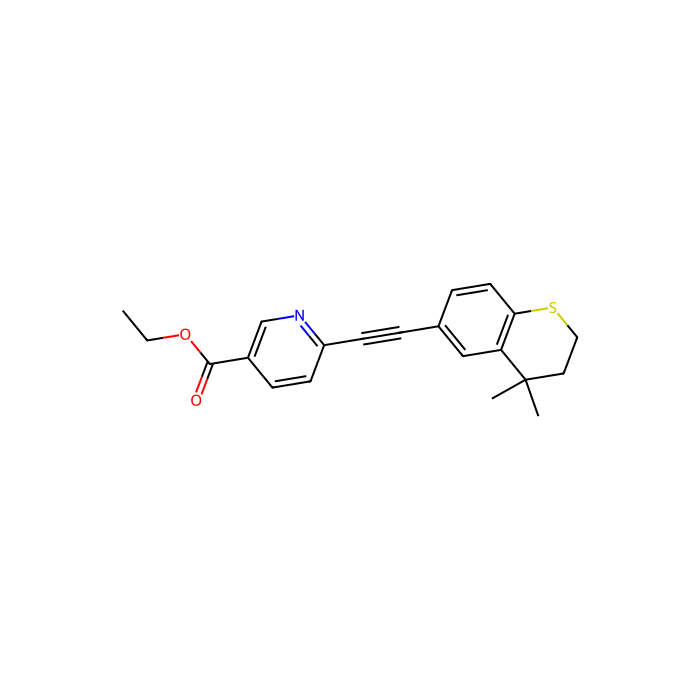
Tazarotene Tazarotene (AGN190168) is a retinoid prodrug of tazarotenic acid, which is a RAR agonist, used to treat psoriasis, acne, and sun damaged skin.
In vitro
Tazarotene causes ERK activation, RB tumor suppressor protein hypophosphorylation, G0 arrest, and myeloid differentiation in HL-60 human myeloblastic leukemia cells. Tazarotene could propel either early or late portions of the period leading to differentiation and G0 arrest and is interchangeable with an RARalpha-selective ligand. Tazarotene therapy regulates gene transcription via interaction with specific nuclear retinoic acid receptors (RARs), thereby modulating the three key pathogenic factors in psoriasis. Tazarotene inhibits the proliferation of fibroblasts and synthesis of DNA and collagen. Tazarotene down-regulates markers of keratinocyte differentiation, keratinocyte proliferation, and inflammation. Tazarotene also up-regulates three novel genes TIG-1 (tazarotene-induced gene-1), TIG-2, and TIG-3, which may mediate an antiproliferative effect. Tazarotene causes growth suppression in retinoid-responsive breast cancer cell lines by up-regulating TIG3.
In vivo
Tazarotene treatment reduces the number and size of microscopic basal cell carcinomas (BCCs) in UV-treated Ptch1+/− mice. Tazarotene treatment reduces the number and size of microscopic basal cell carcinomas (BCCs) in ionizing radiation-treated Ptch1+/− mice.
Cell Data
cell lines:
Concentrations:
Incubation Time:
Powder Purity:≥98%
| ALogP | 4.9 |
|---|
| Isomeric SMILES | CCOC(=O)C1=CN=C(C=C1)C#CC2=CC3=C(C=C2)SCCC3(C)C |
|---|---|
| WGK Germany | 3 |
| RTECS | US5675100 |
| PubChem CID | 5381 |
| Molecular Weight | 351.46 |
| Reaxy-Rn | 8159145 |
Comprehensive hazard, handling, storage, and regulatory compliance document.
Download SDS →Lot-specific quality data. Enter your lot number to retrieve the exact COA.
Look up COA →Full quality attributes and acceptance criteria for this grade.
View spec sheet →| Activity Type | Activity Value -log(M) | Mechanism of Action | Activity Reference | Publications (PubMed IDs) |
|---|
| Activity Type | Activity Value -log(M) | Mechanism of Action | Activity Reference | Publications (PubMed IDs) |
|---|
| Activity Type | Activity Value -log(M) | Mechanism of Action | Activity Reference | Publications (PubMed IDs) |
|---|
| Melt Point(°C) | 105 °C |
|---|
| 1. Yan Deng, Hao Cheng, Ji Zhu, Yue Jiang, Hongwu Sun, Guocheng Li, Jing Wei, Ruoyi Xue, Rang Feng, Jingwen Cao, Wenkang Yu, Yalan Wang, Mingqi Xu, Quanming Zou, Haibo Li. (2025) Tamibarotene-Loaded Nanoemulsion Incorporating Toll-like Receptor 2/6 Agonist as an Intramuscular Adjuvant System Enhances Gastrointestinal Mucosal Immunity. ACS Nano, [PMID:40376869] [10.1021/acsnano.5c00563] |
Our grade selection guide covers purity, stabilizer status, and application suitability for all variants in our catalog.
View Moligand™ grade guide →