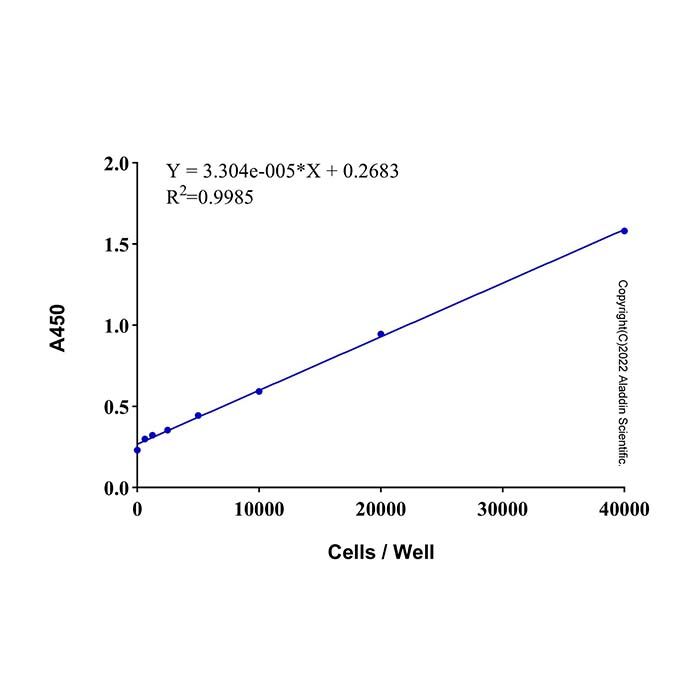
WST‑1 is an upgraded alternative to MTT. It has significant advantages over MTT and other MTT‑related products such as XTT and MTS.First, the formazan produced by the reduction of MTT by some dehydrogenases in mitochondria is not water‑soluble and requires a special solubilization solution.In contrast, the formazan produced by WST‑1, XTT, and MTS is water‑soluble, eliminating the subsequent solubilization step.Second, the formazan generated by WST‑1 is more soluble than that produced by XTT and MTS.Third, WST‑1 is more stable than XTT and MTS, leading to more stable experimental results.In addition, compared with MTT and XTT, WST‑1 has a wider linear range and higher sensitivity.
This kit can be used for cell proliferation assays induced by cytokines,as well as cytotoxicity assays induced by cytotoxic agents such as anticancer drugs,or cell growth inhibition assays induced by various drugs.The assay is highly convenient.No radioisotopes are required, and all detection steps can be performed in a single 96‑well plate.
There is no need to wash or harvest cells, or to perform additional steps to dissolve formazan.
The kit is suitable for high‑throughput detection.Phenol red and serum have no significant effect on the assay.
Components
W1507451 | Components | 100T | 500T | 2500T | Storage | W1507451A | WST-1(powder) | 1 vial | 1 vial | 1 vial | -20℃, Store in the dark. | W1507451B | Electron Coupling Reagent | 1 mL | 5 mL | 25 mL | -20℃, Store in the dark. |
|
Instructions
1. Preparation of WST‑1 solution:
Add 1 mL of electron coupling reagent to the WST‑1 powder and dissolve completely to obtain the WST‑1 solution.The WST‑1 solution can be stored at 4°C protected from light for one week without affecting performance.For long‑term storage, aliquot the solution and store at ‑20°C protected from light for up to six months (avoid repeated freeze‑thaw cycles).Some precipitation may be observed after thawing, which is normal. Incubate in a 37°C water bath for 2–10 minutes; the precipitate will usually dissolve completely.
2. For cell proliferation assays, seed 2000 cells in 100 μL per well.For cytotoxicity assays, seed 5000 cells in 100 μL per well.The exact cell number per well should be determined according to cell size, proliferation rate, and other factors.Culture cells and treat with 0–10 μL of the specified drug as required.
3. Add 10 μL of WST‑1 solution to each well.If the initial culture volume is 200 μL, add 20 μL of WST‑1 solution, and scale proportionally for other volumes.Wells containing the corresponding volume of cell culture medium and WST‑1 solution but no cells can be used as blank controls.
4. Incubate for 0.5–4 hours in a cell culture incubator; 1–2 hours is sufficient for most cell types.The incubation time depends on cell type and density.For initial experiments, measure absorbance at 0.5, 1, 2, and 4 hours using a microplate reader, then select the time point with an appropriate absorbance range for subsequent experiments.
5. Place the 96‑well plate on an orbital shaker and shake for one minute to fully mix the assay system.
6. Measure absorbance at 450 nm.If a 450 nm filter is unavailable, a filter within 420–480 nm can be used.A wavelength above 600 nm can be used as the reference wavelength for dual‑wavelength measurement.
Precautions
1. As the assay is performed using a 96‑well plate, evaporation must be considered during long‑term cell culture.On one hand, the outer wells of the plate are most prone to evaporation; these can be left unused and filled with an equal volume of PBS, water, or medium.On the other hand, placing the plate near the water source inside the incubator can help reduce evaporation.
2. The detection in this kit relies on dehydrogenase‑catalyzed reactions.Therefore, reducing agents (such as certain antioxidants) may interfere with the assay.If a high level of reducing agents is present in the test system, they should be removed beforehand.
3. Ensure there are no air bubbles in any well before measurement with a microplate reader, as bubbles will interfere with the absorbance reading.
4. This product is for research use only by qualified personnel.It is not intended for clinical diagnosis or treatment, or for use in food or drug products.Do not store in ordinary residential premises.
5. For your safety and health, please wear a lab coat and disposable gloves during operation.

 ZJ26F0433906