10mM in DMSO for sensitive chromatographic and analytical workflows requiring minimal baseline interference.
🌡
Storage & shipping
Store at -80°C Ships Dry ice packs + Cold packs Check lot-specific COA for exact specifications.
📋
Quality documents
SDS, COA, datasheet, and spec sheet available for download. Lot-specific COA accessible via lot number lookup.
📚
Literature proof
Cited in 0 peer-reviewed publications across chromatography, organic synthesis, and cross-coupling reactions.
Overview
Information
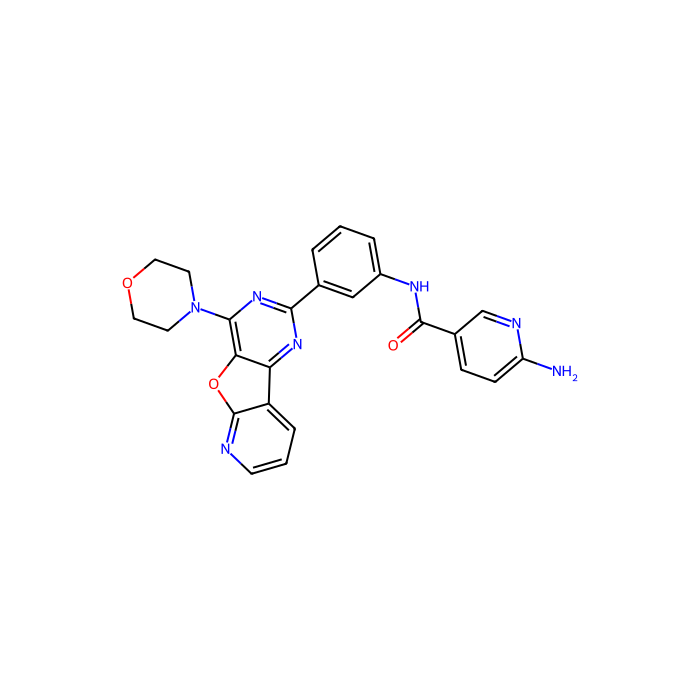
YM201636 is a selectivePIKfyveinhibitor withIC50of 33 nM, less potent to p110α and insensitive to Fabl (yeast orthologue). YM-201636 suppresses the growth of liver cancer via the induction ofautophagy. In vitro
YM201636 potently inhibits mammalian PIKfyve with an IC50 of 33 nM but not yeast orthologue Fab1 with an IC50 of >5 μM, exhibiting around 100-fold selectivity for PtdIns3P p110α with an IC50 of 3 μM. YM201636 (0.8 μM) significantly decreases the production of PtdIns(3,5)P2 by 80% in serum-starved NIH3T3 cells followed by serum stimulation with no effect on serum-stimulated protein kinase B (PKB) Ser 473 phosphorylation. YM-201636 reversibly impairs endosomal trafficking in NIH3T3 cells by blocking PIKfyve and PtdIns(3,5)P2 production, mimicking the effect produced by depleting PIKfyve with siRNA. YM-201636 (0.8 μM) also significantly reduces retroviruses budding from cells by 80%, apparently through interfering with the endosomal sorting complex required for transport (ESCRT) machinery. In 3T3L1 adipocytes, YM-201636 inhibits basal and insulin-activated 2-deoxyglucose uptake with an IC50 of 54 nM, with almost complete inhibition at doses as low as 160 nM. YM-201636 (0.1 μM) has also been shown to completely block insulin-dependent activation of class IA PI 3-kinase. Although not involved in NPM-ALK-dependent proliferation and migration, YM201636 (0.4 μM) strongly reduces invasive capacities of NPM-ALK-expressing cells and their capacity to degrade the extracellular matrix. YM201636 treatment blocks the continuous recycling of junctional proteins claudin-1 and claudin-2 in MDCK cells, leading to the intracellular accumulation and delay of epithelial barrier formation.
YM201636 is a selective PIKfyve inhibitor with IC50 of 33 nM, less potent to p110α and insensitive to Fabl (yeast orthologue). YM-201636 suppresses the growth of liver cancer via the induction of autophagy.
Storage
Store at -80°C
Shipped In
Dry ice packs + Cold packs
This product requires cold chain shipping. Ground and other economy services are not available.
We use cookies to ensure the website functions properly and, where permitted, to improve your experience. You can manage your preferences at any time in Settings. Learn more in our Cookie Policy.
Shall we send you a message when we have discounts available?
Remind me later
Thank you! Please check your email inbox to confirm.
Products are supplied to verified businesses, institutions, and qualified professionals for research and development use only. Not for use in humans, animals, diagnosis, or therapy.