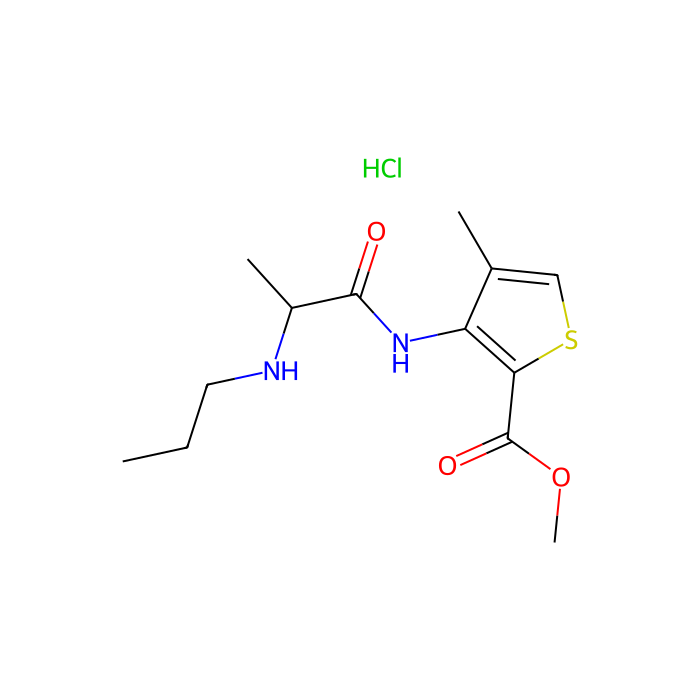
10mM in DMSO for sensitive chromatographic and analytical workflows requiring minimal baseline interference.
🌡
Storage & shipping
Store at -80°C Ships Dry ice packs + Cold packs Check lot-specific COA for exact specifications.
📋
Quality documents
SDS, COA, datasheet, and spec sheet available for download. Lot-specific COA accessible via lot number lookup.
📚
Literature proof
Cited in 1 peer-reviewed publications across chromatography, organic synthesis, and cross-coupling reactions.
Overview
Information
Articaine (Ultracaine) is a dental local anesthetic which contains an additional ester group that is metabolized by estearases in blood and tissue. In vitro
In vivo
The time to maximum drug concentrations of articaine occurs about 10 to 15 minutes after submucosal injection of articaine 4% 80 mg. The elimination half-time of articaine is about 20 minutes. Articaine is better able to diffuse through soft tissue and bone than other local anaesthetics, the concentration of articaine in the alveolus of a tooth in the upper jaw after extraction is about 100 times higher than that in systemic circulation. Articaine: VAS (Visual Analogue Scale) scores (from 0 to 10 cm) by patients 4 to < 13 years of age are 0.5 for simple procedures and 1.1 for complex procedures, and average investigator scores are 0.4 and 0.6 for simple and complex procedures, respectively. No serious adverse events related to the articaine occurres, the only adverse event considered related to articaine is accidental lip injury in one patient. Articaine results in success rate of 64.5% in electronic pulp testing in healthy adult volunteers injected with 4% articaine. Articaine infiltration produces significantly more episodes of no response to maximum stimulation in first molars than lidocaine. Mandibular buccal infiltration is more effective with 4% articaine with epinephrine compared to 2% lidocaine with epinephrine. Articaine (4%) results in the success rate of 24% for the inferior alveolar nerve block in randomized, double-blind study. Articaine formulation results in successful pulpal anesthesia ranged from 75 to 92 percent and onset of pulpal anesthesia ranged from 4.2 to 4.7 minutes in healthy volunteer. For articaine, 4 percent (two of 56) of the subjects reported swelling and no subjects reported bruising. Ninety-eight percent (59 of 60) of the subjects had lip numbness with the articaine solution. Cell Data
We use cookies to ensure the website functions properly and, where permitted, to improve your experience. You can manage your preferences at any time in Settings. Learn more in our Cookie Policy.
Shall we send you a message when we have discounts available?
Remind me later
Thank you! Please check your email inbox to confirm.
Products are supplied to verified businesses, institutions, and qualified professionals for research and development use only. Not for use in humans, animals, diagnosis, or therapy.