
Determine the necessary mass, volume, or concentration for preparing a solution.
| Activity Type | Activity Value -log(M) | Mechanism of Action | Activity Reference | Publications (PubMed IDs) |
|---|
Moligand™, 10mM in DMSO Moligand™ for sensitive chromatographic and analytical workflows requiring minimal baseline interference.
Store at -80°C Ships Dry ice packs + Cold packs Check lot-specific COA for exact specifications.
SDS, COA, datasheet, and spec sheet available for download. Lot-specific COA accessible via lot number lookup.
Cited in 0 peer-reviewed publications across chromatography, organic synthesis, and cross-coupling reactions.
Information
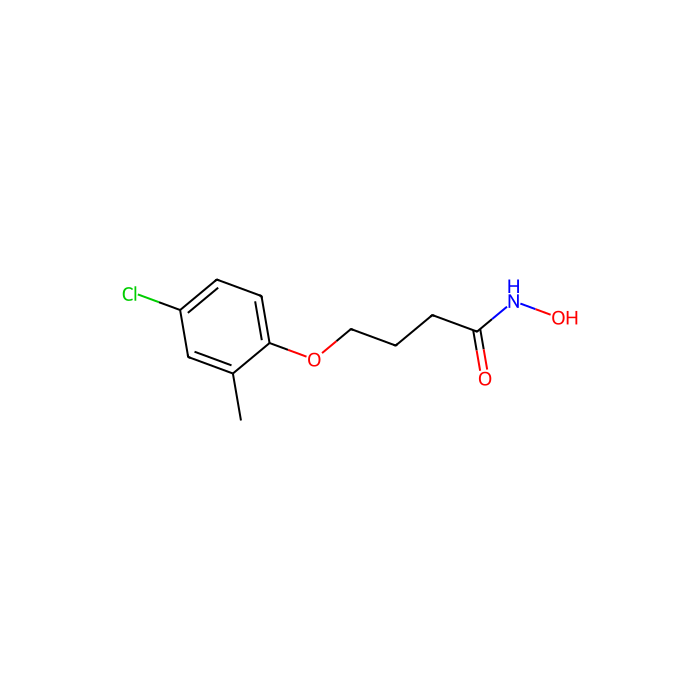
Droxinostat (NS 41080) is a selective inhibitor ofHDAC, mostly for HDACs 6 and 8 withIC50of 2.47 μM and 1.46 μM, greater than 8-fold selective against HDAC3 and no inhibition to HDAC1, 2, 4, 5, 7, 9, and 10.
In vitro
Droxinostat is originally identified as a sensitizer of PPC-1 cells to FAS and TRAIL by downregulating the expression of c-Fas-associated death domain-like interleukin-1-converting enzyme-like inhibitory protein (c-FLIP). In PPC-1 cells cultured in suspension but not adherent conditions, Droxinostat (20 μM–60 μM) sensitizes cells to anoikis by initially activating caspase 8 with subsequent activation of the mitochondrial pathway. Similarly, Droxinostat also sensitizes other cancer cell lines including PC-3, DU-145, T47D, and OVCAR-3, but not LNCaP or MB-MDA-468, to anoikis or CH-11-induced apoptosis. However, the direct targets of Droxinostat remains enigma until recently. It is revealed that in histone deacetylases (HDAC) isoform 1-10, Droxinostat selective inhibits HDAC3, 6, and 8, with IC50 values of 16.9 μM, 2.47 μM, and 1.46 μM, respectively, without inhibiting other HDAC members (IC50 > 20 μM). In MCF-7 breast cancer cells, Droxinostat (10 μM–100 μM) sensitizes cells to apoptosis by decreasing c-FLIPL and c-FLIPS expression, reducing cell survival, and inducing apoptosis.
In vivo
In SCID mice models, Droxinostat (30 μM)-treated PPC-1 cells results in decreased distant tumor formation than untreated cells.
Cell Data
cell lines:MEFs
Concentrations:0–100 μM, dissolved in DMSO (final concentration of DMSO is 0.5%)
Incubation Time:24 hours
Powder Purity:≥96%
| 異性体SMILES | CC1=C(C=CC(=C1)Cl)OCCCC(=O)NO |
|---|---|
| WGKドイツ | 3 |
| 分子量 | 243.69 |
| Reaxy-Rn | 11721332 |
| Reaxys-RN_link_address | https://www.reaxys.com/reaxys/secured/hopinto.do?context=S&query=IDE.XRN=11721332&ln= |
Comprehensive hazard, handling, storage, and regulatory compliance document.
Download SDS →Lot-specific quality data. Enter your lot number to retrieve the exact COA.
Look up COA →Full quality attributes and acceptance criteria for this grade.
View spec sheet →| Activity Type | Activity Value -log(M) | Mechanism of Action | Activity Reference | Publications (PubMed IDs) |
|---|
| Activity Type | Activity Value -log(M) | Mechanism of Action | Activity Reference | Publications (PubMed IDs) |
|---|
| Activity Type | Activity Value -log(M) | Mechanism of Action | Activity Reference | Publications (PubMed IDs) |
|---|
| 溶解度 | Solubility (25°C) In vitro Water: 39 mg/mL (198.86 mM); DMSO: Insoluble; |
|---|
Our grade selection guide covers purity, stabilizer status, and application suitability for all variants in our catalog.
View Moligand™ grade guide →