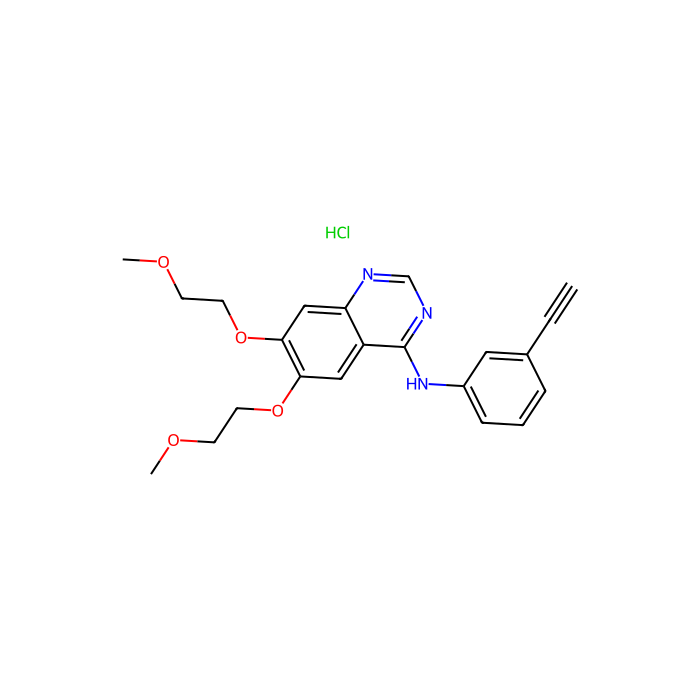
2mM in DMSO for sensitive chromatographic and analytical workflows requiring minimal baseline interference.
🌡
Storage & shipping
Store at -80°C Ships Dry ice packs + Cold packs Check lot-specific COA for exact specifications.
📋
Quality documents
SDS, COA, datasheet, and spec sheet available for download. Lot-specific COA accessible via lot number lookup.
📚
Literature proof
Cited in 4 peer-reviewed publications across chromatography, organic synthesis, and cross-coupling reactions.
Overview
Information
In vitro
Erlotinib HCl potently inhibits EGFR activation in intact cells including HNS human head and neck tumor cells (IC50 20nM), DiFi humancolon cancer cells andMDA MB-468 human breast cancer cells. Erlotinib HCl (1 μM) induces apoptosis in DiFi humancolon cancer cells. Erlotinib inhibits growth of a panel of NSCLC cell lines including A549, H322, H3255, H358 H661, H1650, H1975, H1299, H596 with IC50 ranging from 29 nM to >20 μM. Erlotinib HCl(2 μM) significantly inhibits growth of AsPC-1 and BxPC-3 pancreatic cells. The effects of Erlotinib HCl in combination with gemcitabine are considered additive in KRAS-mutated pancreatic cancer cells. Ten micromolar of Erlotinib HCl inhibits EGFR phospho-rylation at the Y845 (Src-dependent phosphorylation) and Y1068 (auto-phosphorylation) sites. Combination with Erlotinib HCl could down-modulate rapamycin-stimulated Akt activity and produces a synergistic effect on cell growth inhibition.
In vivo
At doses of 100 mg/kg, Erlotinib HCl completely prevents EGF-induced autophosphorylation of EGFR in human HN5 tumors growing as xenografts in athymic mice and of the hepatic EGFR of the treated mice. Erlotinib HCl (100 mg/Kg) inhibits H460a and A549 tumor models with 71 and 93% inhibition rate. Cell Data
cell lines:
Concentrations:30 nM-20 μM
Incubation Time:72 hours
Powder Purity:≥99%
Specifications
Synonyms
CP358774, NSC 718781
Specifications & Purity
2mM in DMSO
Biochemical and Physiological Mechanisms
Erlotinib HCl (OSI-744, CP358774, NSC 718781) is an EGFR inhibitor with IC50 of 2 nM in cell-free assays, >1000-fold more sensitive for EGFR than human c-Src or v-Abl.
Storage
Store at -80°C
Shipped In
Dry ice packs + Cold packs
This product requires cold chain shipping. Ground and other economy services are not available.
2.Yuping Liu, Xiangliang Jiang, Yue Gu, Yan Chen. (2019) Preventive effect of Diallyl Trisulfide on cutaneous toxicities induced by EGFR inhibitor. INTERNATIONAL IMMUNOPHARMACOLOGY, [PMID:30682720][10.1016/j.intimp.2019.01.023]
3.Yueying Zhang, Dan Gao, Shangfu Li, Weili Wei, Jinshun Lin, Yuyang Jiang. (2019) 1,5-Diaminonaphthalene functionalized carbon nanodots as a novel matrix for the analysis of small molecules by matrix-assisted laser desorption/ionization mass spectrometry. Analytical Methods, 11 (8):(1131-1136). [PMID:][10.1039/C8AY02665C]
We use cookies to ensure the website functions properly and, where permitted, to improve your experience. You can manage your preferences at any time in Settings. Learn more in our Cookie Policy.
Shall we send you a message when we have discounts available?
Remind me later
Thank you! Please check your email inbox to confirm.
Products are supplied to verified businesses, institutions, and qualified professionals for research and development use only. Not for use in humans, animals, diagnosis, or therapy.