
Induction Strategies for E. coli Expression in Biopharmaceutical Production
Induction Strategies for E. coli Expression in Biopharmaceutical Production
In E. coli expression, induction is critical. The research-standard inducer IPTG (isopropyl β-D-thiogalactopyranoside) is favored for its efficiency, stability, and low cost. However, in GMP-grade production IPTG is tightly restricted due to cell toxicity, chemical-residue risk, and regulatory compliance requirements.
I. Why is IPTG widely used in research?
IPTG is a lactose analog that mimics lactose binding to the lac repressor, causing it to dissociate from DNA and initiate transcription of the target gene.
Advantages:
- High efficiency and stability: rapid induction and high protein yield.
- Low cost and easy to obtain.
- Sustained activity: not metabolized by E. coli, maintains a steady induction level.
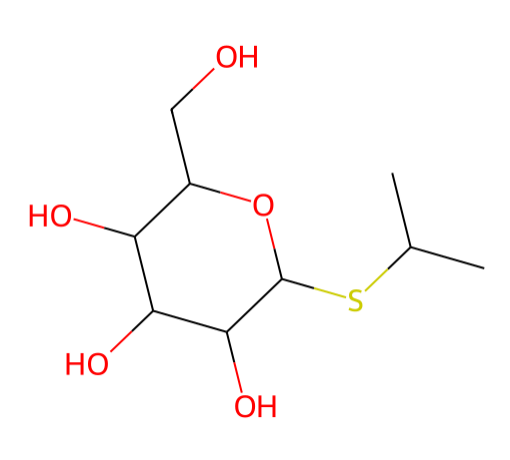
Figure 1. Chemical structure of IPTG
II. Why is IPTG unsuitable for drug-grade protein manufacturing?
Regulators (e.g., FDA, EMA) demand high safety, consistency, and controllability across the process when the product is intended for therapy.
1.Cytotoxicity risk
At higher concentrations IPTG stresses host cells, affecting folding/activity and increasing inclusion bodies.
2.Chemical-residue concern
As a synthetic chemical, trace carryover may persist despite purification and is misaligned with GMP expectations.
3.Compliance barrier
Regulatory filings must list all materials and safety data; IPTG complicates review and increases risk.
III. Induction systems suitable for GMP manufacturing
To meet the safety and compliance requirements of pharmaceutical manufacturing, the research and industrial communities have developed multiple alternative induction strategies:
1.Heat induction
Principle: Temperature-sensitive repressors (e.g., λ cI857) suppress expression at low temperature and inactivate at ~42 °C to turn on expression.
Pros: No chemical inducer—eliminates residue risk.
Cons: Heat shock can affect quality; large-scale temperature control is challenging.
2.L-arabinose induction
Principle: L-arabinose binds AraC to activate expression from the arabinose operon.
Pros: Natural, metabolizable, non-toxic; tunable by concentration.
Cons: Higher cost; induction may wane as sugar is metabolized.
3.Metabolizable inducers (e.g., lactose)
Principle: Engineer the system so lactose replaces IPTG.
Pros: Safe, inexpensive, scale-friendly.
Cons: Slightly lower efficiency; less precise control than IPTG.
Induction mode | Suitable scenarios | Advantages | Disadvantages |
IPTG induction | Research-grade protein production | Efficient, stable, inexpensive, easy to use | Toxicity and residue risks; not GMP-compliant |
Heat induction | GMP production; large-scale fermentation | No chemical additives; safety and compliance | Difficult temperature control; heat-shock may impact quality |
L-arabinose induction | GMP production; needs fine control | Natural and safe; highly tunable | Higher cost; induction persistence limited by metabolism |
Lactose induction | GMP production; cost-sensitive projects | Safe and inexpensive | Lower efficiency; less precise control |
In research settings, IPTG remains the most cost-effective inducer. However, once a target protein advances to drug development or industrial-scale manufacturing, safety, compliance, and process controllability become the top priorities. At that point, the induction method should be chosen according to production needs—favoring safer systems such as heat induction, L-arabinose, or lactose—to ensure product quality and regulatory consistency.
Aladdin: https://www.aladdinsci.com/