
Determine the necessary mass, volume, or concentration for preparing a solution.
| Activity Type | Activity Value -log(M) | Mechanism of Action | Activity Reference | Publications (PubMed IDs) |
|---|
Moligand™,≥99% Moligand™ for sensitive chromatographic and analytical workflows requiring minimal baseline interference.
Store at -20°C Ships Ice chest + Ice pads Check lot-specific COA for exact specifications.
SDS, COA, datasheet, and spec sheet available for download. Lot-specific COA accessible via lot number lookup.
Cited in 0 peer-reviewed publications across chromatography, organic synthesis, and cross-coupling reactions.
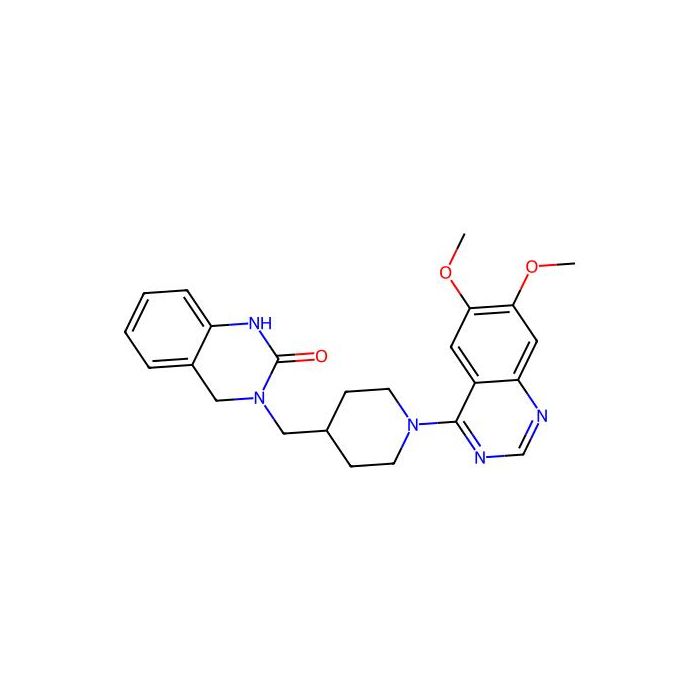
K-756 is a direct and selective tankyrase ( TNKS ) inhibitor, which inhibits the ADP-ribosylation activity of TNKS1 and TNKS2 with IC 50 s of 31 and 36 nM, respectively.
In Vitro
K-756 is a novel and selective Wnt/β-catenin pathway inhibitor targeting tankyrase (TNKS). TNKS is one of the members of the PARP family (it is also known as PARP5). K-756 binds to the induced pocket of TNKS and inhibits its enzyme activity. To study the isoform selectivity of K-756, the PARP family enzyme inhibitory activity at 10 μM is evaluated. K-756 inhibits TNKS1 and TNKS2 by 97% and 100%, respectively. In contrast, the inhibitory activity of K-756 against PARP1, PARP2, PARP3, PARP6, PARP7, and PARP11 is less than 13%. K-756 inhibits the cell growth of APC-mutant colorectal cancer COLO 320DM and SW403 cells by inhibiting the Wnt/β-catenin pathway. K-756 strongly inhibits the reporter activity in DLD-1/TCF-Luc cells with an IC 50 of 110 nM, but does not inhibit DLD-1/mtTCF-Luc cells, even at 1,000 nM. APC-mutant colorectal cancer cell line COLO 320DM and SW403 cells are treated with K-756 and after 144 hours, cell growth inhibition is measured by an XTT assay. The application of K-756 inhibits the cell growth of COLO 320DM with a GI 50 of 780 nM. K-756 also inhibits SW403 with a GI 50 of 270 nM. MCE has not independently confirmed the accuracy of these methods. They are for reference only.
In Vivo
DLD-1/TCF-Luc cell xenografts are created in SCID mice. Vehicle (0.5% MC400) or K-756 is administered orally once a day for 3 days at 100, 200, and 400 mg/kg. The Wnt/β-catenin signal inhibition in the tumor is detected by measuring FGF20 and LGR5 and luciferase activity. The expression of FGF20 and reporter activity are significantly decreased at doses of 100 mg/kg and above at 3-day administration. The expression of LGR5 is significantly decreased at doses of 200 mg/kg and above at 3-day administration. The maximum inhibitory activity is reached with the administration of K-756 at a dose of 400 mg/kg at 3-day administration. The Wnt/β-catenin signal inhibition at a dose of 400 mg/kg is observed from 1-day administration . MCE has not independently confirmed the accuracy of these methods. They are for reference only.
Form:Solid
IC50& Target:TNKS1 31 nM (IC 50 ) TNKS2 36 nM (IC 50 )
| Canonical Smiles | COC1=C(C=C2C(=C1)C(=NC=N2)N3CCC(CC3)CN4CC5=CC=CC=C5NC4=O)OC |
|---|---|
| IUPAC Name | 3-[[1-(6,7-dimethoxyquinazolin-4-yl)piperidin-4-yl]methyl]-1,4-dihydroquinazolin-2-one |
| InChIKey | GWXCGEJJQFHPPA-UHFFFAOYSA-N |
| INCHI | 1S/C24H27N5O3/c1-31-21-11-18-20(12-22(21)32-2)25-15-26-23(18)28-9-7-16(8-10-28)13-29-14-17-5-3-4-6-19(17)27-24(29)30/h3-6,11-12,15-16H,7-10,13-14H2,1-2H3,(H,27,30) |
| Isomeric SMILES | COC1=C(C=C2C(=C1)C(=NC=N2)N3CCC(CC3)CN4CC5=CC=CC=C5NC4=O)OC |
| Molecular Weight | 433.50 |
Comprehensive hazard, handling, storage, and regulatory compliance document.
Download SDS →Lot-specific quality data. Enter your lot number to retrieve the exact COA.
Look up COA →Full quality attributes and acceptance criteria for this grade.
View spec sheet →Taxonomy Tree
| Kingdom | Organic compounds |
|---|---|
| Superclass | Organoheterocyclic compounds |
| Class | Diazanaphthalenes |
| Subclass | Benzodiazines |
| Intermediate Tree Nodes | Quinazolines |
| Direct Parent | Quinazolinamines |
| Alternative Parents | Dialkylarylamines Anisoles Pyrimidones Aminopyrimidines and derivatives Alkyl aryl ethers Piperidines Imidolactams Heteroaromatic compounds Ureas Azacyclic compounds Organic oxides Hydrocarbon derivatives Carbonyl compounds |
| Molecular Framework | Aromatic heteropolycyclic compounds |
| Substituents | Quinazolinamine - Anisole - Phenol ether - Dialkylarylamine - Alkyl aryl ether - Aminopyrimidine - Pyrimidone - Piperidine - Imidolactam - Benzenoid - Pyrimidine - Heteroaromatic compound - Urea - Ether - Azacycle - Organooxygen compound - Organonitrogen compound - Organic nitrogen compound - Carbonyl group - Organic oxide - Organic oxygen compound - Hydrocarbon derivative - Amine - Aromatic heteropolycyclic compound |
| Description | This compound belongs to the class of organic compounds known as quinazolinamines. These are heterocyclic aromatic compounds containing a quianazoline moiety substituted by one or more amine groups. |
| External Descriptors | Not available |
| Activity Type | Activity Value -log(M) | Mechanism of Action | Activity Reference | Publications (PubMed IDs) |
|---|
| Activity Type | Activity Value -log(M) | Mechanism of Action | Activity Reference | Publications (PubMed IDs) |
|---|
| Activity Type | Relation | Activity value | Units | Action Type | Journal | PubMed Id | doi | Assay Aladdin ID |
|---|
| Activity Type | Relation | Activity value | Units | Action Type | Journal | PubMed Id | doi | Assay Aladdin ID |
|---|
| Activity Type | Relation | Activity value | Units | Action Type | Journal | PubMed Id | doi | Assay Aladdin ID |
|---|
| Activity Type | Relation | Activity value | Units | Action Type | Journal | PubMed Id | doi | Assay Aladdin ID |
|---|
| Solubility | DMSO : 4.55 mg/mL (10.50 mM; Need ultrasonic) |
|---|---|
| Molecular Weight | 433.500 g/mol |
| XLogP3 | 3.100 |
| Hydrogen Bond Donor Count | 1 |
| Hydrogen Bond Acceptor Count | 6 |
| Rotatable Bond Count | 5 |
| Exact Mass | 433.211 Da |
| Monoisotopic Mass | 433.211 Da |
| Topological Polar Surface Area | 79.800 Ų |
| Heavy Atom Count | 32 |
| Formal Charge | 0 |
| Complexity | 643.000 |
| Isotope Atom Count | 0 |
| Defined Atom Stereocenter Count | 0 |
| Undefined Atom Stereocenter Count | 0 |
| Defined Bond Stereocenter Count | 0 |
| Undefined Bond Stereocenter Count | 0 |
| The total count of all stereochemical bonds | 0 |
| Covalently-Bonded Unit Count | 1 |
Our grade selection guide covers purity, stabilizer status, and application suitability for all variants in our catalog.
View Moligand™ grade guide →