
Determine the necessary mass, volume, or concentration for preparing a solution.
| Activity Type | Activity Value -log(M) | Mechanism of Action | Activity Reference | Publications (PubMed IDs) |
|---|
≥99% for sensitive chromatographic and analytical workflows requiring minimal baseline interference.
Store at -20°C Ships Ice chest + Ice pads Check lot-specific COA for exact specifications.
SDS, COA, datasheet, and spec sheet available for download. Lot-specific COA accessible via lot number lookup.
Cited in 0 peer-reviewed publications across chromatography, organic synthesis, and cross-coupling reactions.
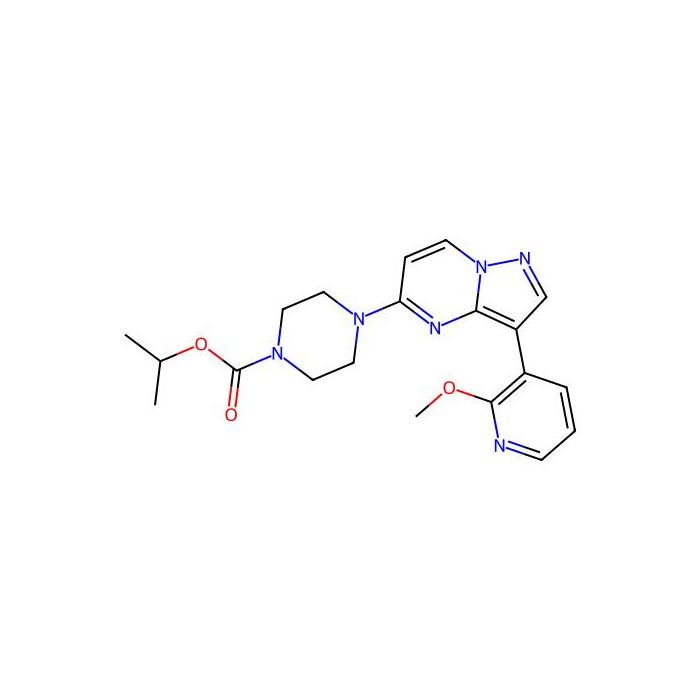
LP-935509 is an orally active, potent, selective, ATP-competitive and brain-penetrant inhibitor of adaptor protein-2 associated kinase 1 (AAK1) with an IC 50 of 3.3 nM and a K i of 0.9 nM, respectively. LP-935509 is also a potent inhibitor of BIKE ( IC 50 =14 nM) and a modest inhibitor of GAK ( IC 50 =320 nM). LP-935509 shows antinociceptive activity. LP-935509 can be used for neuropathic pain and SARS-CoV-2 research
In Vitro
LP-935509 inhibits μ2 phosphorylation with an IC 50 value of 2.8 ± 0.4 nM, inhibits phosphorylation of a peptide derived from the μ2 protein with an IC 50 value of 3.3 ± 0.7 nM. LP-935509 exhibits a dose-dependent inhibition of the SARS-CoV-2 S-RBD internalization into host cells. MCE has not independently confirmed the accuracy of these methods. They are for reference only.
In Vivo
LP-935509 (0-60 mg/kg; PO, single) causes a robust reduction in pain behavior . LP-935509 (0.1-30 mg/kg; PO, single dosage) causes a dose-dependent reversal of thermal hyperalgesia in CCI model . LP-935509 (IV (1 mg/kg) or orally (10 mg/kg); once) has 100% oral bioavailability and a plasma half life of 3.6 hours . MCE has not independently confirmed the accuracy of these methods. They are for reference only. Animal Model: Male C57BL/6J mice (with SNL(spinal nerve ligation) injury, n=8-10 male mice per group) Dosage: 0, 10, 30 and 60 mg/kg (10 ml/kg) Administration: PO, single Result: Caused a dose-dependent reduction in phase II paw flinches that was significantly lower than the vehicle-treated animals; exhibited a dose-dependent reversal of the mechanical allodynia; Caused a robust reduction in pain behavior. Animal Model: Male Sprague-Dawley rats (CCI (chronic constriction injury)-operated rats) Dosage: 0, 0.1, 0.3, 1, 3, 10, or 30 mg/kg Administration: PO, two daily, for 5 days Result: Caused a dose-dependent reversal of thermal hyperalgesia, cold allodynia, mechanical allodynia, and mechanical hyperalgesia in CCI animals. Reversed the behavioral deficits, with ED 50 values ranging from 2 mg/kg to 10 mg/kg. Animal Model: Male Sprague-Dawley rats Dosage: 1 mg/kg (IV), 10 mg/kg (PO) Administration: IV, PO; once (Pharmacokinetic Analysis) Result: Had 100% oral bioavailability and a plasma half life of 3.6 hours; The Cmax for the 10 mg/kg oral dose was 5.2 µM at 0.5-hour postdose; had a plasma-free fraction of 2.6% in mice. Brain drug levels exceeded plasma drug levels with a brain/plasma drug ratio typically between 3 and 4, showing that LP-935509 was highly brain-penetrant.
Form:Solid
IC50& Target:IC50: 3.3 ± 0.7 nM (AAK1), 14 nM (BIKE), 320 ± 40 nM (GAK)
| カノニカル・スマイル | CC(C)OC(=O)N1CCN(CC1)C2=NC3=C(C=NN3C=C2)C4=C(N=CC=C4)OC |
|---|---|
| IUPAC Name | propan-2-yl 4-[3-(2-methoxypyridin-3-yl)pyrazolo[1,5-a]pyrimidin-5-yl]piperazine-1-carboxylate |
| InChIKey | GOOYSJIWTIHOGW-UHFFFAOYSA-N |
| INCHI | 1S/C20H24N6O3/c1-14(2)29-20(27)25-11-9-24(10-12-25)17-6-8-26-18(23-17)16(13-22-26)15-5-4-7-21-19(15)28-3/h4-8,13-14H,9-12H2,1-3H3 |
| 異性体SMILES | CC(C)OC(=O)N1CCN(CC1)C2=NC3=C(C=NN3C=C2)C4=C(N=CC=C4)OC |
| PubChem CID | 86697436 |
| 分子量 | 396.44 |
Comprehensive hazard, handling, storage, and regulatory compliance document.
Download SDS →Lot-specific quality data. Enter your lot number to retrieve the exact COA.
Look up COA →Full quality attributes and acceptance criteria for this grade.
View spec sheet →Taxonomy Tree
| Kingdom | Organic compounds |
|---|---|
| Superclass | Organoheterocyclic compounds |
| 分類 | Diazinanes |
| Subclass | Piperazines |
| Intermediate Tree Nodes | Not available |
| Direct Parent | N-arylpiperazines |
| Alternative Parents | Pyrazolylpyridines Pyrazolo[1,5-a]pyrimidines Piperazine carboxylic acids Dialkylarylamines Aminopyrimidines and derivatives Alkyl aryl ethers Imidolactams Pyrazoles Heteroaromatic compounds Carbamate esters Azacyclic compounds Organic oxides Hydrocarbon derivatives Carbonyl compounds |
| Molecular Framework | Aromatic heteropolycyclic compounds |
| Substituents | N-arylpiperazine - 3-pyrazolylpyridine - Pyrazolo[1,5-a]pyrimidine - Piperazine-1-carboxylic acid - Pyrazolopyrimidine - Dialkylarylamine - Alkyl aryl ether - Aminopyrimidine - Imidolactam - Pyrimidine - Pyridine - Azole - Heteroaromatic compound - Pyrazole - Carbamic acid ester - Ether - Azacycle - Organooxygen compound - Organonitrogen compound - Organic nitrogen compound - Carbonyl group - Organic oxide - Organic oxygen compound - Hydrocarbon derivative - Amine - Aromatic heteropolycyclic compound |
| 説明 | This compound belongs to the class of organic compounds known as n-arylpiperazines. These are organic compounds containing a piperazine ring where the nitrogen ring atom carries an aryl group. |
| External Descriptors | Not available |
| Activity Type | Activity Value -log(M) | Mechanism of Action | Activity Reference | Publications (PubMed IDs) |
|---|
| 溶解度 | DMSO : 50 mg/mL (126.12 mM; Need ultrasonic) |
|---|---|
| 分子量 | 396.400 g/mol |
| XLogP3 | 2.100 |
| Hydrogen Bond Donor Count | 0 |
| Hydrogen Bond Acceptor Count | 7 |
| Rotatable Bond Count | 5 |
| Exact Mass | 396.191 Da |
| Monoisotopic Mass | 396.191 Da |
| Topological Polar Surface Area | 85.100 Ų |
| Heavy Atom Count | 29 |
| Formal Charge | 0 |
| Complexity | 556.000 |
| Isotope Atom Count | 0 |
| Defined Atom Stereocenter Count | 0 |
| Undefined Atom Stereocenter Count | 0 |
| Defined Bond Stereocenter Count | 0 |
| Undefined Bond Stereocenter Count | 0 |
| The total count of all stereochemical bonds | 0 |
| Covalently-Bonded Unit Count | 1 |