
Determine the necessary mass, volume, or concentration for preparing a solution.
| Activity Type | Relation | Activity value | Units | Action Type | Journal | PubMed Id | doi | Assay Aladdin ID |
|---|
Moligand™, ≥95% Moligand™ for sensitive chromatographic and analytical workflows requiring minimal baseline interference.
Store at 2-8°C,Argon charged Ships Wet ice Check lot-specific COA for exact specifications.
SDS, COA, datasheet, and spec sheet available for download. Lot-specific COA accessible via lot number lookup.
Cited in 1 peer-reviewed publications across chromatography, organic synthesis, and cross-coupling reactions.
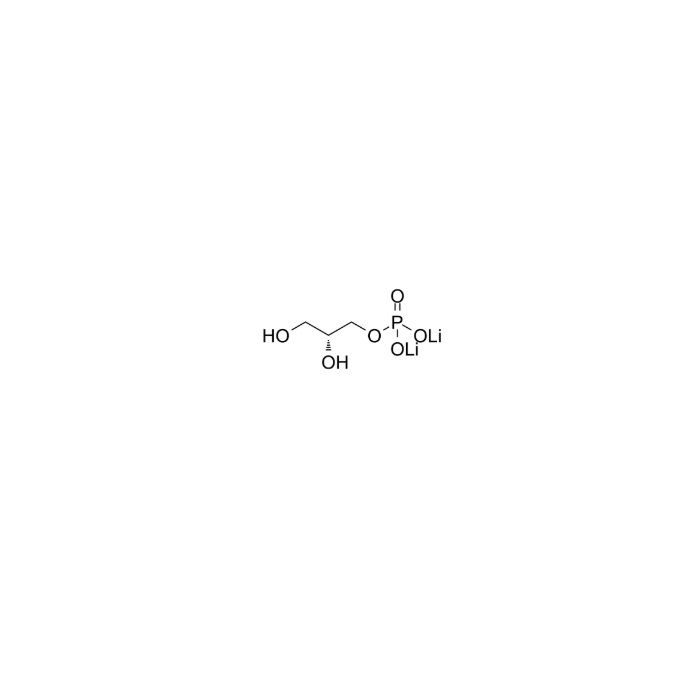
sn-Glycerol 3-phosphate is an important intermediate in glycolysis and lipid metabolism. The cytosolic sn-Glycerol 3-phosphate dehydrogenase (GPDH) consumes NADH to generate sn-Glycerol 3-phosphate from dihydroxyacetone phosphate (DHAP). Glyceroneogenesis is an important supplier of sn-Glycerol 3-phosphate for lipid metabolism .
| ALogP | -2.9 |
|---|
| Canonical Smiles | C(C(COP(=O)(O)O)O)O |
|---|---|
| IUPAC Name | [(2R)-2,3-dihydroxypropyl] dihydrogen phosphate |
| InChIKey | AWUCVROLDVIAJX-GSVOUGTGSA-N |
| INCHI | 1S/C3H9O6P/c4-1-3(5)2-9-10(6,7)8/h3-5H,1-2H2,(H2,6,7,8)/t3-/m1/s1 |
| Isomeric SMILES | C([C@H](COP(=O)(O)O)O)O |
| Molecular Weight | 183.94 |
| Reaxy-Rn | 1723974 |
| Reaxys-RN_link_address | https://www.reaxys.com/reaxys/secured/hopinto.do?context=S&query=IDE.XRN=1723974&ln= |
Comprehensive hazard, handling, storage, and regulatory compliance document.
Download SDS →Lot-specific quality data. Enter your lot number to retrieve the exact COA.
Look up COA →Full quality attributes and acceptance criteria for this grade.
View spec sheet →Taxonomy Tree
| Kingdom | Organic compounds |
|---|---|
| Superclass | Lipids and lipid-like molecules |
| Class | Glycerophospholipids |
| Subclass | Glycerophosphates |
| Intermediate Tree Nodes | Not available |
| Direct Parent | Glycerophosphates |
| Alternative Parents | Monoalkyl phosphates Secondary alcohols 1,2-diols Primary alcohols Organic oxides Hydrocarbon derivatives |
| Molecular Framework | Aliphatic acyclic compounds |
| Substituents | Sn-glycerol-3-phosphate - Monoalkyl phosphate - Alkyl phosphate - Phosphoric acid ester - Organic phosphoric acid derivative - Secondary alcohol - 1,2-diol - Organic oxygen compound - Organic oxide - Hydrocarbon derivative - Primary alcohol - Organooxygen compound - Alcohol - Aliphatic acyclic compound |
| Description | This compound belongs to the class of organic compounds known as glycerophosphates. These are compounds containing a glycerol linked to a phosphate group. |
| External Descriptors | sn-glycerol 3-phosphates - glycerol 1-phosphate |
| Activity Type | Relation | Activity value | Units | Action Type | Journal | PubMed Id | doi | Assay Aladdin ID |
|---|
Find and download the COA for your product by matching the lot number on the packaging.
| Lot Number | Certificate Type | Date | Item |
|---|---|---|---|
 E2608443 E2608443 | Certificate of Analysis | Mar 20, 2026 | G696252 |
| E2608459 | Certificate of Analysis | Mar 20, 2026 | G696252 |
| K2514567 | Certificate of Analysis | Nov 12, 2025 | G696252 |
| K2514568 | Certificate of Analysis | Nov 12, 2025 | G696252 |
| Solubility | H2O: 50 mg/mL (271.83 mM; Ultrasonic-assisted dissolution) |
|---|---|
| Sensitivity | Moisture sensitive |
| Molecular Weight | 172.070 g/mol |
| XLogP3 | -2.900 |
| Hydrogen Bond Donor Count | 4 |
| Hydrogen Bond Acceptor Count | 6 |
| Rotatable Bond Count | 4 |
| Exact Mass | 172.014 Da |
| Monoisotopic Mass | 172.014 Da |
| Topological Polar Surface Area | 107.000 Ų |
| Heavy Atom Count | 10 |
| Formal Charge | 0 |
| Complexity | 129.000 |
| Isotope Atom Count | 0 |
| Defined Atom Stereocenter Count | 1 |
| Undefined Atom Stereocenter Count | 0 |
| Defined Bond Stereocenter Count | 0 |
| Undefined Bond Stereocenter Count | 0 |
| The total count of all stereochemical bonds | 0 |
| Covalently-Bonded Unit Count | 1 |
| 1. Ming-Yan Wang, Meng-Xu Yi, Xing-Yu Mo, Shan-Jie Wei, Yu Qiao, Zheng Zhang, Zhao-Liang Su, Hong-Yan Lu. (2024) Over-activation of iNKT cells aggravate lung injury in bronchopulmonary dysplasia mice. Redox Biology, [PMID:39342744] [10.1016/j.redox.2024.103370] |
Our grade selection guide covers purity, stabilizer status, and application suitability for all variants in our catalog.
View Moligand™ grade guide →