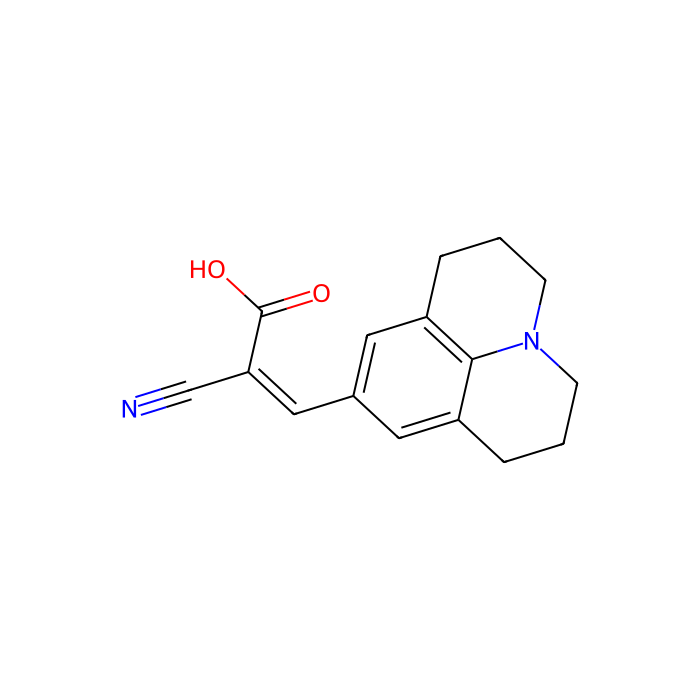
9-(2-Carboxy-2-cyanovinyl)julolidine - for fluorescence analysis, ≥97%(HPLC) , CAS No.142978-18-5

CAS: 142978-18-5 Cat. No.: C131104 Molecular Weight: 268.31 EC Number: 635-077-5
AVAILABLE TO ORDER
GRADE & PURITY for Fluorescence analysis ? Fluorescence-analysis grade — very low fluorescent impurities for clean spectra. Use in fluorescence assays where background interferes. ≥97%(HPLC)
Synonyms
J-100084 | (E)-2-Cyano-3-(1,2,3,5,6,7-hexahydropyrido[3,2,1-ij]quinolin-9-yl)acrylic acid | (2E)-3-{1-azatricyclo[7.3.1.0?,??]trideca-5,7,9(13)-trien-7-yl}-2-cyanoprop-2-enoic acid | 2-Ccvj | 9-([E]-2-Carboxy-2-cyanovinyl)julolidine CCVJ | SCHEMBL13428212
Storage
Store at 2-8°C
Shipped In
Wet ice
 ·  off list, applied to all prices below.
Size
Status
Price
Qty
1mg
C131104-1mg
8-12 wks(?) Production requires sourcing of materials. We appreciate your patience and understanding.
$57.90
5mg
C131104-5mg
2
$108.90
25mg
C131104-25mg
1
$254.90
Enter a quantity for the sizes you want to add.
🧪

Why this grade

for fluorescence analysis, ≥97%(HPLC) for Fluorescence analysis for sensitive chromatographic and analytical workflows requiring minimal baseline interference.

🌡

Storage & shipping

Store at 2-8°C Ships Wet ice Check lot-specific COA for exact specifications.

📋

Quality documents

SDS, COA, datasheet, and spec sheet available for download. Lot-specific COA accessible via lot number lookup.

📚

Literature proof

Cited in 0 peer-reviewed publications across chromatography, organic synthesis, and cross-coupling reactions.

Overview

9-(2-Carboxy-2-cyanovinyl)julolidine is a fluorescent probe used for binding to proteins.
Fluorescent probe for binding to proteins etc., quantum yield increases by decreasing free rotation: fluorescent molecular rotor.

Specifications

Synonyms
J-100084 | (E)-2-Cyano-3-(1, 2, 3, 5, 6, 7-hexahydropyrido[3, 2, 1-ij]quinolin-9-yl)acrylic acid | (2E)-3-{1-azatricyclo[7.3.1.0?, ??]trideca-5, 7, 9(13)-trien-7-yl}-2-cyanoprop-2-enoic acid | 2-Ccvj | 9-([E]-2-Carboxy-2-cyanovinyl)julolidine CCVJ | SCHEMBL13428212
Specifications & Purity
for fluorescence analysis, ≥97%(HPLC)
Biochemical and Physiological Mechanisms
Fluorescent molecular rotor. Sensitive to viscosity.
Storage
Store at 2-8°C
Shipped In
Wet ice
This product requires cold chain shipping. Ground and other economy services are not available.
Grade
for Fluorescence analysis
Note
Wherever possible, you should prepare and use solutions on the same day. However, if you need to make up stock solutions in advance, we recommend that you store the solution as aliquots in tightly sealed vials at -20°C. Generally, these will be useable for up to one month. Before use, and prior to opening the vial we recommend that you allow your product to equilibrate to room temperature for at least 1 hour. Need more advice on solubility, usage and handling? Please visit our frequently asked questions (FAQ) page for more details.
Purity
≥97%(HPLC)
Names and Identifiers
Canonical SmilesC1CC2=CC(=CC3=C2N(C1)CCC3)C=C(C#N)C(=O)O
IUPAC Name(E)-3-(1-azatricyclo[7.3.1.05,13]trideca-5,7,9(13)-trien-7-yl)-2-cyanoprop-2-enoic acid
InChIKeyJXENNHTVELFRHV-NTEUORMPSA-N
INCHI1S/C16H16N2O2/c17-10-14(16(19)20)9-11-7-12-3-1-5-18-6-2-4-13(8-11)15(12)18/h7-9H,1-6H2,(H,19,20)/b14-9+
Isomeric SMILES C1CC2=CC(=CC3=C2N(C1)CCC3)/C=C(\C#N)/C(=O)O
WGK Germany 3
Molecular Weight 268.31
Reaxy-Rn 18860107
Reaxys-RN_link_address https://www.reaxys.com/reaxys/secured/hopinto.do?context=S&query=IDE.XRN=18860107&ln=

Documentation

📋 Safety Data Sheet (SDS)

Comprehensive hazard, handling, storage, and regulatory compliance document.

Download SDS →

✅ Certificate of Analysis (COA)

Lot-specific quality data. Enter your lot number to retrieve the exact COA.

Look up COA →

📊 Datasheet

Quick-reference summary of product specifications and applications.

View datasheet →

🔬 Specification Sheet

Full quality attributes and acceptance criteria for this grade.

View spec sheet →

Advanced Data

Taxonomic Classification

Taxonomy Tree

KingdomOrganic compounds
SuperclassOrganoheterocyclic compounds
ClassQuinolines and derivatives
SubclassHydroquinolines
Intermediate Tree Nodes Not available
Direct ParentHydroquinolines
Alternative Parents Dialkylarylamines  Aralkylamines  Benzenoids  Amino acids  Nitriles  Monocarboxylic acids and derivatives  Carboxylic acids  Azacyclic compounds  Organopnictogen compounds  Organic oxides  Hydrocarbon derivatives  Carbonyl compounds  
Molecular FrameworkAromatic heteropolycyclic compounds
Substituents Tetrahydroquinoline - Tertiary aliphatic/aromatic amine - Dialkylarylamine - Aralkylamine - Benzenoid - Tertiary amine - Amino acid - Amino acid or derivatives - Carboxylic acid derivative - Carboxylic acid - Monocarboxylic acid or derivatives - Carbonitrile - Nitrile - Azacycle - Organic oxygen compound - Carbonyl group - Organic nitrogen compound - Organonitrogen compound - Organooxygen compound - Amine - Organic oxide - Hydrocarbon derivative - Organopnictogen compound - Aromatic heteropolycyclic compound
DescriptionThis compound belongs to the class of organic compounds known as hydroquinolines. These are derivatives of quinoline in which in which at least one double bond in the quinoline moiety are reduced by adding two hydrogen atoms.
External Descriptors Not available
3D Structure
Interactive Chemical Structure Model


Certificates(CoA,COO,BSE/TSE and Analysis Chart)
C of A & Other Certificates(BSE/TSE, COO):
Analytical Chart:

Find and download the COA for your product by matching the lot number on the packaging.

3 results found

Lot NumberCertificate TypeDateItem
G2219307Certificate of AnalysisFeb 04, 2026 C131104
G2219310Certificate of AnalysisFeb 04, 2026 C131104
J1529019Certificate of AnalysisFeb 07, 2025 C131104
Chemical and Physical Properties
SolubilitySoluble in DMSO, chloroform, and DMF. Insoluble in water.
SensitivityMoisture & Light sensitive
Molecular Weight268.310 g/mol
XLogP32.700
Hydrogen Bond Donor Count1
Hydrogen Bond Acceptor Count4
Rotatable Bond Count2
Exact Mass268.121 Da
Monoisotopic Mass268.121 Da
Topological Polar Surface Area64.300 Ų
Heavy Atom Count20
Formal Charge0
Complexity456.000
Isotope Atom Count0
Defined Atom Stereocenter Count0
Undefined Atom Stereocenter Count0
Defined Bond Stereocenter Count1
Undefined Bond Stereocenter Count0
The total count of all stereochemical bonds1
Covalently-Bonded Unit Count1
Documents & Articles
Solution Calculators
Reviews

Customer Reviews

Need help choosing the grade?

Our grade selection guide covers purity, stabilizer status, and application suitability for all variants in our catalog.

View for Fluorescence analysis grade guide →

Shall we send you a message when we have discounts available?

Remind me later

Thank you! Please check your email inbox to confirm.

Oops! Notifications are disabled.