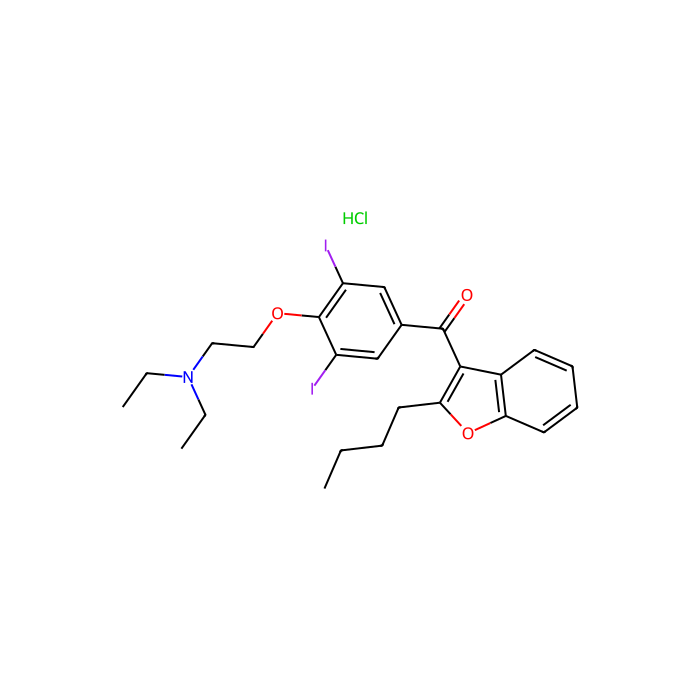
10mM in DMSO for sensitive chromatographic and analytical workflows requiring minimal baseline interference.
🌡
Storage & shipping
Store at -80°C Ships Dry ice packs + Cold packs Check lot-specific COA for exact specifications.
📋
Quality documents
SDS, COA, datasheet, and spec sheet available for download. Lot-specific COA accessible via lot number lookup.
📚
Literature proof
Cited in 3 peer-reviewed publications across chromatography, organic synthesis, and cross-coupling reactions.
Overview
Information
Amiodarone (NSC 85442) HCl Amiodarone (NSC 85442) HCl is a sodium/potassium-ATPase inhibitor and an autophagy activator, used to treat various types of cardiac dysrhythmias. In vitro
Amiodarone possesses an inhibitory effect on the fast sodium channel as well as on the slow calcium channel. Amiodarone also has non-competitive antisympathetic effects, and modulates thyroid function and phospholipid metabolism. Amiodarone penetrates deeply into the lipid matrix of the membrane, and is released from cardiac tissues very slowly when washed out. Amiodarone (44–88 μM) depresses Vmax of guinea pig papillary muscle without affecting the resting membrane potential, and that this Vmax inhibition is enhanced in a frequency- or use-dependent manner like Class I antiarrhythmic drugs. Amiodarone (50–88 μM) is also found to suppress the depolarization-induced spontaneous action potentials (abnormal automaticity) in ventricular muscles and in Purkinje fibers.
In vivo
Amiodarone (1.25–25 mg/kg) results in a decrease in sinus rate, a prolongation of effective and functional refractory periods of the atrioventricular node, and a frequency-dependent conduction delay in the atrioventricular node and in the ventricle of anesthetized dogs. Amiodarone (50 mg/kg/day, i.p. for 3–4 weeks) results in significant decreases in the current density of\xa0iK\xa0and\xa0ito\xa0in ventricular cells without affecting\xa0iCa\xa0and\xa0iK1 densities in rabbit. Amiodarone (AM) inhibits intracellular conversion from thyroxine (T4) to triiodothyronine (T3) via 5′-deiodination (5′DI) without affecting intracellular conversion from T4\xa0to reverse T3\xa0(rT3).\xa0 Cell Data
1.Wang Yiran, Shi Jihua, Dai Dapeng, Cai Jianping, Wang Shuanghu, Hong Yun, Zhou Shan, Zhao Fangling, Zhou Quan, Geng Peiwu, Zhou Yunfang, Xu Xue, Luo Qingfeng. (2022) Evaluation of commonly used cardiovascular drugs in inhibiting vonoprazan metabolism in vitro and in vivo. Frontiers in Pharmacology, [PMID:36052128][10.3389/fphar.2022.909168]
2.Lili Wu, Wanping Zhong, Junjin Liu, Weichao Han, Shilong Zhong, Qiang Wei, Shuwen Liu, Lan Tang. (2015) Human microsomal cyttrochrome P450-mediated reduction of oxysophocarpine, an active and highly toxic constituent derived from Sophora flavescens species, and its intestinal absorption and metabolism in rat. FITOTERAPIA, [PMID:26045316][10.1016/j.fitote.2015.05.021]
3.Guo Qing, Gan Jun, Wang En-ze, Wei Yu-ming, Xu Jie, Xu Yun, Zhang Fei-fei, Cui Meng, Jia Meng-xing, Kong Ming-jian, Tang Qiong-yao, Zhang Zhe. (2025) Electrophysiological characterization of human KCNT1 channel modulators and the therapeutic potential of hydroquinine and tipepidine in KCNT1 mutation-associated epilepsy mouse model. ACTA PHARMACOLOGICA SINICA, [PMID:39870847][10.1038/s41401-024-01457-8]
Solution Calculators
Molarity Calculator
Determine the necessary mass, volume, or concentration for preparing a solution.
Dilution Calculator
Determine the dilution needed to prepare a stock solution.
We use cookies to ensure the website functions properly and, where permitted, to improve your experience. You can manage your preferences at any time in Settings. Learn more in our Cookie Policy.
Shall we send you a message when we have discounts available?
Remind me later
Thank you! Please check your email inbox to confirm.
Products are supplied to verified businesses, institutions, and qualified professionals for research and development use only. Not for use in humans, animals, diagnosis, or therapy.