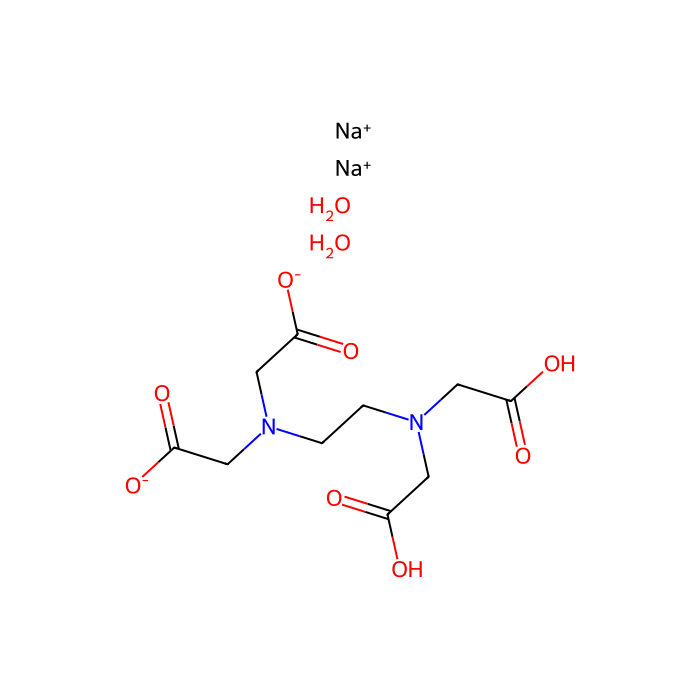
EDTA disodium salt concentrate - Diluted to 1 liters, the diluted concentration was 0.1M , CAS No.6381-92-6

CAS: 6381-92-6 Cat. No.: E299201 분자식: C10H14N2Na2O8·2H2O 분자량: 372.24 Beilstein Registry Number: 3900609 EC 번호: 613-386-6
주문 가능
등급 & 순도 Diluted to 1 liters, the diluted concentration was 0.1M
Synonyms
Disodium edetate | Sodium 2,2'-((2-(bis(carboxymethyl)amino)ethyl)azanediyl)diacetate dihydrate | BP-20565 | Disodium edetate dihydrate | EDTA DISODIUM SALT DIHYDRATE | Edta disodium | EDTA, Disodium Salt, Dihydrate | Ethylenediaminetetraaceticaciddisodiu
Storage
Room temperature,Argon charged
Shipped In
Normal
★
크기
USA
독일 (EU)*
가격
수량
1EA
E299201-1EA
주문제작 · 8~12주

US$77.90

US$90.90
저장 US$13.00 (14.30%)
Enter a quantity for the sizes you want to add.
🧪
이 등급을 선택하는 이유

Diluted to 1 liters, the diluted concentration was 0.1M 최소한의 기준선 간섭이 필요한 민감한 크로마토그래피 및 분석 워크플로우용.

🌡

보관 및 배송

Room temperature,Argon charged Normal 출고. 정확한 사양은 로트별 COA를 확인하세요.

📋

품질 문서

SDS, COA, 데이터시트, 사양서를 다운로드할 수 있습니다. 로트별 COA는 로트 번호 조회를 통해 확인할 수 있습니다.

📚

문헌적 근거

크로마토그래피, 유기 합성 및 교차 커플링 반응 분야의 동료 심사 논문 851편에서 인용되었습니다.

개요

Ampoule to make 1L

사양

동의어
Disodium edetate | Sodium 2,2'-((2-(bis(carboxymethyl)amino)ethyl)azanediyl)diacetate dihydrate | BP-20565 | Disodium edetate dihydrate | EDTA DISODIUM SALT DIHYDRATE | Edta disodium | EDTA, Disodium Salt, Dihydrate | Ethylenediaminetetraaceticaciddisodiu
사양 및 순도
Diluted to 1 liters, the diluted concentration was 0.1M
보관 조건
Room temperature,Argon charged
배송
Normal
이름과 식별자
정식 스마일
C(CN(CC(=O)[O-])CC(=O)[O-])N(CC(=O)O)CC(=O)O.O.O.[Na+].[Na+]
IUPAC Name
disodium;2-[2-[bis(carboxymethyl)amino]ethyl-(carboxylatomethyl)amino]acetate;dihydrate
InChIKey
OVBJJZOQPCKUOR-UHFFFAOYSA-L
INCHI
1S/C10H16N2O8.2Na.2H2O/c13-7(14)3-11(4-8(15)16)1-2-12(5-9(17)18)6-10(19)20;;;;/h1-6H2,(H,13,14)(H,15,16)(H,17,18)(H,19,20);;;2*1H2/q;2*+1;;/p-2
이성체 SMILES
C(CN(CC(=O)[O-])CC(=O)[O-])N(CC(=O)O)CC(=O)O.O.O.[Na+].[Na+]
WGK 독일
2
RTECS
AH4410000
분자량
372.24
Beilstein
3900609
Reaxy-Rn
11343500
Reaxys-RN_link_address
https://www.reaxys.com/reaxys/secured/hopinto.do?context=S&query=IDE.XRN=11343500&ln=

문서

📋 안전 데이터 시트(SDS)

위험성, 취급, 보관 및 규제 준수를 포괄하는 종합 문서.

<<<<<<< HEAD SDS 다운로드 → ======= SDS 다운로드 → >>>>>>> release248-p3

✅ 분석 성적서(COA)

로트별 품질 데이터. 로트 번호를 입력하여 정확한 COA를 확인하세요.

COA 조회 →

📊 데이터시트

제품 사양 및 응용 분야에 대한 빠른 참조 요약.

데이터시트 보기 →

🔬 사양서

이 등급의 전체 품질 특성 및 합격 기준.

사양서 보기 →

고급 데이터

Taxonomic Classification

Taxonomy Tree

KingdomOrganic compounds
SuperclassOrganic acids and derivatives
분류Carboxylic acids and derivatives
SubclassTetracarboxylic acids and derivatives
Intermediate Tree Nodes Not available
Direct ParentTetracarboxylic acids and derivatives
Alternative Parents Alpha amino acids  Trialkylamines  Carboxylic acid salts  Amino acids  Carboxylic acids  Organopnictogen compounds  Organic zwitterions  Organic sodium salts  Organic oxides  Hydrocarbon derivatives  Carbonyl compounds  
Molecular FrameworkAliphatic acyclic compounds
Substituents Tetracarboxylic acid or derivatives - Alpha-amino acid - Alpha-amino acid or derivatives - Amino acid or derivatives - Carboxylic acid salt - Amino acid - Tertiary amine - Tertiary aliphatic amine - Carboxylic acid - Organic alkali metal salt - Organic sodium salt - Organic nitrogen compound - Hydrocarbon derivative - Organooxygen compound - Organonitrogen compound - Organic oxide - Carbonyl group - Organopnictogen compound - Amine - Organic oxygen compound - Organic zwitterion - Organic salt - Aliphatic acyclic compound
설명This compound belongs to the class of organic compounds known as tetracarboxylic acids and derivatives. These are carboxylic acids containing exactly four carboxyl groups.
External Descriptors hydrate
3D 구조
상호 작용 화학 구조 모델


인증서(CoA, COO, BSE/TSE 및 분석 차트)
C of A & Other Certificates(BSE/TSE, COO):
Analytical Chart:

Find and download the COA for your product by matching the lot number on the packaging.

4 results found

Lot NumberCertificate Type날짜항목
A2329705A2329705Certificate of AnalysisOct 15, 2026 E299201
A2305002A2305002Certificate of AnalysisAug 14, 2026 E299201
F2228001F2228001Certificate of AnalysisJan 24, 2026 E299201
F2108013F2108013Certificate of AnalysisDec 12, 2024 E299201
화학 및 물리적 특성
발화점(°F)>212 °F
발화점(°C)>100 °C
녹는점(°C)248 °C
분자량372.240 g/mol
XLogP3
Hydrogen Bond Donor Count4
Hydrogen Bond Acceptor Count12
Rotatable Bond Count9
Exact Mass372.076 Da
Monoisotopic Mass372.076 Da
Topological Polar Surface Area163.000 Ų
Heavy Atom Count24
Formal Charge0
Complexity340.000
Isotope Atom Count0
Defined Atom Stereocenter Count0
Undefined Atom Stereocenter Count0
Defined Bond Stereocenter Count0
Undefined Bond Stereocenter Count0
The total count of all stereochemical bonds0
Covalently-Bonded Unit Count5
자주 묻는 질문과 기사
Protease Inhibitors
Comparing Guanidine Hydrochloride and Urea for Inclusion-Body Solubilization
Buffer exchange of a sample using a dialysis bag
Red Blood Cell Lysis Buffer — Technical Description & Operating Guide
Professional Guide to Streptavidin-Modified Proteins
Why Is EDTA So Widely Used?
Standard Operating Procedure (SOP) for Bis-Tris Polyacrylamide Gel Electrophoresis (SDS-PAGE)
Protein Tris-Acetate Electrophoresis System Standard Operating Procedure
Buffer Additives to Prevent Protein Precipitation
Common Protectants and Formulations for Protein Storage
Structural and Catalytic Roles of Metal Ions in Protein Enzyme Activity
Differences Between Transformation and Transfection
Eight Common Lysis Buffers
Frequently Asked Questions about Cell Culture
FAQ on Molecular Interaction Assays
Fatty Acids from Basics to Lab Practice: Structural Classification, Research Uses, and Selection Tips (with an Aladdin Representative Product Quick-Reference Table)
How to Choose a Hydrogen Evolution (HER) Catalyst: Kinetic Barriers in Water Electrolysis, AWE/PEM/AEM Pathways, and a Materials-Family Roadmap (with a Product Map)
A Practical Guide to Small-Molecule Chemical Probes: Concept Clarification, Causal Validation, and Experimental Selection (with Product Navigation and Tables A–D)
Calcium Gluconate: Physicochemical Properties, Pharmacopoeial Quality Control, and Application Guidelines
Practical Guide to Sodium Carboxymethyl Cellulose (CMC-Na): Thickening/Stabilizing Mechanisms, Key Controls for Solution Preparation, and Selection Navigation (including Table 1 and Tables A–C)
A Review of Ten Commonly Used Techniques for Detection, Quantification, and Interaction Analysis in Nucleic Acid Research
Selection of Common Research Salts: A Task Map for Alkali Metal Salts & Alkaline Earth Metal Salts (with Product Tables 1–6)
Why Acridine Can Turn “Trace Molecules” into a Measurable Light Signal: A Mechanistic, Selection, and Troubleshooting Guide to Acridinium Ester Chemiluminescent Immunoassays (Including Product Tables 1–4)
Plant Omics Panorama: Workflow Frameworks and Multi-Omics Integration from Genomics to Transcriptomics, Proteomics, and Metabolomics
Acid Phosphatase: Dephosphorylation Reactions in Acidic Microenvironments and Their Research, Assay, and Detection Applications
Diaphorase: NAD(P)H-Dependent Electron-Transfer Activity and Its Applications in Detection and Research
Glutathione (GSH) Quantification: Method Systems, Experimental Workflows, and Key Quality-Control Considerations
Deoxyribonuclease (DNase): DNA Hydrolytic Cleavage Properties, Methodological Value, and Multi-Context Applications
Cholesterol Esterase: Mechanistic Insights and Application Frameworks Driven by Interfacial Hydrolysis
Glutathione Reductase: A Flavin-Dependent Reductive System Maintaining GSH/GSSG Homeostasis, with Assays and Applications
Agarose Precast Gels: Composition, Advantages, and Application Workflows for Standardized Nucleic Acid Electrophoresis Matrices
Lipid Panel Testing in Research (TC, TG, HDL-C, LDL-C): Indicator System, Assay Principles, Technical Routes, and Application Overview
EMSA PAGE Precast Gels: Principle Alignment, Performance Advantages, and Application Scenarios
Angiotensin-Converting Enzyme (ACE): A Review of Molecular Features, Catalytic Functions, and Research and Translational Applications
Micrococcal Nuclease (MNase): A Technical Review of Enzymatic Properties, Reaction Control, and Research and Biomanufacturing Applications
Hemicellulases: A Review of Substrate Specificity, Catalytic Systems, and Research and Industrial Applications
Bromelain: Enzymological Properties and Key Points for Food, Pharmaceutical, and Industrial Applications
AmpC β-Lactamases (Cephalosporinases): Mechanisms of Production, Diagnostic Pathways, and Research and Clinical Applications
Flavones: Structural Features, Physicochemical Properties, and Key Points for Research and Applications
Review of Collagenase: Enzymological Features, Type Systems, and Research Applications
Furin: A Review of Its Structural Features, Substrate Recognition, and Research Applications
Invertebrate Oxygen Carrier Proteins in Immunology and Vaccine Research
Coupling Mechanisms Between Terminal Reducing-Power Allocation in Photosynthetic Electron Transport and Metabolic Demand
Thiol and Disulfide Status in Biological Samples: Detection Methods and Applications
Comparison of Low-pH, High-pH, and Enzymatic Antigen Retrieval Systems in IHC
Selection Strategy for PBS, TBS, PBST, and TBST Washing Systems in IHC
Comparison of Principles, System Control, and Result Interpretation in Hydroxyl Radical Scavenging Capacity Assays
Preparation Methods and Precautions for Silane Coupling Agent Primer Solutions
From Functional Groups to Experimental Decision-Making: Protein Crosslinker Selection and Experimental Essentials
Principles, Method Selection, and Result Interpretation for Malondialdehyde Content Detection
Oxalate Metabolism and Degradation Detection Methods: Enzymatic Assays, Chromatography, and Enzymatic Degradation System Analysis
Differences, Mechanisms of Action, and Selection of Sodium Metasilicate and Sodium Tripolyphosphate in Detergent and Cleaning Formulations
The Role, Selection, and Validation of Chelating Agents in Daily Chemical Formulations
From Structure to Rheology: How Carbomer Forms Gel Structures and Enables Thickening, Suspension, and Auxiliary Emulsion Stabilization
Why Can 6501 (Cocamide DEA) Stabilize Foam and Build Viscosity? Structural Mechanism, 1:1/1:1.5 Differences, and Application Selection
Differences, Functions, and Selection Guidelines for Sodium Hydroxide Flakes, Granules, Liquid Caustic Soda, and Caustic Soda in Household and Personal Care Product Manufacturing: The Functional and Application Logic of Sodium Hydroxide
Practical Guide to TSA Tyramide Signal Amplification: How to Select Reagents, Optimize the Workflow, and Reduce Background When Detection Signals Are Weak for Low-Abundance Targets
AES (Fatty Alcohol Polyoxyethylene Ether Sulfate) in Personal and Home-Care Cleansing Formulations: An Analysis of Structure, Performance, and Low-Temperature Flowability
Xiao Fang Bai, Da Fang Bai, PnB and DPnB: Mechanisms and Selection of Butyl Glycol Ethers in Hard-Surface Cleaning Formulations
Signal Transduction Mechanism of Graphene Biosensors: From Molecular Recognition to Electrical/Optical Signal Readout and Materials Selection
What Is Synthetic Biology? The Industrialization Pathway from Upstream Reagent Toolchains to Biomanufacturing Applications
How Can Sodium Tripolyphosphate (STPP) Be Replaced? From Detergency Mechanisms to Formulation Choices for Low-Phosphorus/Phosphorus-Free Builder Systems
Interfacial Mechanism and Formulation Applications of AEO-9 (Fatty Alcohol Polyoxyethylene Ether): An Analysis of Emulsification, Wetting, Oil Soil Removal, and Co-Formulation Compatibility
More Than a pH Adjuster: Mechanisms, Selection Logic, and Alternative Acid Source Analysis of Citric Acid in Home-Care Cleaning
Sodium Metasilicate in Cleaning Applications: Hydration-Form Differences, Mechanisms of Action, and Selection Logic
Analysis of the Foaming Performance Differences Between K12 and AOS: Structure, Acid–Base Stability, and Formulation Selection
Structural Characteristics, Low-Temperature Flowability, and Home-Care Cleaning Applications of Palm-Derived Isomeric Alcohol Polyoxyethylene Ether PLE-S9
Performance Sources and Formulation Applications of Enzyme-Based Ingredients in Daily Chemical Products: Fermentation Transformation, Enzymatic Reactions, and Application Principles
Mechanisms and Troubleshooting of Foam Reduction in Personal and Household Care Formulations: Film Rupture, Weak Interfacial Films, Insufficient Surfactant Supply, and Phase-State Disturbance
Why Do Rust Spots Appear on Neutral Wall Putty? Iron Sources, Moisture Migration, Oxidative Color Development, and Prevention Measures
Dispersants, Anti-Redeposition Agents, and Scale-Control Materials in Household Cleaning Formulations: Mechanisms of Action, Selection Logic, and Representative Products
Comparison of Magnesium (Mg) Content Detection Methods: Principles and Application Selection of Titration, Colorimetry, AAS, ICP-OES, and ICP-MS
Histological Staining Methods for Identifying Hepatitis B Virus: Comparison of HE, Orcein, Aldehyde Fuchsin, Victoria Blue, Immunohistochemistry, and In Situ Hybridization
The Skin Anti-Aging Mechanisms of α-Lipoic Acid: ALA/DHLA Redox Cycling, the Antioxidant Network, and Regulation of Collagen AGE Formation
Antioxidant Mechanisms, Stability, and Delivery Strategies of Resveratrol in Skincare Research
Antioxidant Mechanisms of Ferulic Acid in Skincare, Vitamin C/E Synergy, and Stable Delivery Applications
Skin Anti-Aging Mechanisms of Carnosine and Decarboxy Carnosine: Active Carbonyl Scavenging, Oxidative-Stress Buffering, and Inhibition of Collagen Glycation Cross-Linking
Exosome-Related Ingredients in Skincare Products: Sources and Preparation, Quality Control, Evidence of Efficacy, and Safety Assessment
Common Reducing Agents in Antibody–Drug Conjugates (ADCs)
Potential Mechanisms of Tea Polyphenols in Oily, Acne-Prone Skin: Effects of EGCG on Sebum Production, Lipid Peroxidation, and Inflammatory Responses
Structural Characteristics of Ergothioneine, OCTN1-Mediated Uptake by Skin Cells, and Antioxidant Mechanisms
Citations of This Product
솔루션 계산기
리뷰

고객 리뷰

Shall we send you a message when we have discounts available?

Remind me later

Thank you! Please check your email inbox to confirm.

Oops! Notifications are disabled.