
Determine the necessary mass, volume, or concentration for preparing a solution.
| Activity Type | Activity Value -log(M) | Mechanism of Action | Activity Reference | Publications (PubMed IDs) |
|---|
10mM in DMSO for sensitive chromatographic and analytical workflows requiring minimal baseline interference.
Store at -80°C Ships Dry ice packs + Cold packs Check lot-specific COA for exact specifications.
SDS, COA, datasheet, and spec sheet available for download. Lot-specific COA accessible via lot number lookup.
Cited in 1 peer-reviewed publications across chromatography, organic synthesis, and cross-coupling reactions.
Information
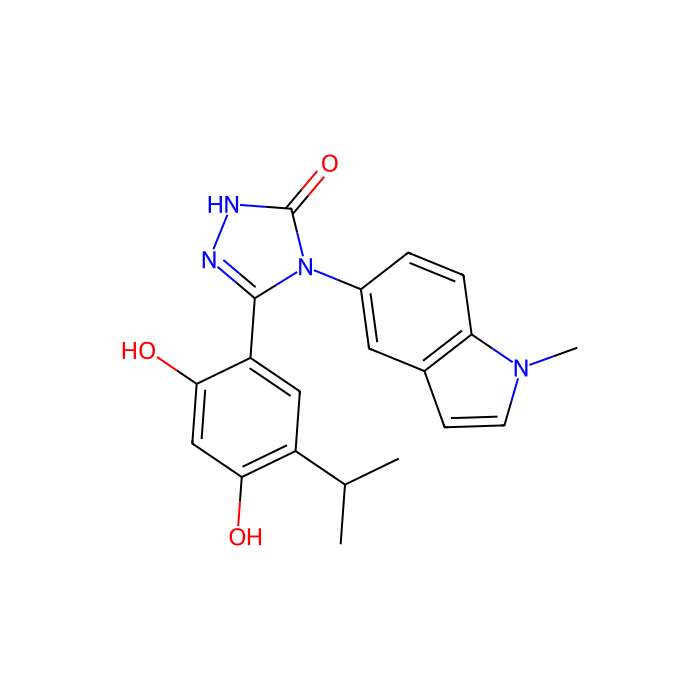
Ganetespib (STA-9090) Ganetespib (STA-9090) is an HSP90 inhibitor with IC50 of 4 nM in OSA 8 cells, induces apoptosis of OSA cells while normal osteoblasts are not affected; active metabolite of STA-1474. Phase 3.
In vitro
The 50% inhibitory concentrations (IC50) for Ganetespib against malignant mast cell lines are 10-50 times lower than that for 17-AAG, indicating that triazolone class of HSP90 inhibitors likely exhibits greater potency than geldanamycin based inhibitors. Ganetespib inhibits MG63 cell lines with IC50 of 43 nM. Ganetespib binds to the ATP-binding domain at the N-terminus of Hsp90 and serves as a potent Hsp90 inhibitor by causing degradation of multiple oncogenic Hsp90 client proteins including HER2/neu, mutated EGFR, Akt, c-Kit, IGF-1R, PDGFRα, Jak1, Jak2, STAT3, STAT5, HIF-1α, CDC2 and c-Met as well as Wilms\' tumor 1. Ganetespib, at low nanomolar concentrations, potently arrests cell proliferation and induces apoptosis in a wide variety of human cancer cell lines, including many receptor tyrosine kinase inhibitor- and tanespimycin-resistant cell lines. Ganetespib exhibits potent cytotoxicity in a range of solid and hematologic tumor cell lines, including those that express mutated kinases that confer resistance to small-molecule tyrosine kinase inhibitors. Ganetespib treatment rapidly caused the degradation of known Hsp90 client proteins, exhibits superior potency to the ansamycin inhibitor 17-AAG, and shows sustained activity even with short exposure times. In anohter study, Ganetespib induces apoptosis of malignant canine mast cell lines. Ganetespib is active at significantly lower concentrations for C2 and BR canine malignant mast cells with IC50 of 19 and 4 nM, respectively, while 17-AAG inhibits C2 and BR canine malignant mast cells with IC50 of 958 and 44 nM, respectively. Both the expression of WT and mutant Kit are downregulated by 100 nM Ganetespib after 24 hours in all lines treated including C2 and BMCMCs cells. However, no effects on PI3K or HSP90 expression are observed following treatment with Ganetespib.
In vivo
Administration of Ganetespib leads to significant tumor shrinkage in several tumor xenograft models in mice and appears to be less toxic. Furthermore Ganetespib demonstrated better tumor penetration compared with tanespimycin. Ganetespib inhibits in vivo tumor growth in both malignant mast cell and OSA xenograft models. Ganetespib significantly inhibits tumor growth when dosed with two repeating cycles of 25 mg/kg/day for 3 days, with a %T/C value of 18. Ganetespib is well-tolerated, with the vehicle and Ganetespib groups having average bodyweight changes relative to the start of the study of +0.3% and -8.1% on day 17, respectively.
Cell Data
cell lines:
Concentrations:0.001-1μM
Incubation Time:5 days
Powder Purity:≥98%
| ALogP | 3.1 |
|---|
| Isomeric SMILES | CC(C)C1=C(C=C(C(=C1)C2=NNC(=O)N2C3=CC4=C(C=C3)N(C=C4)C)O)O |
|---|---|
| Molecular Weight | 364.4 |
| Reaxy-Rn | 11457851 |
| Reaxys-RN_link_address | https://www.reaxys.com/reaxys/secured/hopinto.do?context=S&query=IDE.XRN=11457851&ln= |
Comprehensive hazard, handling, storage, and regulatory compliance document.
Download SDS →Lot-specific quality data. Enter your lot number to retrieve the exact COA.
Look up COA →Full quality attributes and acceptance criteria for this grade.
View spec sheet →| Activity Type | Activity Value -log(M) | Mechanism of Action | Activity Reference | Publications (PubMed IDs) |
|---|
| Activity Type | Activity Value -log(M) | Mechanism of Action | Activity Reference | Publications (PubMed IDs) |
|---|
| Activity Type | Activity Value -log(M) | Mechanism of Action | Activity Reference | Publications (PubMed IDs) |
|---|
| Activity Type | Activity Value -log(M) | Mechanism of Action | Activity Reference | Publications (PubMed IDs) |
|---|
| Solubility | Solubility (25°C) In vitro |
|---|
| 1. Lingyun Ruan, Yuanyuan Cao, Caixia Ren, Huan Li, Xuesong Feng, Rongzhang Hao. (2023) Hyaluronic Acid-Functionalized Polydopamine Nanoparticles Augment Photothermal Therapy via Synergetic Tumor-Targeting and Heat Shock Protein Inhibition. ACS Applied Nano Materials, [PMID:] [10.1021/acsanm.3c04655] |