
Determine the necessary mass, volume, or concentration for preparing a solution.
| Activity Type | Relation | Activity value | Units | Action Type | Journal | PubMed Id | doi | Assay Aladdin ID |
|---|
Moligand™, 10mM in DMSO Moligand™ for sensitive chromatographic and analytical workflows requiring minimal baseline interference.
Store at -80°C Ships Dry ice packs + Cold packs Check lot-specific COA for exact specifications.
SDS, COA, datasheet, and spec sheet available for download. Lot-specific COA accessible via lot number lookup.
Cited in 0 peer-reviewed publications across chromatography, organic synthesis, and cross-coupling reactions.
Information
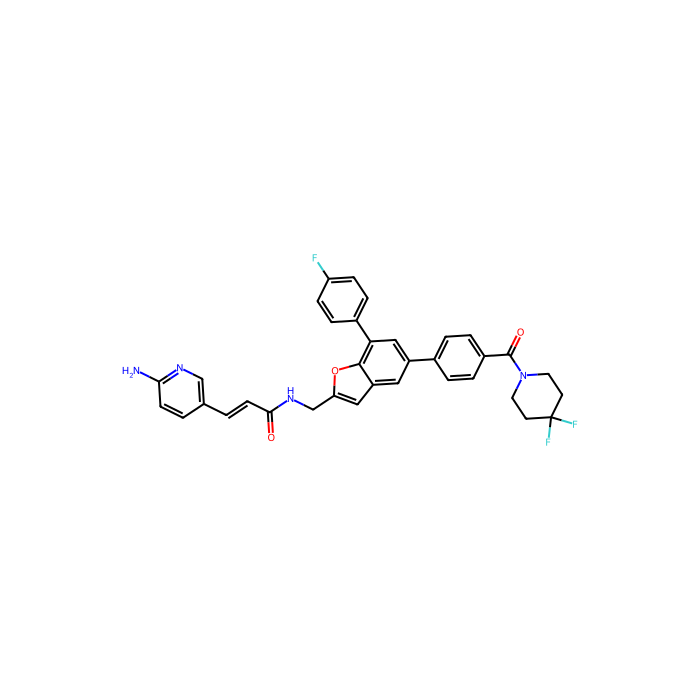
KPT 9274 ( ATG-019) KPT 9274 ( ATG-019) is an orally bioavailable small molecule that is a non-competitive dual inhibitor of PAK4 and NAMPT . It shows an IC50 of ~120 nM for NAMPT in a cell-free enzymatic assay.
Targets
PAK4 (Cell-free assay); NAMPT (Cell-free assay) ; ~120 nM
In vitro
KPT-9274 interferences with PAK4 and NAD biosynthetic pathways results in reduction of G2/M transit as well as induction of apoptosis and decrease in cell invasion and migration in several human RCC cell lines. The inhibition of the PAK4 pathway by KPT-9274 attenuates nuclear β-catenin as well as the Wnt/β-catenin targets cyclin D1 and c-Myc.
In vivo
KPT-9274 administration to a 786-O (VHL-mut) human RCC xenograft model leads to dose-dependent inhibition of tumor growth with no apparent toxicity. It also shows remarkable anti-tumor activity in sub-cutaneous xenograft models of pancreatic ductal adenocarcinoma (PDAC) cell lines and cancer stem cells as a single agent. KPT-9274 possesses desirable PK properties and is well tolerated in mice with the absence of any signs of toxicity when 200 mg/kg daily is administered either intravenously or orally.
Cell Research(from reference)
Cell lines:786-0, ACHN, Caki-1 and U-2 OS cells
Concentrations:1μM and 5μM
Incubation Time:12 hours
| ALogP | 5.59 |
|---|---|
| hba_count | 4 |
| HBD Count | 2 |
| Rotatable Bond | 7 |
| Canonical Smiles | C1CN(CCC1(F)F)C(=O)C2=CC=C(C=C2)C3=CC(=C4C(=C3)C=C(O4)CNC(=O)C=CC5=CN=C(C=C5)N)C6=CC=C(C=C6)F |
|---|---|
| IUPAC Name | (E)-3-(6-aminopyridin-3-yl)-N-[[5-[4-(4,4-difluoropiperidine-1-carbonyl)phenyl]-7-(4-fluorophenyl)-1-benzofuran-2-yl]methyl]prop-2-enamide |
| InChIKey | MRFOPLWJZULAQD-SWGQDTFXSA-N |
| INCHI | 1S/C35H29F3N4O3/c36-28-9-7-24(8-10-28)30-19-26(23-3-5-25(6-4-23)34(44)42-15-13-35(37,38)14-16-42)17-27-18-29(45-33(27)30)21-41-32(43)12-2-22-1-11-31(39)40-20-22/h1-12,17-20H,13-16,21H2,(H2,39,40)(H,41,43)/b12-2+ |
| Isomeric SMILES | C1CN(CCC1(F)F)C(=O)C2=CC=C(C=C2)C3=CC(=C4C(=C3)C=C(O4)CNC(=O)/C=C/C5=CN=C(C=C5)N)C6=CC=C(C=C6)F |
| Molecular Weight | 610.62 |
| Reaxy-Rn | 30718506 |
| Reaxys-RN_link_address | https://www.reaxys.com/reaxys/secured/hopinto.do?context=S&query=IDE.XRN=30718506&ln= |
Comprehensive hazard, handling, storage, and regulatory compliance document.
Download SDS →Lot-specific quality data. Enter your lot number to retrieve the exact COA.
Look up COA →Full quality attributes and acceptance criteria for this grade.
View spec sheet →Taxonomy Tree
| Kingdom | Organic compounds |
|---|---|
| Superclass | Organoheterocyclic compounds |
| Class | Benzofurans |
| Subclass | Phenylbenzofurans |
| Intermediate Tree Nodes | Not available |
| Direct Parent | Phenylbenzofurans |
| Alternative Parents | N-benzoylpiperidines 1-benzoylpiperidines Benzamides Fluorobenzenes Aminopyridines and derivatives Imidolactams Aryl fluorides Tertiary carboxylic acid amides Heteroaromatic compounds Furans Secondary carboxylic acid amides Amino acids and derivatives Oxacyclic compounds Azacyclic compounds Primary amines Organopnictogen compounds Organofluorides Organic oxides Hydrocarbon derivatives Carbonyl compounds Alkyl fluorides |
| Molecular Framework | Aromatic heteropolycyclic compounds |
| Substituents | Phenylbenzofuran - 1-benzoylpiperidine - N-benzoylpiperidine - N-acyl-piperidine - Benzoic acid or derivatives - Benzamide - Benzoyl - Halobenzene - Fluorobenzene - Aminopyridine - Imidolactam - Benzenoid - Pyridine - Piperidine - Monocyclic benzene moiety - Aryl halide - Aryl fluoride - Heteroaromatic compound - Tertiary carboxylic acid amide - Furan - Secondary carboxylic acid amide - Carboxamide group - Amino acid or derivatives - Oxacycle - Azacycle - Carboxylic acid derivative - Organic nitrogen compound - Organic oxygen compound - Organopnictogen compound - Organic oxide - Hydrocarbon derivative - Primary amine - Organooxygen compound - Organonitrogen compound - Organofluoride - Organohalogen compound - Carbonyl group - Amine - Alkyl halide - Alkyl fluoride - Aromatic heteropolycyclic compound |
| Description | This compound belongs to the class of organic compounds known as phenylbenzofurans. These are organic aromatic compounds that contain a phenyl group attached to a benzofuran moiety. Benzofuran is a bicyclic compound containing a benzene fused to a furan. |
| External Descriptors | Not available |
| Activity Type | Relation | Activity value | Units | Action Type | Journal | PubMed Id | doi | Assay Aladdin ID |
|---|
| Activity Type | Relation | Activity value | Units | Action Type | Journal | PubMed Id | doi | Assay Aladdin ID |
|---|
| DMSO(mg / mL) Max Solubility | 100 |
|---|---|
| DMSO(mM) Max Solubility | 163.7679735 |
| Water(mg / mL) Max Solubility | <1 |
| Molecular Weight | 610.600 g/mol |
| XLogP3 | 6.100 |
| Hydrogen Bond Donor Count | 2 |
| Hydrogen Bond Acceptor Count | 8 |
| Rotatable Bond Count | 7 |
| Exact Mass | 610.219 Da |
| Monoisotopic Mass | 610.219 Da |
| Topological Polar Surface Area | 101.000 Ų |
| Heavy Atom Count | 45 |
| Formal Charge | 0 |
| Complexity | 1040.000 |
| Isotope Atom Count | 0 |
| Defined Atom Stereocenter Count | 0 |
| Undefined Atom Stereocenter Count | 0 |
| Defined Bond Stereocenter Count | 1 |
| Undefined Bond Stereocenter Count | 0 |
| The total count of all stereochemical bonds | 1 |
| Covalently-Bonded Unit Count | 1 |
Our grade selection guide covers purity, stabilizer status, and application suitability for all variants in our catalog.
View Moligand™ grade guide →