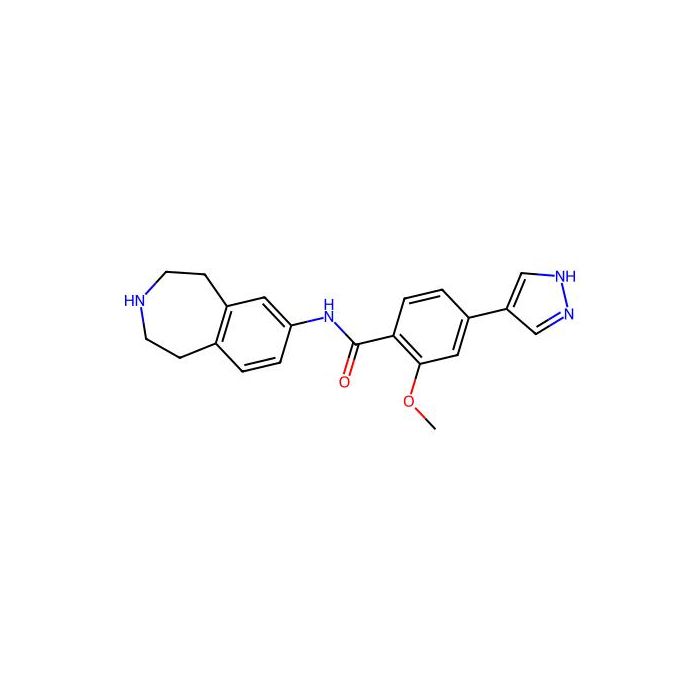
This compound belongs to the class of organic compounds known as phenylpyrazoles. These are compounds containing a phenylpyrazole skeleton, which consists of a pyrazole bound to a phenyl group.
External Descriptors
Not available
1. Djoumbou Feunang Y, Eisner R, Knox C, Chepelev L, Hastings J, Owen G, Fahy E, Steinbeck C, Subramanian S, Bolton E, Greiner R, and Wishart DS. ClassyFire: Automated Chemical Classification With A Comprehensive, Computable Taxonomy. Journal of Cheminformatics, 2016, 8:61.
Determine the necessary mass, volume, or concentration for preparing a solution.
Dilution Calculator
Determine the dilution needed to prepare a stock solution.
Reconstitution Calculator
리뷰
고객 리뷰
Application Protocols
Item-specific tested applications and dilutions: Not specified for this item.
General example protocols (for guidance only; verify and optimize locally):
Preparing a DMSO stock: Warm vial to room temperature in a desiccator. Dissolve compound in anhydrous DMSO to 10 mM. Vortex gently until fully dissolved. Aliquot into low‑bind tubes (e.g., 20–50 µL) and store at −20°C, desiccated.
Biochemical kinase assay (ADP‑Glo): Prepare kinase, substrate peptide/protein, and ATP at ~Km in assay buffer (e.g., 40 mM HEPES, 10 mM MgCl2, 0.01% Tween‑20, 1 mM DTT). Add compound (serially diluted) to a constant final DMSO (0.1%). Incubate 30 min at 25–30°C. Quantify ADP and calculate IC50 using a 4‑parameter fit.
Cell treatment: Dilute DMSO stock into pre‑warmed complete medium to the desired working concentration while keeping DMSO ≤0.1–0.2% v/v. Incubate cells 4–24 h. Assess target pathway endpoints (e.g., phospho‑substrate Western blot). Include vehicle controls and, if possible, a target-validation control (genetic knockdown or orthogonal probe).
Documentation: Record batch/lot, stock concentration, and freeze–thaw count for reproducibility.
Biological Roles
Item-specific biological annotations: Not specified for this item in the Product Data.
Literature/general context (not a claim about this specific lot):
Targeted pathway: MELK (maternal embryonic leucine zipper kinase) is a serine/threonine kinase implicated in regulation of cell cycle progression, mitotic events, and stress-response signaling. It can interact with cell cycle regulators and is studied for roles in proliferation and self-renewal programs.
Chemical probes such as “MELK‑T1” are used to interrogate MELK-dependent phosphorylation cascades, enabling assignment of functional consequences to MELK activity in cells and biochemical systems.
Systems-level impact: Inhibition of MELK activity is commonly examined for effects on substrate phosphorylation, checkpoint control, and transcriptional programs mediated through downstream effectors; orthogonal genetic methods (siRNA/CRISPR) are often combined to delineate on‑target biology.
Usage boundaries:
Research use only (per Product Data). No medical, diagnostic, or clinical applications are implied. All biological conclusions should be supported by appropriate controls, including target validation by complementary methods.
Buffer Applications
This product is not a buffering agent. Therefore, classic buffer system guidance (pH ranges, capacity) is not directly applicable.
Practical notes for assay buffers (general, for small-molecule kinase studies):
Typical kinase assay buffer might include: 20–50 mM HEPES or Tris (pH 7.2–7.5), 5–10 mM MgCl2/MnCl2 (per enzyme requirements), 0.01–0.05% Tween‑20, 1 mM DTT or TCEP, and 0.1 mg/mL BSA to reduce nonspecific binding.
Maintain a consistent final DMSO concentration across wells (e.g., 0.1% v/v) when introducing compound from DMSO stocks.
For cell culture studies, dissolve the compound in DMSO and dilute into complete medium; ensure vehicle controls are identical in solvent percentage.
Green Alternatives
Applicability: Green alternative considerations are limited here because MELK‑T1 is a discrete bioactive compound rather than a solvent or reagent that can be readily substituted.
Greener handling practices (general suggestions):
Use minimal DMSO volumes for stock solutions and avoid unnecessary solvent exchanges. Consolidate experiments to reduce solvent waste.
Prefer aqueous assay buffers with the lowest effective co-solvent percentage (e.g., ≤0.1–0.5% DMSO) consistent with solubility and performance.
Implement microscale assay formats (384/1536‑well) to reduce compound and solvent consumption.
Manage waste responsibly: segregate DMSO/organic waste and follow institutional EHS guidance for disposal.
If solvent substitution is required (assay-dependent):
Ethanol or aqueous cyclodextrin formulations can sometimes replace or reduce DMSO in biochemical assays, but confirm compound stability and assay compatibility experimentally.
Bottom line: The compound itself has no direct “green” substitute for its biological function; sustainability gains come from solvent minimization, right‑sizing experiments, and efficient sample handling.
Pharmaceutical Uses
Item-specific pharmacopeial status or excipient role: Not specified for this item; refer to CoA/Spec Sheet.
MELK‑T1 is used as a reference tool compound in discovery biology to probe MELK-related pathways, evaluate target engagement assays, and generate structure–activity relationship (SAR) hypotheses.
Typical roles include: positive control in biochemical inhibition assays, comparator in kinome selectivity panels, and benchmark in DMPK method development (e.g., microsomal stability, plasma protein binding)—all strictly for research use only.
Compliance note:
Not for human or veterinary use, not for diagnostic procedures. No claims are made regarding therapeutic efficacy or safety. Any formulation studies must remain within preclinical research settings under institutional approvals.
Physical Properties
Item-specific physical data (specifications):
Melting point: Not specified for this item; refer to CoA/Spec Sheet.
Boiling point: Not specified for this item; refer to CoA/Spec Sheet.
Density: Not specified for this item; refer to CoA/Spec Sheet.
Solubility: Not specified for this item; refer to CoA/Spec Sheet.
LogP / cLogP: Not specified for this item; refer to CoA/Spec Sheet.
pKa: Not specified for this item; refer to CoA/Spec Sheet.
Refractive index/UV cutoff: Not specified for this item; refer to CoA/Spec Sheet.
Literature/general expectations for kinase-tool small molecules (not item specifications):
Solubility behavior: Many kinase inhibitors are sparingly soluble in water and readily soluble in polar aprotic solvents (e.g., DMSO) at 10–50 mM stock concentrations.
Solid state: Frequently isolated as crystalline or amorphous solids; hydrate/solvate formation depends on scaffold and processing.
Partitioning: Tool inhibitors often exhibit moderate-to-high lipophilicity (cLogP ~2–4, literature typical), aiding cell permeability but reducing aqueous solubility.
Practical note: Determine actual solubility and any polymorph behavior for this exact item empirically or from the CoA/SDS before scaling preparations or designing dosing solutions.
Quality and Grades
Item-specific quality details:
Grade/Purity: Not specified for this item; refer to CoA/Spec Sheet.
Appearance: Not specified for this item; refer to CoA/Spec Sheet.
Research-grade small molecules are typically qualified by purity (% by HPLC/UPLC), identity (1H NMR/HRMS), and residual solvents/water. Low-UV or LC/MS grades may be offered when intended for analytical workflows.
Where stabilizers or salt forms are used, they are declared; absence of such a note implies none are intentionally added—but confirm on the CoA for this specific lot.
What to expect from Aladdin Scientific:
Identity confirmation by orthogonal methods (e.g., LC–MS, NMR) and chromatographic purity reporting are standard for bioactive tool compounds.
If your application demands trace impurity limits (metals, peroxides, water content), request the lot-specific CoA; if specifications are critical (e.g., for quantitative bioassays), we recommend reserving a single lot for the duration of your study.
Reaction and Applications
This product is a bioactive small molecule for research use (per Product Data category), not a classical reaction solvent or building block.
Synthetic reaction applications: Not typically applicable.
Research/application contexts (literature/general; not item-specific claims):
Kinase biology: “MELK‑T1” is widely cited as a chemical probe for maternal embryonic leucine zipper kinase (MELK), enabling interrogation of MELK-dependent phosphorylation events in biochemical assays and cell systems.
Mechanistic studies: Employed to assess ATP-competitive inhibition, explore kinase signaling networks, and benchmark selectivity across kinome panels.
Assay types: In vitro enzyme inhibition assays (radiometric, ADP‑Glo, mobility shift), cell-based pathway readouts (e.g., phospho-substrate levels by Western blot), and target engagement methods (CETSA/thermal shift, NanoBRET) are commonly reported for such inhibitors.
Practical tips (general):
Prepare fresh working solutions from frozen DMSO stocks immediately before use; filter (0.22 µm) if particulate forms on dilution.
Include matched vehicle controls; verify that any observed effects are not solvent-driven.
Validate target linkage via orthogonal approaches (e.g., genetic knockdown/CRISPR, rescue experiments) to confirm on-target pharmacology.
Reaction Conditions
Classical chemical reaction conditions are not applicable to this product, as it is a bioactive small molecule used as a tool compound rather than a reagent.
General conditions for biochemical/biophysical assays (literature/general; not item specs):
Enzyme inhibition (ADP‑Glo or radiometric): 20–50 mM HEPES, pH 7.2–7.5; 5–10 mM MgCl2; 0.01–0.05% Tween‑20; 1 mM DTT; ATP at or near Km; incubate 15–60 min at 25–30°C. Maintain constant DMSO (e.g., 0.1%).
Thermal shift/CETSA: Prepare cells or purified protein with graded compound concentrations; heat-step or gradient protocol; analyze soluble fractions by SDS‑PAGE/Western or DSF for Tm shifts.
Cell-based assays: Dose from DMSO stocks into culture medium; typical exposure 2–24 h at 37°C with matched vehicle controls; quantify pathway readouts (e.g., phospho‑substrate levels).
Expected ranges: IC50/EC50 and exposure times are target- and system-dependent; consult primary literature for MELK‑T1 under your specific assay format and verify experimentally.
Safety and Handling
GHS information (from Product Data):
Signal Word: Not specified for this item; refer to SDS.
Hazard statements: Not specified for this item; refer to SDS.
GHS classification/pictograms: Not specified for this item; refer to SDS.
General laboratory precautions for small-molecule research tools (not item-specific):
Use appropriate PPE: lab coat, safety glasses, and suitable gloves (nitrile recommended). Handle powders in a fume hood to minimize inhalation and dust exposure.
Avoid contact with skin and eyes; do not ingest or inhale. Wash thoroughly after handling.
Prevent environmental release; collect waste in labeled organic waste streams per institutional/EHS guidelines.
Storage incompatibilities and stability:
Store at −20°C, desiccated (per Product Data). Protect from moisture and prolonged light if chromophores are present (general precaution for heteroaromatics).
Avoid repeated freeze–thaw of stock solutions; aliquot as needed (see Storage & Reconstitution).
First-aid overview (consult SDS for authoritative guidance):
Inhalation: Move to fresh air; seek medical advice if symptoms persist.
Skin/eye contact: Rinse with water for several minutes; remove contaminated clothing; seek medical attention if irritation persists.
Ingestion: Rinse mouth; seek medical attention.
Fire and reactivity (general): Most organic solids are combustible; use CO2, dry chemical, or foam. Avoid strong oxidizers until compatibility is known.
Solvent Selection
Item-specific solubility/miscibility: Not specified for this item; refer to CoA/Spec Sheet.
General practice for small-molecule kinase tools (literature/general, not item specifications):
Primary solvent: Anhydrous DMSO is typically used to prepare concentrated stocks (e.g., 10–50 mM), then diluted into aqueous buffers immediately before use.
Co-solvent systems: For higher working concentrations, aqueous buffer + DMSO (0.1–1% v/v), or buffer + DMSO + a benign co-solvent (e.g., ethanol ≤2% v/v) can improve solubility. Nonionic surfactants (e.g., 0.01–0.1% Tween‑20) sometimes aid dispersion.
pH effects: If the scaffold has ionizable groups, modest pH adjustments (pH 6.5–7.5) may affect apparent solubility; avoid extreme pH unless stability is verified.
Selection tips:
Choose DMSO for stock preparation when chemical stability and assay compatibility permit.
For biochemical assays sensitive to DMSO, minimize final DMSO ≤0.1–0.5% if feasible; validate that controls match vehicle.
For in vitro cell work, keep DMSO ≤0.1–0.2% to reduce solvent cytotoxicity; verify with vehicle controls.
Quick comparison (general):
DMSO: maximal solvency, excellent for cryostable aliquots; possible assay interference at higher %.
Ethanol: broader biological compatibility at low %; lower solvency than DMSO.
PEG400: enhances solubility but viscous; consider for in vivo formulation method development only within institutional approvals (research use only).
Storage and Reconstitution
Storage conditions (from Product Data):
Store at −20°C, desiccated.
Shipped in ice chest with ice pads.
Reconstitution (general guidance; not item-specific specifications):
Allow vial to equilibrate to room temperature in a desiccator before opening to prevent moisture condensation.
Prepare a concentrated stock in anhydrous DMSO (e.g., 10–50 mM). Mix gently until dissolved. If insoluble, sonicate briefly or warm mildly (≤37°C) and re‑verify integrity by LC–MS/HPLC if available.
Sterile-filter working solutions (0.22 µm) if they will contact cells or if particulate is observed.
Aliquot stocks into moisture‑tight, low‑bind microtubes to avoid repeated freeze–thaw; keep headspace minimal to limit moisture ingress.
Handling and stability (general):
Minimize light exposure if chromophoric; store aliquots in amber tubes when possible.
Avoid more than 3–4 freeze–thaw cycles for any single aliquot. Discard aliquots that show precipitation or discoloration upon thawing/dilution.
Document preparation date, solvent, and concentration on each aliquot label.
Research use note: For research use only (per Product Data). Refer to the SDS and CoA for any lot‑specific stability and compatibility information.
Structure and Identity
Item-specific identifiers (from Product Data):
SKU: M769771
Product Name: MELK-T1
CAS: 1610586-62-3
PubChem CID: 73442760
InChIKey: 106269 (as provided)
SMILES: Not specified for this item; refer to CoA/Spec Sheet.
Molecular formula: Not specified for this item; refer to CoA/Spec Sheet.
Molecular weight: Not specified for this item; refer to CoA/Spec Sheet.
Structural description:
Item-specific structural features are not provided in the Product Data. Accordingly, no definitive functional groups, ring systems, or stereochemical elements can be stated for this catalog listing.
Literature context (general): “MELK‑T1” is commonly reported as a small‑molecule inhibitor used to probe the serine/threonine kinase MELK. Reported scaffolds for MELK inhibitors frequently include heteroaromatic cores with H‑bond donor/acceptor elements arranged for ATP‑site engagement; however, the exact structure should be verified from primary literature or the item’s CoA.
2D structure in words: Not available from the provided Product Data. Consult the supplied Certificate of Analysis (CoA) or request a structure disclosure if required for your application.
Synthetic Utility
Not a general synthetic reagent or building block; thus, classical synthetic utility (e.g., as a coupling partner or catalyst ligand) is not applicable.
Relevant chemistry context (general):
If analytical reference standards are required, the compound can serve as a calibrant in LC–MS or HPLC methods for quantifying itself in matrices (e.g., assay buffer, cell lysate extracts), pending availability of purity and response factor data from the CoA.
Derivatization for probe development (general notion): Some research groups derivatize kinase inhibitors to create tagged probes (e.g., biotinylated or clickable analogs) for chemoproteomics. Such efforts require structural information and are outside the scope of the current product data.
Target Specificity
Item-specific target details (from Product Data): Not specified for this item.
Literature/general note (not a claim for this specific lot): The designation “MELK‑T1” is commonly associated with small‑molecule inhibitors reported to target MELK (maternal embryonic leucine zipper kinase). Selectivity profiles, if required, should be obtained from peer‑reviewed sources and confirmed under your assay conditions.
For definitive information (this catalog item): Please refer to the lot-specific CoA or contact Technical Support for available selectivity or off‑target data.
자주 묻는 질문
What is the purity of this product?
This product is supplied at ≥98% purity (chemical assay). Lot-specific values are stated on the Certificate of Analysis.
How should this product be stored?
Store at ?20 °C, desiccated. Keep the container tightly closed with desiccant — the material is moisture-sensitive.
How is this product shipped?
This product ships in an insulated container with ice pads. Unpack on arrival and transfer it to the storage condition stated above.
What are the CAS number, molecular formula and molecular weight?
The CAS Number is 1610586-62-3. InChIKey GMZCYCKIXQZORP-UHFFFAOYSA-N.
What documentation is provided?
Available product documentation, including Certificates of Analysis (COA), Safety Data Sheets (SDS), and specification sheets, is shown in the product document area. Document availability and access follow the current site policy.
Products are supplied to verified businesses, institutions, and qualified professionals for research and development use only. Not for use in humans, animals, diagnosis, or therapy.