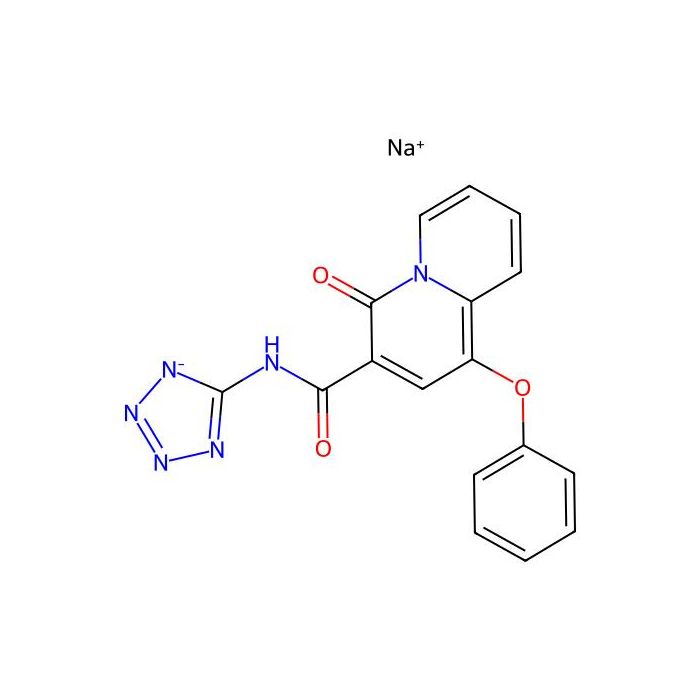
Quinotolast sodium - ≥98% , CAS No.101193-62-8

CAS: 101193-62-8 Cat. No.: Q650386 Molecular Weight: 371.31 PubChem CID: 14600474
AVAILABLE TO ORDER
GRADE & PURITY ≥98%
Synonyms
UNII-G8K8E99F1S | sodium;4-oxo-1-phenoxy-N-(2H-tetrazol-5-yl)quinolizine-3-carboxamide | G8K8E99F1S | FR71021 | FR-71021 | Q27278938 | Quinotolast sodium anhydrous | Quinotolast sodium | QUINOTOLAST SODIUM [JAN] | 4H-Quinolizine-3-carboxamide, 4-oxo-1-phe
Storage
Store at 2-8°C,Desiccated
Shipped In
Wet ice
 ·  off list, applied to all prices below.
Size
Status
Price
Qty
5mg
Q650386-5mg
8-12 wks(?) Production requires sourcing of materials. We appreciate your patience and understanding.
$1,000.90
10mg
Q650386-10mg
8-12 wks(?) Production requires sourcing of materials. We appreciate your patience and understanding.
$1,700.90
Enter a quantity for the sizes you want to add.
🧪

Why this grade

≥98% for sensitive chromatographic and analytical workflows requiring minimal baseline interference.

🌡

Storage & shipping

Store at 2-8°C,Desiccated Ships Wet ice Check lot-specific COA for exact specifications.

📋

Quality documents

SDS, COA, datasheet, and spec sheet available for download. Lot-specific COA accessible via lot number lookup.

📚

Literature proof

Cited in 0 peer-reviewed publications across chromatography, organic synthesis, and cross-coupling reactions.

Overview

Quinotolast sodium in the concentration range of 1-100 μg/mL inhibits histamine , LTC 4 and PGD 2 release in a concentration-dependent manner.

In Vitro

Quinotolast inhibits the release of histamine and the generation of leukotriene (LT) C 4 and prostaglandin (PG) D 2 from dispersed human lung cells. Quinotolast (100 μg/mL) significantly inhibits PGD 2 and LTC 4 release. Quinotolast inhibits PGD 2 release by 100% and LTC 4 release by 54%. The inhibitory effect of Quinotolast on histamine release from dispersed lung cells is largely independent of the preincubation period, no tachyphylaxis being observed. Quinotolast shows a significant inhibition of inflammatory mediators from human dispersed lung cells. Quinotolast also shows strong inhibitory effects on histamine and peptide leukotrienes release from guinea pig lung fragments or mouse cultured mast cells. Quinotolast concentration-dependently inhibits pLTs release from cultured mast cells. The IC 50 value for Quinotolast is 0.72 μg/mL. MCE has not independently confirmed the accuracy of these methods. They are for reference only.

In Vivo

Quinotolast potently inhibits such type I allergic reactions as passive cutaneous anaphylaxis (PCA) and anaphylactic bronchoconstriction in rats by both intravenous and oral dosing. When Quinotolast is given i.v. to rats, Quinotolast, dose-dependently inhibits PCA. The doses of Quinotolast required to inhibit the reaction by 50% (ED 50 ) is 0.0063 mg/kg. Given p.o., Quinotolast inhibits the reaction. ED 50 value for Quinotolast is 0.0081 mg/kg. Although almost complete inhibition is observed with Quinotolast at a dose of 0.32 mg/kg, its effect is slightly attenuated at a dose of 1 mg/kg. MCE has not independently confirmed the accuracy of these methods. They are for reference only.

Cell Assay

Mast cells are obtained after the culture of bone marrow cells from the femurs of female BDF 1 mice in the presence of conditioned medium from WEHI-3 cells containing interleukin 3. The cells are suspended with Tyrode's buffer (137 mM NaCI, 2.7 mM KC1, 1.8 mM CaCl 2 , 1 mM MgCl 2 , 0.4 mM NaH 2 PO 4 , 11.9 mM NaHCO 3 , 5.6 mM glucose) containing 0.1% gelatin and are sensitized with mouse monoclonal anti-DNP IgE (50 μg/10 6 cells). Then the cells are washed and resuspended with Tyrode's buffer containing 0.25% BSA. The cells (2×10 6 cells) are incubated for 5 min at\n37°C and challenged with TNP-BSA (2 ng BSA/mL). Quinotolast (0.1, 1, 10, 100 ug/mL) is added to the reaction tube simultaneously with the antigen. Ten minutes later, the reaction is stopped by the addition of EDTA (2.7 mM). pLTs in the cell supernatant sre quantified as immunoreactive leukotriene C 4 (iLTC 4 ) with a leukotriene C 4 /D 4 /E 4 [ 3 H] assay system. % Inhibition is calculated in each experiment from the amount of immunoreactive leukotriene C 4 (iLTC 4 ). MCE has not independently confirmed the accuracy of these methods. They are for reference only.

Animal administration

Rats Rats (8 week-old) are used. To study the presence of tachyphylaxis by Quinotolast, Quinotolast (0.001, 0.01, 0.1, 1,10 and 100 mg/kg) is given i.v. in a large dose 30 min before challenge, and again at a smaller dose simultaneously with the antigen challenge. aladdin has not independently confirmed the accuracy of these methods. They are for reference only.

Form:Solid

IC50& Target:Histamine LTC 4

Specifications

Synonyms
UNII-G8K8E99F1S | sodium;4-oxo-1-phenoxy-N-(2H-tetrazol-5-yl)quinolizine-3-carboxamide | G8K8E99F1S | FR71021 | FR-71021 | Q27278938 | Quinotolast sodium anhydrous | Quinotolast sodium | QUINOTOLAST SODIUM [JAN] | 4H-Quinolizine-3-carboxamide, 4-oxo-1-phe
Specifications & Purity
≥98%
Biochemical and Physiological Mechanisms
Quinotolast sodium in the concentration range of 1-100 μg/mL inhibits histamine , LTC 4 and PGD 2 release in a concentration-dependent manner.
Storage
Store at 2-8°C, Desiccated
Shipped In
Wet ice
This product requires cold chain shipping. Ground and other economy services are not available.
Purity
≥98%
Names and Identifiers
Canonical SmilesC1=CC=C(C=C1)OC2=C3C=CC=CN3C(=O)C(=C2)C(=O)NC4=NN=N[N-]4.[Na+]
IUPAC Namesodium;4-oxo-1-phenoxy-N-(1,2,3-triaza-4-azanidacyclopenta-2,5-dien-5-yl)quinolizine-3-carboxamide
InChIKeyCDPWRMHFRRXOQH-UHFFFAOYSA-M
INCHI1S/C17H12N6O3.Na/c24-15(18-17-19-21-22-20-17)12-10-14(26-11-6-2-1-3-7-11)13-8-4-5-9-23(13)16(12)25;/h1-10H,(H2,18,19,20,21,22,24);/q;+1/p-1
Isomeric SMILES C1=CC=C(C=C1)OC2=C3C=CC=CN3C(=O)C(=C2)C(=O)NC4=NN=N[N-]4.[Na+]
Alternate CAS 101193-62-8
PubChem CID 14600474
MeSH Entry Terms FR 71021;FR-71021;FR71021;quinotolast;quinotolast sodium;quinotolast sodium, monohydrate;quinotolast sodium, tetrahydrate;sodium 5-(4-oxo-1-phenoxy-4H-quinolizine-3-carboxamide)tetrazolate
Molecular Weight 371.31

Documentation

📋 Safety Data Sheet (SDS)

Comprehensive hazard, handling, storage, and regulatory compliance document.

Download SDS →

✅ Certificate of Analysis (COA)

Lot-specific quality data. Enter your lot number to retrieve the exact COA.

Look up COA →

📊 Datasheet

Quick-reference summary of product specifications and applications.

View datasheet →

🔬 Specification Sheet

Full quality attributes and acceptance criteria for this grade.

View spec sheet →

Advanced Data

Taxonomic Classification

Taxonomy Tree

KingdomOrganic compounds
SuperclassOrganic oxygen compounds
ClassOrganooxygen compounds
SubclassEthers
Intermediate Tree Nodes Not available
Direct ParentDiarylethers
Alternative Parents Quinolizines  Phenoxy compounds  Phenol ethers  Pyridinones  Tetrazoles  Heteroaromatic compounds  Lactams  Propargyl-type 1,3-dipolar organic compounds  Carboximidic acids  Azacyclic compounds  Organonitrogen compounds  Organic zwitterions  Organic sodium salts  Organic oxides  Hydrocarbon derivatives  
Molecular FrameworkAromatic heteropolycyclic compounds
Substituents Diaryl ether - Quinolizine - Phenol ether - Phenoxy compound - Pyridinone - Monocyclic benzene moiety - Pyridine - Benzenoid - Azole - Heteroaromatic compound - Tetrazole - Lactam - Propargyl-type 1,3-dipolar organic compound - Organic alkali metal salt - Carboximidic acid - Azacycle - Organic 1,3-dipolar compound - Carboximidic acid derivative - Organoheterocyclic compound - Organic nitrogen compound - Organonitrogen compound - Organic zwitterion - Organic salt - Organic sodium salt - Hydrocarbon derivative - Organic oxide - Aromatic heteropolycyclic compound
DescriptionThis compound belongs to the class of organic compounds known as diarylethers. These are organic compounds containing the dialkyl ether functional group, with the formula ROR', where R and R' are aryl groups.
External Descriptors Not available
3D Structure
Interactive Chemical Structure Model


Certificates(CoA,COO,BSE/TSE and Analysis Chart)
C of A & Other Certificates(BSE/TSE, COO):
Analytical Chart:
Chemical and Physical Properties
SolubilityDMSO : 115 mg/mL (309.71 mM; ultrasonic and warming and heat to 60°C)
Solution Calculators
Reviews

Customer Reviews

Shall we send you a message when we have discounts available?

Remind me later

Thank you! Please check your email inbox to confirm.

Oops! Notifications are disabled.