
Determine the necessary mass, volume, or concentration for preparing a solution.
| Activity Type | Activity Value -log(M) | Mechanism of Action | Activity Reference | Publications (PubMed IDs) |
|---|
Moligand™, ≥99% Moligand™ for sensitive chromatographic and analytical workflows requiring minimal baseline interference.
Store at -20°C Ships Ice chest + Ice pads Check lot-specific COA for exact specifications.
SDS, COA, datasheet, and spec sheet available for download. Lot-specific COA accessible via lot number lookup.
Cited in 0 peer-reviewed publications across chromatography, organic synthesis, and cross-coupling reactions.
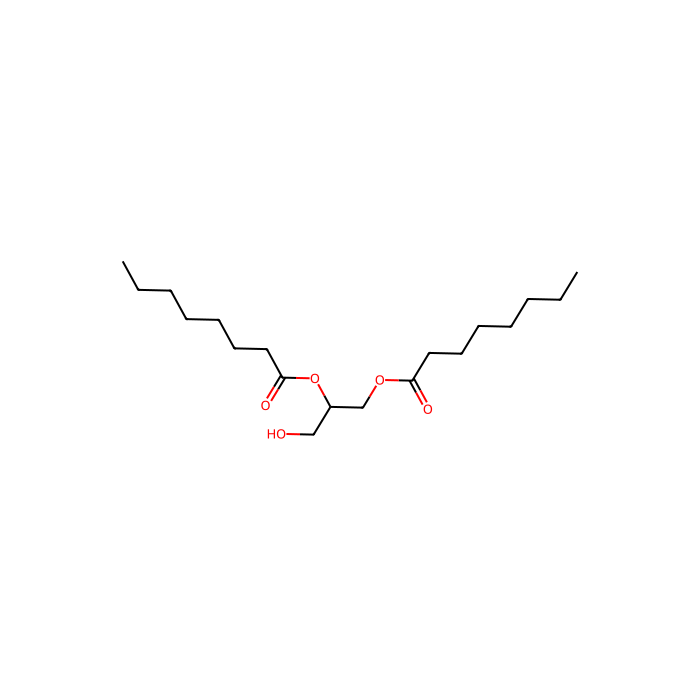
1,2-Dioctanoyl-sn-glycerol is a cell-permeable activator of PKC (protein kinase C). Exhibits lower affinity for PKCa than for other isozymes. Shown to mimic the effects of tumor-promoting phorbol diesters on mitogenesis and epidermal growth factor binding and action in intact cells.
(1,2-dioctanoyl-sn-glycerol), also referred as di-C8, is a short-chain[1] cell-permeable diacyl glycerol.In biochemical signaling, diacylglycerol (DAG) functions as a second messenger signaling lipid, and is a product of the hydrolysis of the phospholipid PIP2 (phosphatidylinositolbisphosphate) by the enzyme phospholipase C (PLC) (a membrane-bound enzyme) that, through the same reaction, produces inositol trisphosphate (IP3). Although inositol trisphosphate (IP3) diffuses into the cytosol, DAG remains within the plasma membrane due to its hydrophobic properties. IP3 stimulates the release of calcium ions from the smooth endoplasmic reticulum, whereas DAG is a physiological activator of protein kinase C (PKC). The production of DAG in the membrane facilitates translocation of PKC from the cytosol to the plasma membrane.Diacylglycerol mimicks the effects of the tumor-promoting compounds phorbol esters.
Application:
to study its stimulatory effect on protein kinase C (PKC) in human cell lines;
as a lipid cofactor in PKC activity assay;
in vesicular-fusion protein Sec-18 binding studies;
Cell permeable lipid shown to mimic the effect of tumor-promoting phorbol diesters on mitogenesis and EGF binding and action in intact cells.
| Canonical Smiles | CCCCCCCC(=O)OCC(CO)OC(=O)CCCCCCC |
|---|---|
| IUPAC Name | [(2S)-3-hydroxy-2-octanoyloxypropyl] octanoate |
| InChIKey | ZQBULZYTDGUSSK-KRWDZBQOSA-N |
| INCHI | 1S/C19H36O5/c1-3-5-7-9-11-13-18(21)23-16-17(15-20)24-19(22)14-12-10-8-6-4-2/h17,20H,3-16H2,1-2H3/t17-/m0/s1 |
| Isomeric SMILES | CCCCCCCC(=O)OC[C@H](CO)OC(=O)CCCCCCC |
| PubChem CID | 148879 |
| Molecular Weight | 344.49 |
| Beilstein | 1714754 |
Comprehensive hazard, handling, storage, and regulatory compliance document.
Download SDS →Lot-specific quality data. Enter your lot number to retrieve the exact COA.
Look up COA →Full quality attributes and acceptance criteria for this grade.
View spec sheet →Taxonomy Tree
| Kingdom | Organic compounds |
|---|---|
| Superclass | Lipids and lipid-like molecules |
| Class | Glycerolipids |
| Subclass | Diradylglycerols |
| Intermediate Tree Nodes | Diacylglycerols |
| Direct Parent | 1,2-diacylglycerols |
| Alternative Parents | Fatty acid esters Dicarboxylic acids and derivatives Carboxylic acid esters Primary alcohols Organic oxides Hydrocarbon derivatives Carbonyl compounds |
| Molecular Framework | Aliphatic acyclic compounds |
| Substituents | 1,2-acyl-sn-glycerol - Fatty acid ester - Fatty acyl - Dicarboxylic acid or derivatives - Carboxylic acid ester - Carboxylic acid derivative - Organic oxygen compound - Organic oxide - Hydrocarbon derivative - Primary alcohol - Organooxygen compound - Carbonyl group - Alcohol - Aliphatic acyclic compound |
| Description | This compound belongs to the class of organic compounds known as 1,2-diacylglycerols. These are diacylglycerols containing a glycerol acylated at positions 1 and 2. |
| External Descriptors | octanoate ester - 1,2-diacyl-sn-glycerol |
| Activity Type | Activity Value -log(M) | Mechanism of Action | Activity Reference | Publications (PubMed IDs) |
|---|
| Activity Type | Relation | Activity value | Units | Action Type | Journal | PubMed Id | doi | Assay Aladdin ID |
|---|
| Activity Type | Relation | Activity value | Units | Action Type | Journal | PubMed Id | doi | Assay Aladdin ID |
|---|
| Activity Type | Relation | Activity value | Units | Action Type | Journal | PubMed Id | doi | Assay Aladdin ID |
|---|
| Activity Type | Relation | Activity value | Units | Action Type | Journal | PubMed Id | doi | Assay Aladdin ID |
|---|
Find and download the COA for your product by matching the lot number on the packaging.
| Lot Number | Certificate Type | Date | Item |
|---|---|---|---|
 K2115425 K2115425 | Certificate of Analysis | Aug 21, 2023 | S397171 |
| Solubility | Soluble in DMSO (7 mg/ml), chloroform, 100% ethanol, dichloromethane, ether, ethyl acetate, methanol, most organic solvents, DMF (7 mg/ml), PBS (pH 7.2) (250 ug/ml), water (>250 ug/ml) at 25 °C, and cyclohexane. |
|---|---|
| Boil Point(°C) | 81-82° C |
| Molecular Weight | 344.500 g/mol |
| XLogP3 | 5.400 |
| Hydrogen Bond Donor Count | 1 |
| Hydrogen Bond Acceptor Count | 5 |
| Rotatable Bond Count | 18 |
| Exact Mass | 344.256 Da |
| Monoisotopic Mass | 344.256 Da |
| Topological Polar Surface Area | 72.800 Ų |
| Heavy Atom Count | 24 |
| Formal Charge | 0 |
| Complexity | 317.000 |
| Isotope Atom Count | 0 |
| Defined Atom Stereocenter Count | 1 |
| Undefined Atom Stereocenter Count | 0 |
| Defined Bond Stereocenter Count | 0 |
| Undefined Bond Stereocenter Count | 0 |
| The total count of all stereochemical bonds | 0 |
| Covalently-Bonded Unit Count | 1 |
Our grade selection guide covers purity, stabilizer status, and application suitability for all variants in our catalog.
View Moligand™ grade guide →