≥98% for sensitive chromatographic and analytical workflows requiring minimal baseline interference.
🌡
Storage & shipping
Store at 2-8°C,Desiccated Ships Wet ice Check lot-specific COA for exact specifications.
📋
Quality documents
SDS, COA, datasheet, and spec sheet available for download. Lot-specific COA accessible via lot number lookup.
📚
Literature proof
Cited in 0 peer-reviewed publications across chromatography, organic synthesis, and cross-coupling reactions.
Overview
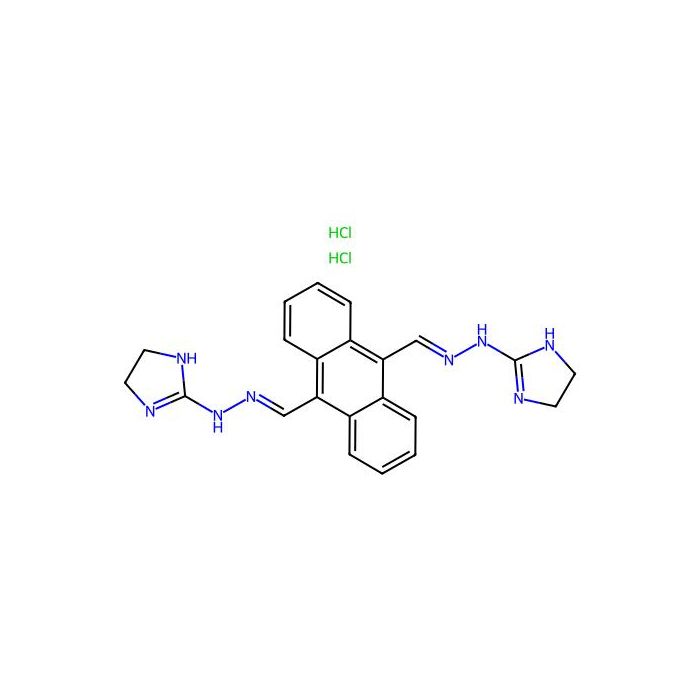
Bisantrene dihydrochloride is a highly effective antitumor agent, it exerts its cytotoxicity by affecting DNA intercalation. Bisantrene dihydrochloride targets eukaryotic type II topoisomerases . Bisantrene dihydrochloride is a substrate of MDR1
In Vitro
Bisantrene dihydrochloride promots DNase I cleavage at oligopurine-oligopyrimidine tracts and slightly reduces the cleavage activity at alternating purine-pyrimidine sequences. Bisantrene dihydrochloride is an inhibitor of [ 3 H]uridine incorporation into RNA and [ 3 H]thymidine incorporation into DNA. MCE has not independently confirmed the accuracy of these methods. They are for reference only.
In Vivo
Bisantrene dihydrochloride is an antitumor agent active against a number of experimental tumors, including P388 leukemia, L1210 leukemia, Lieberman plasma cell tumor, B16 melanoma, colon tumor 26, and Ridgway osteogenic sarcoma. Bisantrene dihydrochloride is effective over a dose range of 1.56 to 150 mg/kg depending upon the frequency, route, and schedule of the treatment and the tumor model used. Bisantrene dihydrochloride (25, 50 and 100 mg/kg; i.p.; once) pretreats with macrophages shows antitumor effect to mice with P815 tumor cells injection. Bisantrene dihydrochloride (10-150 mg/kg; i.v.; once) dose-dependently induces leukopenia in Neo mice. B cells and macrophages are targets for bisantrene dihydrochloride toxicity. MCE has not independently confirmed the accuracy of these methods. They are for reference only.
Bisantrene dihydrochloride is a highly effective antitumor agent, it exerts its cytotoxicity by affecting DNA intercalation. Bisantrene dihydrochloride targets eukaryotic type II topoisomerases . Bisantrene dihydrochloride is a substrate of MDR1[
Storage
Store at 2-8°C, Desiccated
Shipped In
Wet ice
This product requires cold chain shipping. Ground and other economy services are not available.
This compound belongs to the class of organic compounds known as anthracenes. These are organic compounds containing a system of three linearly fused benzene rings.
External Descriptors
Not available
1. Djoumbou Feunang Y, Eisner R, Knox C, Chepelev L, Hastings J, Owen G, Fahy E, Steinbeck C, Subramanian S, Bolton E, Greiner R, and Wishart DS. ClassyFire: Automated Chemical Classification With A Comprehensive, Computable Taxonomy. Journal of Cheminformatics, 2016, 8:61.
We use cookies to ensure the website functions properly and, where permitted, to improve your experience. You can manage your preferences at any time in Settings. Learn more in our Cookie Policy.
Shall we send you a message when we have discounts available?
Remind me later
Thank you! Please check your email inbox to confirm.
Products are supplied to verified businesses, institutions, and qualified professionals for research and development use only. Not for use in humans, animals, diagnosis, or therapy.