Determine the necessary mass, volume, or concentration for preparing a solution.
≥99% for sensitive chromatographic and analytical workflows requiring minimal baseline interference.
Store at -20°C Ships Ice chest + Ice pads Check lot-specific COA for exact specifications.
SDS, COA, datasheet, and spec sheet available for download. Lot-specific COA accessible via lot number lookup.
Cited in 0 peer-reviewed publications across chromatography, organic synthesis, and cross-coupling reactions.
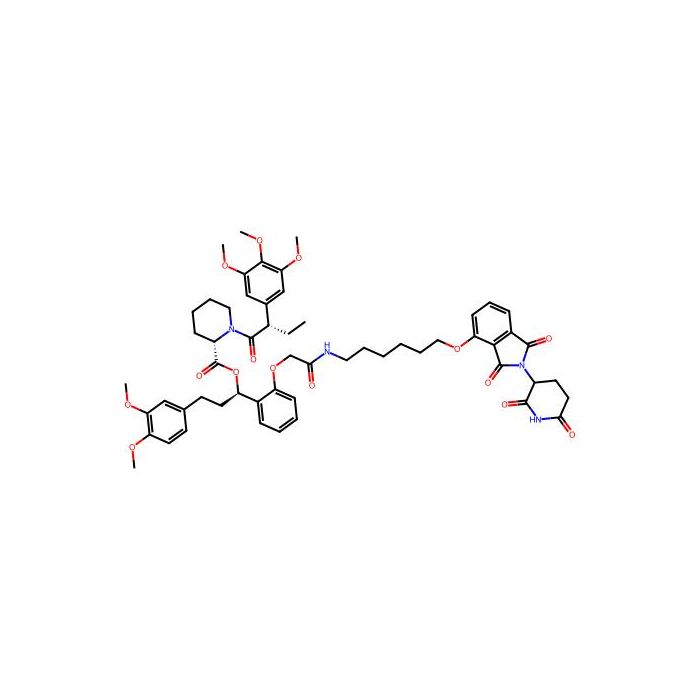
FKBP12 PROTAC dTAG-13 (dTAG-13), a PROTAC-based heterobifunctional degrader, is a selective degrader of FKBP12 F36V with expression of FKBP12F36V in-frame with a protein of interest. FKBP12 PROTAC dTAG-13 effectively engages FKBP12 F36V and CRBN, thereby selectively degrading FKBP12 F36V
In Vitro
TAG-13 (1-1000 nM; 4 hours; 293FT WT cells) treatment potently reduces FKBP12 F36V -Nluc levels in 293FT WT cell, indicating the requirement of CRBN for the observed effects. Treatment of MV4;11 cells expressing BRD4(short)-FKBP12 F36V with dTAG-13 leads to robust degradation of BRD4. dTAG-13 treatment leads to rapid degradation of BRD4 within one hou. dTAG-13 treatment leads to rapid and potent degradation of the BRD4 fusion chimera in the heterozygous and homozygous knock-in clones, with no effect on endogenous FKBP12 WT. MCE has not independently confirmed the accuracy of these methods. They are for reference only. Western Blot AnalysisCell Line: 293FT WT cells Concentration: 1 nM, 10 nM, 100 nM, 1000 nM Incubation Time: 4 hours Result: Potently reduced FKBP12 F36V -Nluc levels in 293FT WT cell.
In Vivo
Following bone marrow engraftment of MV4;11 cells expressing luc-FKBP12F36V in mice, the bioluminescent signal after vehicle or dTAG-13 administration is monitored. A significant, rapid, and durable effect on bioluminescent signal is observed four hours after dTAG-13 administration, indicating effective degradation of luc-FKBP12F36V. Twenty-eight hours following the final treatment, the recovery of cellular bioluminescence to levels comparable between vehicle and dTAG-13 treatment groups is observed . MCE has not independently confirmed the accuracy of these methods. They are for reference only.
Form:Solid
IC50& Target:Cereblon FKBP12(F36V)
| Canonical Smiles | CCC(C1=CC(=C(C(=C1)OC)OC)OC)C(=O)N2CCCCC2C(=O)OC(CCC3=CC(=C(C=C3)OC)OC)C4=CC=CC=C4OCC(=O)NCCCCCCOC5=CC=CC6=C5C(=O)N(C6=O)C7CCC(=O)NC7=O |
|---|---|
| IUPAC Name | [(1R)-3-(3,4-dimethoxyphenyl)-1-[2-[2-[6-[2-(2,6-dioxopiperidin-3-yl)-1,3-dioxoisoindol-4-yl]oxyhexylamino]-2-oxoethoxy]phenyl]propyl] (2S)-1-[(2S)-2-(3,4,5-trimethoxyphenyl)butanoyl]piperidine-2-carboxylate |
| InChIKey | BJFBRLAWLPZOMJ-QHVFGHLPSA-N |
| INCHI | 1S/C57H68N4O15/c1-7-37(36-32-47(71-4)52(73-6)48(33-36)72-5)54(65)60-29-14-12-19-41(60)57(68)76-43(25-22-35-23-26-44(69-2)46(31-35)70-3)38-17-10-11-20-42(38)75-34-50(63)58-28-13-8-9-15-30-74-45-21-16-18-39-51(45)56(67)61(55(39)66)40-24-27-49(62)59-53(40)64/h10-11,16-18,20-21,23,26,31-33,37,40-41,43H,7-9,12-15,19,22,24-25,27-30,34H2,1-6H3,(H,58,63)(H,59,62,64)/t37-,40?,41-,43+/m0/s1 |
| Isomeric SMILES | CC[C@@H](C1=CC(=C(C(=C1)OC)OC)OC)C(=O)N2CCCC[C@H]2C(=O)O[C@H](CCC3=CC(=C(C=C3)OC)OC)C4=CC=CC=C4OCC(=O)NCCCCCCOC5=CC=CC6=C5C(=O)N(C6=O)C7CCC(=O)NC7=O |
| PubChem CID | 124187630 |
| Molecular Weight | 1049.17 |
Comprehensive hazard, handling, storage, and regulatory compliance document.
Download SDS →Lot-specific quality data. Enter your lot number to retrieve the exact COA.
Look up COA →Full quality attributes and acceptance criteria for this grade.
View spec sheet →Taxonomy Tree
| Kingdom | Organic compounds |
|---|---|
| Superclass | Phenylpropanoids and polyketides |
| Class | Linear 1,3-diarylpropanoids |
| Subclass | Not available |
| Intermediate Tree Nodes | Not available |
| Direct Parent | Linear 1,3-diarylpropanoids |
| Alternative Parents | Alpha amino acid esters Phthalimides Phenylacetamides Dimethoxybenzenes Benzyloxycarbonyls Piperidinecarboxylic acids Phenylpropanes N-acylpiperidines Isoindoles Piperidinediones Phenoxy compounds Anisoles Delta lactams Alkyl aryl ethers N-substituted carboxylic acid imides Tertiary carboxylic acid amides N-unsubstituted carboxylic acid imides Dicarboximides Secondary carboxylic acid amides Carboxylic acid esters Monocarboxylic acids and derivatives Azacyclic compounds Organopnictogen compounds Organonitrogen compounds Organic oxides Hydrocarbon derivatives Carbonyl compounds |
| Molecular Framework | Aromatic heteropolycyclic compounds |
| Substituents | Linear 1,3-diarylpropanoid - Alpha-amino acid ester - Phthalimide - O-dimethoxybenzene - Dimethoxybenzene - Phenylacetamide - Isoindolone - Benzyloxycarbonyl - Alpha-amino acid or derivatives - Piperidinecarboxylic acid - Phenylpropane - N-acyl-piperidine - Isoindole or derivatives - Isoindole - Isoindoline - Phenoxy compound - Methoxybenzene - Piperidinedione - Phenol ether - Anisole - Piperidinone - Delta-lactam - Alkyl aryl ether - Benzenoid - Piperidine - Carboxylic acid imide, n-substituted - Monocyclic benzene moiety - Tertiary carboxylic acid amide - Carboxylic acid imide, n-unsubstituted - Dicarboximide - Carboxylic acid imide - Secondary carboxylic acid amide - Lactam - Carboxylic acid ester - Carboxamide group - Azacycle - Organoheterocyclic compound - Monocarboxylic acid or derivatives - Ether - Carboxylic acid derivative - Organic nitrogen compound - Organic oxygen compound - Organopnictogen compound - Organic oxide - Hydrocarbon derivative - Organooxygen compound - Organonitrogen compound - Carbonyl group - Aromatic heteropolycyclic compound |
| Description | This compound belongs to the class of organic compounds known as linear 1,3-diarylpropanoids. These are organic compounds with a structure based on a C6-C3-C6 skeleton, where the two benzene rings are not linked together. |
| External Descriptors | Not available |
| Solubility | DMSO : 180 mg/mL (171.56 mM; Need ultrasonic) |
|---|---|
| Molecular Weight | 1049.200 g/mol |
| XLogP3 | 7.400 |
| Hydrogen Bond Donor Count | 2 |
| Hydrogen Bond Acceptor Count | 15 |
| Rotatable Bond Count | 27 |
| Exact Mass | 1048.47 Da |
| Monoisotopic Mass | 1048.47 Da |
| Topological Polar Surface Area | 224.000 Ų |
| Heavy Atom Count | 76 |
| Formal Charge | 0 |
| Complexity | 1930.000 |
| Isotope Atom Count | 0 |
| Defined Atom Stereocenter Count | 3 |
| Undefined Atom Stereocenter Count | 1 |
| Defined Bond Stereocenter Count | 0 |
| Undefined Bond Stereocenter Count | 0 |
| The total count of all stereochemical bonds | 0 |
| Covalently-Bonded Unit Count | 1 |