Iron is an essential trace element in the human body, with a total content of approximately 3270 mg. It is widely distributed: 67.6% of iron is found in hemoglobin as a prosthetic group, involved in oxygen transport; 2.59% and 4.15% are present in bone and myoglobin, respectively; and storage iron accounts for about 25.37%. Serum iron is bound to transferrin in the form of ferric ions (Fe³⁺). Therefore, measuring serum iron requires first dissociating Fe³⁺ from transferrin.
Assay Principle
This assay utilizes a microplate method with Ferrozine as the chromogen. In an acidic medium, serum iron bound to transferrin is released. Iron in other samples is also liberated under acidic conditions. The released iron is then reduced to ferrous ions (Fe²⁺) by a reducing agent (present in the assay buffer). The Fe²⁺ subsequently reacts with Ferrozine to form a magenta-colored complex. The absorbance at 562 nm is measured using a microplate reader. This method is suitable for detecting iron content in samples such as serum, plasma, and tissues. As this direct detection method is used, a serum blank should be included to correct for the sample's inherent color. The iron content is calculated according to the formula. This kit shows a good linear relationship up to 140 μmol/L. Triglycerides ≤ 3.39 mmol/L and bilirubin ≤ 171 μmol/L basically do not interfere with this method. This kit is for research use only and not suitable for clinical diagnosis or other purposes.
I1505775
| Component
| 100T
| Storage
|
I1505775A
| Iron Standard (100 μg/mL)
| 1 mL | 2-8℃. Store in the dark.
|
I1505775B
| Iron Standard Diluent
| 2 mL
| RT
|
I1505775C
| Fe Assay Buffer | 25 mL
| 2-8℃
|
I1505775D
| Ferrozine Chromogenic Solution
| 1 mL
| 2-8℃. Store in the dark.
|
I1505775E
| ddH₂O | 10 mL
| RT |
Required Materials Not Provided
Centrifuge tubes or test tubes, Microplate reader, 96-well plate
Experimental Procedure
1. (Optional) Sample Preparation
1.1 Plasma/Serum Samples
1.2 Cell or Tissue Samples
Homogenize an appropriate amount of cells or tissue.
Centrifuge at low speed and collect the supernatant.
Store at -20°C for Fe detection.
1.3 High-Concentration Samples
Note: (Optional) After preparation, determine the protein concentration using a BCA Protein Assay Kit to calculate Fe content per mg protein.
2. Preparation of Iron Standard Working Solution
3. Fe Assay Setup
Use a 96-well plate cleaned with dilute hydrochloric acid and rinsed with deionized water.
Set up Blank, Standard, and Test wells according to the table below.
Add reagents in the specified order, avoiding bubbles.
If the sample's iron concentration is too high, reduce the sample volume or dilute appropriately before assaying. Duplicate wells are recommended.
Reagent (μL)
| Blank Well
| Standard Well
| Test Well
|
ddH₂O
| 75
| —
| —
|
Iron Standard Working Solution (2 μg/mL)
| —
| 75
| —
|
Sample
| —
| —
| 75
|
Fe Assay Buffer
| 200 | 200 | 200 |
Mix well. Read absorbance at 562nm, zeroed with the Blank well. Record for Test well (This is the Serum Blank,
Ferrozine Chromogenic Solution | 8.5 | 8.5
| 8.5 |
4. Fe Measurement
Mix well.
Incubate at room temperature for 15 minutes or at 37°C for 10 minutes.
Zero the instrument with the Blank well.
Measure the absorbance of the Standard and Test wells at 562 nm (recorded as A<sub>standard</sub> and A<sub>test</sub>).
Complete the colorimetric measurement within 1 hour.
5. Calculation
5.1 Plasma Iron, Serum Iron
Fe (μmol/L) = { [Atest - (Aserum blank × 0.97)] / Astandard } × 35.8
Fe (mg/L) = { [Atest - (Aserum blank × 0.97)] / Astandard } × 2
5.2 Tissue Iron, Cell Iron
Fe (μmol/g prot) = { [Atest - (Aserum blank × 0.97)] / Astandard } × 35.8 / Pr
Fe (mg/g prot) = { [Atest - (Aserum blank × 0.97)] / Astandard } × 2 / Pr
Fe (μmol/N cells) = { [Atest - (Aserum blank × 0.97)] / Astandard } × 35.8 / (N × Vsample / Vtotal extract)
Fe (mg/N cells) = { [Atest - (Aserum blank × 0.97)] / Astandard } × 2 / (N × Vsample / Vtotal extract)
Parameter Definitions:
Atest: Absorbance of the Test well after adding Ferrozine Chromogenic Solution.
Aserum blank: Absorbance of the Test well before adding Ferrozine Chromogenic Solution.
Astandard: Absorbance of the Standard well.
Pr: Protein concentration of the test sample (g/L).
N: Total number of cells or bacteria.
Vsample: Volume of sample added to the reaction system (L).
Vtotal extract: Total volume of the sample extraction buffer (L).
Unit Conversions:
Reference Interval:
6. Standard Curve Reference
*(Placeholder for standard curve graph and data, typically showing absorbance vs. concentration for standards like 0, 0.5, 1, 2, 4, 6, 8, 10 μg/mL, measured at 562 nm)*
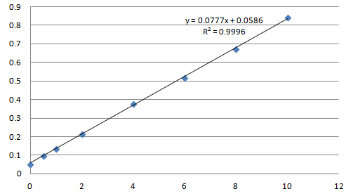
*Note: Standard curves may vary due to differences in instruments and operational techniques. Empirical data suggests deviations in the standard curve at iron standard concentrations below 0.1 μg/mL and above 40 μg/mL.*
Precautions
Hemolyzed samples interfere with the assay; avoid using them if possible.
If the sample concentration is too high, dilute with distilled water and re-assay, multiplying the result by the dilution factor.
Use high-purity deionized water during the experiment; do not use ordinary distilled water.
Glassware should be soaked in 10% hydrochloric acid for 24 hours and rinsed with deionized water before use.
Avoid contact with iron objects to prevent iron contamination.
The standard color is stable for 24 hours. The serum color is stable for 30 minutes; the color intensifies slowly over time, so measurement must be completed within 1 hour.
The value 0.97 is a volume correction factor.
The within-run coefficient of variation (CV) for this method is ≤ 3.1%; the between-run CV is ≤ 2.6%.
Use reagents promptly after opening to avoid affecting subsequent experimental results.
For your safety and health, wear lab coats and disposable gloves during operation.


 ZJ26F0737117